Science & TechnologyS


Solar Flares

Massive solar flare could have caused eighth century radiation burst

A mysterious spike in atmospheric carbon-14 levels 12 centuries ago might be a sign the Sun is capable of producing solar storms dozens of times worse than anything we've ever seen, a team of physicists calculates in a paper published this week in Nature.

Carbon-14 (14C) is created when high-energy radiation strikes the Earth's upper atmosphere, converting nitrogen-14 into 14C, which eventually makes its way into plants via photosynthesis.

Earlier this year, a team of Japanese physicists discovered a spike in 14C in tree rings of Japanese cedars dating from the 774 - 75 growing season. But they were unable to explain where that 14C might have come from because all possible explanations appeared unlikely.

But Adrian Melott, a physicist at the University of Kansas in Lawrence, who is the lead author of the new study, says that the Japanese team made a miscalculation in ruling out one of these possibilities - a giant solar storm.

Telescope

Even brown dwarfs may grow rocky planets: Sizing up grains of cosmic dust around failed star

Image
© M. KornmesserThis artist’s impression shows the disc of gas and cosmic dust around a brown dwarf. Rocky planets are thought to form through the random collision and sticking together of what are initially microscopic particles in the disc of material around a star. These tiny grains, known as cosmic dust, are similar to very fine soot or sand. Astronomers using the Atacama Large Millimeter/submillimeter Array (ALMA) have for the first time found that the outer region of a dusty disc encircling a brown dwarf — a star-like object, but one too small to shine brightly like a star — also contains millimetre-sized solid grains like those found in denser discs around newborn stars. The surprising finding challenges theories of how rocky, Earth-scale planets form, and suggests that rocky planets may be even more common in the Universe than expected.
Astronomers using the Atacama Large Millimeter/submillimeter Array (ALMA) have for the first time found that the outer region of a dusty disc encircling a brown dwarf contains millimetre-sized solid grains like those found in denser discs around newborn stars. The surprising finding challenges theories of how rocky, Earth-scale planets form, and suggests that rocky planets may be even more common in the Universe than expected.

Rocky planets are thought to form through the random collision and sticking together of what are initially microscopic particles in the disc of material around a star. These tiny grains, known as cosmic dust, are similar to very fine soot or sand. However, in the outer regions around a brown dwarf -- a star-like object, but one too small to shine brightly like a star -- astronomers expected that grains could not grow because the discs were too sparse, and particles would be moving too fast to stick together after colliding. Also, prevailing theories say that any grains that manage to form should move quickly towards the central brown dwarf, disappearing from the outer parts of the disc where they could be detected.

Camera

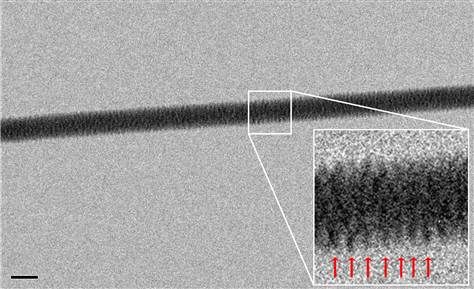
DNA is directly photographed for the first time

Italian physics professor Enzo Di Fabrizio captures twisted ladder that props up life
Image
© Enzo Di FabrizioDNA's double-helix structure is on display for the first time in this electron microscope photograph of a small bundle of DNA strands.

Fifty-nine years after James Watson and Francis Crick deduced the double-helix structure of DNA, a scientist has captured the first direct photograph of the twisted ladder that props up life.

Enzo Di Fabrizio, a physics professor at Magna Graecia University in Catanzaro, Italy, snapped the picture using an electron microscope.

Previously, scientists had only seen DNA's structure indirectly. The double-corkscrew form was first discovered using a technique called X-ray crystallography, in which a material's shape is reconstructed based on how X-rays bounce after they collide with it.

Info

Native Americans and Northern Europeans more closely related than previously thought

Bethesda, MD - November 30, 2012 -- Using genetic analyses, scientists have discovered that Northern European populations - including British, Scandinavians, French, and some Eastern Europeans - descend from a mixture of two very different ancestral populations, and one of these populations is related to Native Americans.

This discovery helps fill gaps in scientific understanding of both Native American and Northern European ancestry, while providing an explanation for some genetic similarities among what would otherwise seem to be very divergent groups. This research was published in the November 2012 issue of the Genetics Society of America's journal GENETICS.

According to Nick Patterson, first author of the report, "There is a genetic link between the paleolithic population of Europe and modern Native Americans. The evidence is that the population that crossed the Bering Strait from Siberia into the Americas more than 15,000 years ago was likely related to the ancient population of Europe."

Laptop

Artificial brain mimics human abilities and flaws

Spaun
© Seamartini Graphics, ShutterstockSpaun's mistakes, not its abilities, are what surprised its makers the most.
Spaun, a new software model of a human brain, is able to play simple pattern games, draw what it sees and do a little mental arithmetic. It powers everything it does with 2.5 million virtual neurons, compared with a human brain's 100 billion. But its mistakes, not its abilities, are what surprised its makers the most, said Chris Eliasmith, an engineer and neuroscientist at the University of Waterloo in Canada.

Ask Spaun a question, and it hesitates a moment before answering, pausing for about as long as humans do. Give Spaun a list of numbers to memorize, and it falters when the list gets too long. And Spaun is better at remembering the numbers at the beginning and end of a list than at recalling numbers in the middle, just like people are.

"There are some fairly subtle details of human behavior that the model does capture," said Eliasmith, who led the development of Spaun, or the Semantic Pointer Architecture Unified Network. "It's definitely not on the same scale [as a human brain]," he told TechNewsdaily. "It gives a flavor of a lot of different things brains can do."

Eliasmith and his team of Waterloo neuroscientists say Spaun is the first model of a biological brain that performs tasks and has behaviors. Because it is able to do such a variety of things, Spaun could help scientists understand how humans do the same, Eliasmith said. In addition, other scientists could run simplified simulations of certain brain disorders or psychiatric drugs using Spaun, he said.

Cassiopaea

Perseus' Black Hole Sun: Mammoth black hole containing as much mass as 17 billion Suns

Astronomers have discovered a mammoth black hole containing as much mass as 17billion Suns. The monster object is more than 11 times wider than the orbit of Neptune, the eighth planet in our Solar System. It lies at the heart of a small lens-shaped galaxy called NGC1277, 220million light years away in the constellation Perseus.

News of the incredible object comes as a separate research team reported the discovery of a quasar with the most energetic outflow ever seen. Observations of the incredible quasar known as SDSS J1106+1939 may answer questions about how the mass of a galaxy is linked to its central black hole mass and why there are so few large galaxies in the universe. The black hole at NGC1277 makes up an enormous 14 per cent of the galaxy's mass. Other black holes found at the centres of galaxies only account for around 0.1 per cent.
Image
© PANews of the incredible object comes as a separate research team reported the discovery of a quasar with the most energetic outflow ever seen.

Observations of the incredible quasar known as SDSS J1106+1939 may answer questions about how the mass of a galaxy is linked to its central black hole mass and why there are so few large galaxies in the universe.

The black hole at NGC1277 makes up an enormous 14 per cent of the galaxy's mass. Other black holes found at the centres of galaxies only account for around 0.1 per cent.

Card - VISA

The cashless society is almost here - and with some very sinister implications

Cashless money
Cashless money is here, and growing rapidly.
Among the long list of items bundled by consensus reality merchants under the banner of 'conspiracy theory', is a world without cash - where technocrats rule over the populace, and everything and anything is exchanged via plastic and RFID chips.

In this sterile and controlled Orwellian hi-tech society, the idea of cash being passed from hand to hand would be as archaic as the thought of carrying around a rucksack of tally sticks today.

Still, despite the incredible penetration of credit and debit card transactions into economic aggregate, and the boom in internet shopping, few will comfortably admit that a cashless society is nearly upon us. In part, it's a natural denial by many fueled by the idea of our society is indeed on a collision course with the sort of dystopic impersonal future like that depicted in the 1970′s sci-fi film classic, 'Logan's Run'.

Cashless money is here, and growing rapidly.

Over the years, futurists and commentators alike seemed to agree that a cashless society will be a slow creep, and would automatically phase itself in simply by virtue of the sheer volume of electronic transactions that would gradually make cash less available and more costly to redeem, or exchange. This is still true for the most part. What few counted on, however, was how the final push would like place, and why. Some will be surprised by these new emerging mechanisms, and the political and sinister implications they will ultimately lead to.

Comment: The article ends with a wise observation:"The cashless society is already here. The question now is how far will society allow it to penetrate and completely control each and every aspect of their day to day lives."


Info

DNA imaged with electron microscope for the first time

DNA
© Enzo di FabrizioIt may be why life is screwed up.
It's the most famous corkscrew in history. Now an electron microscope has captured the famous Watson-Crick double helix in all its glory, by imaging threads of DNA resting on a silicon bed of nails. The technique will let researchers see how proteins, RNA and other biomolecules interact with DNA.

The structure of DNA was originally discovered using X-ray crystallography. This involves X-rays scattering off atoms in crystallised arrays of DNA to form a complex pattern of dots on photographic film. Interpreting the images requires complex mathematics to figure out what crystal structure could give rise to the observed patterns.

The new images are much more obvious, as they are a direct picture of the DNA strands, albeit seen with electrons rather than X-ray photons. The trick used by Enzo di Fabrizio at the University of Genoa, Italy, and his team was to snag DNA threads out of a dilute solution and lay them on a bed of nanoscopic silicon pillars.

The team developed a pattern of pillars that is extremely water-repellent, causing the moisture to evaporate quickly and leave behind strands of DNA stretched out and ready to view. The team also drilled tiny holes in the base of the nanopillar bed, through which they shone beams of electrons to make their high-resolution images. The results reveal the corkscrew thread of the DNA double helix, clearly visible. With this technique, researchers should be able to see how single molecules of DNA interact with other biomolecules.

Saturn

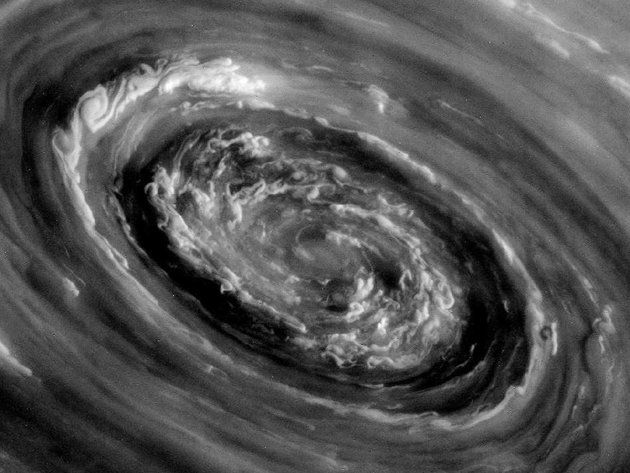
Saturn storm clouds captured by Cassini

NASA's Cassini orbiter has been sending back incredible images of Saturn and its moons to earth, since 2004. The latest Saturn photos from the spacecraft reveal a dizzying glimpse into a monster storm raging on the ringed planet's north pole.
Image
© REUTERS/NASA/JPL-Caltech/Space Science InstituteRoiling storm clouds and a swirling vortex at the center of Saturn's famed north polar hexagon is seen in an image from NASA's Cassini mission taken November 27, 2012. The camera was pointing toward Saturn from approximately 224,618 miles (361,488 kilometers) away.
Image
© NASA/JPL-Caltech/Space Science InstituteSaturn's mysterious northern vortex, a vast hexagon-shaped storm, dominates this photo taken Nov. 27, 2012, by NASA's Cassini spacecraft. This image is a raw and unprocessed view.
Nasa's Cassini spacecraft has captured dramatic images of rolling storm clouds on Saturn.

The pictures were obtained while the spacecraft was "travelling the Saturnian system in a set of inclined, or tilted, orbits that give mission scientists a vertigo-inducing view of Saturn's polar regions," Nasa said.

The results show storm clouds and a swirling vortex at the centre of Saturn's north polar hexagon.

Comment: From 2011:
Storm as Wide as Earth Rages on Saturn
Monster Storm Rearranges Saturn Before Our Eyes


Info

Organics discovered on Mercury

Mercury
© NASAThe north pole of Mercury as seen by MESSENGER during a 2008 flyby.
NASA dispatched the Curiosity rover to Mars to look for organics, but a probe orbiting Mercury has beaten it to the punch.

New results from the MESSENGER spacecraft not only confirm that the planet closest to the sun has ice inside shaded craters near the north pole, but that a thin layer of very dark organic material seems to be covering a good part of the frozen water.

Both likely arrived via comets or asteroids millions -- or hundreds of millions -- of years ago.

Unlike Curiosity, which will be directly sampling Martian rocks and soils to look for signs of organic material, MESSENGER bounces laser beams and counts neutrons and gamma rays to collect information remotely about chemical elements on Mercury's surface.

The information is correlated with detailed topographical and temperature maps, laboratory tests and computer models and then compared with candidate materials to find the best match for the observed conditions.

After years of painstaking work, scientists believe the most likely explanation is that the warmer parts of the shadowed craters contain black patches of organic material overlaying ice. The material, which is somewhat like tar, coal and soot, is believed to be similar to what has been observed on icy bodies in the outer solar system and in the nuclei of comets.