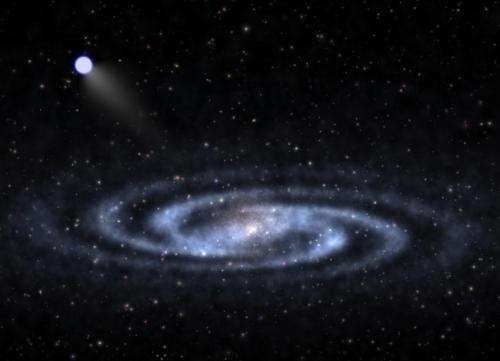
© Ben Bromley, University of UtahThis is an astrophysicist-artist's conception of a hypervelocity star speeding away from the visible part of a spiral galaxy like our Milky Way and into the invisible halo of mysterious "dark matter" that surrounds the galaxy's visible portions. University of Utah researcher Zheng Zheng and colleagues in the US and China discovered the closest bright hypervelocity star yet found.
"The hypervelocity star tells us a lot about our galaxy - especially its center and the dark matter halo," says Zheng Zheng, an assistant professor of physics and astronomy and lead author of the study published recently in Astrophysical Journal Letters by a team of U.S. and Chinese astronomers.
"We can't see the dark matter halo, but its gravity acts on the star," Zheng says. "We gain insight from the star's trajectory and velocity, which are affected by gravity from different parts of our galaxy."