
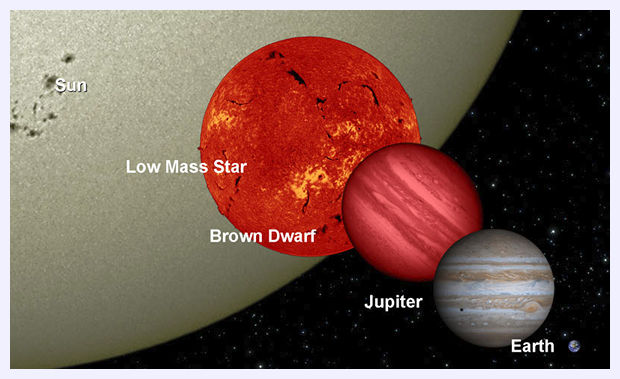
© NASASize comparison of our Sun, a low mass star, a brown dwarf, Jupiter, and Earth. Stars with less mass than the Sun are smaller and cooler, and hence much fainter in visible light. Brown dwarfs have less than eight percent of the mass of the Sun, which is not enough to sustain the fusion reaction that keeps the Sun hot. These cool orbs are nearly impossible to see in visible light, but stand out when viewed in infrared. Their diameters are about the same as Jupiter's, but they can have up to 80 times more mass and are thought to have planetary systems of their own.
Light is in crisis. The universe is far brighter than it should be based on the number of light-emitting objects we can find, a cosmic accounting problem that has astronomers baffled.
"Something is very wrong," says Juna Kollmeier at the Observatories of the Carnegie Institution of Washington in Pasadena, California.
Solving the mystery could show us novel ways to hunt for dark matter, or reveal the presence of another unknown "dark" component to the cosmos.
"It's such a big discrepancy that whatever we find is going to be amazing, and it will overturn something we currently think is true," says Kollmeier.
The trouble stems from the most recent census of objects that produce high-energy ultraviolet light. Some of the biggest known sources are quasars - galaxies with actively feeding black holes at their centres. These behemoths spit out plenty of UV light as matter falling into them is heated and compressed. Young galaxies filled with hot, bright stars are also contributors.















Comment: For more on Nemesis - Sol's dark companion - see Pierre Lescaudron and Laura Knight-Jadczyk's new book, Earth Changes and the Human-Cosmic Connection.
Perhaps 'something wicked this way comes?'