
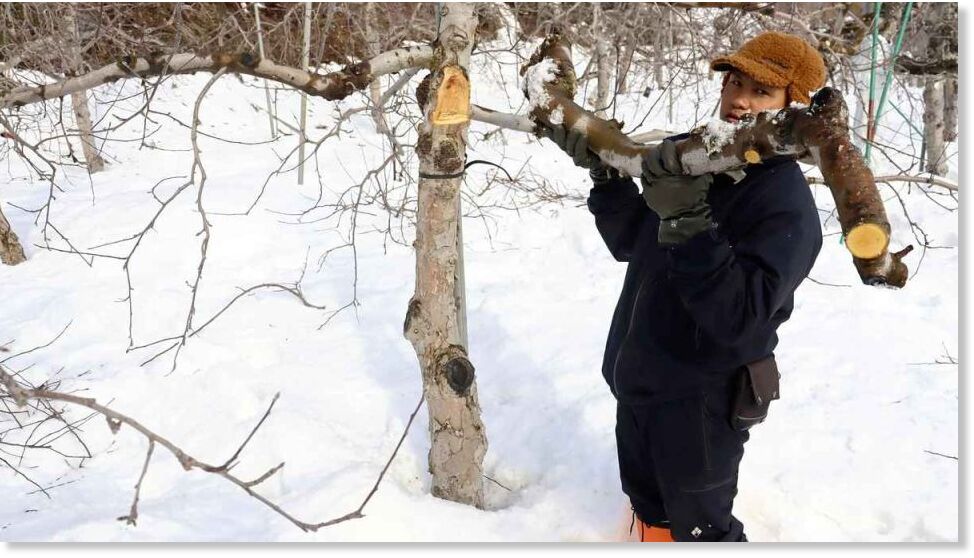
© THE YOMIURI SHIMBUNA farmer holds a branch that broke off an apple tree due to snow in Hirosaki, Aomori Prefecture, on Feb. 16. “This is useless,” he said.
Because many farm roads remain buried in snow, confirming the extent of the damage done so far will take a long time, and it could be worse than in typical years.
"I can only sigh because more branches have been broken than last year," a farmer said in mid-February while carefully digging up branches buried in the snow in an apple orchard in Hirosaki, Aomori Prefecture. In January, the city saw a record snowfall of 148 centimeters.
Last winter, broken branches on apple trees alone caused more than ¥20 billion in damage in the prefecture. The yield from his 5-hectare farm dropped by nearly 10 tonnes, down over 10% from typical years. Branches have been broken over a wide area this year, and he said, "I'm afraid this year's yield will be lower than last year's."
In Kita-Akita, Akita Prefecture, where 160 centimeters of snow fell in the downtown area in January, about 70 structures such as vinyl greenhouses and coops for "Hinai Jidori" chickens suffered damage from heavy snowfall.
A vegetable farmer said 10 of his greenhouses, nearly half of the total, have been damaged. His spinach and kogomi ostrich fern plants have been left buried in the snow without being harvested, and his tractor is snowbound. He estimates the damage to be about ¥40 million.
"I've never seen snow like this before, and the surge in material prices makes it difficult to rebuild my greenhouses." he said.
Niigata Prefecture, which has also seen heavy snowfall in some areas, has confirmed damage to about 190 agricultural facilities in nine municipalities in the prefecture as of Feb. 26.
In Hirosaki, the city usually begins to remove snow on farm roads in February, but it moved up the timing to the end of January. This winter, however, the city has not been able to handle the snow removal operations alone, so it secured a supplementary budget of ¥17.6 million to outsource some of the work to a construction company.
The Aomori municipal government moved up the start of snow removal on 84 kilometers of farm roads in the city to early January. However, operations on farm roads have been progressing slowly because of the need to remove snow on other roads used for daily life. Under such circumstances, the municipal government has not been able to assess the extent of agricultural damage.
"It has been snowing for a long period of time this season, and the damage from the snowfall may be greater than the previous year," said an official of the Japan Agricultural Cooperative (JA) Aomori.



Reader Comments
to our Newsletter