

© tomaszmichalkania via Pixabay
After the 9/11 Islamic terror attacks in the United States, two decades of the "Global War on Terrorism," communist China's expansive "Belt and Road Initiative," immigration-fueled social strife, the collapse of public trust in government institutions, the prevalence of pre-civil war conditions across Europe, the rise of Indian economic power, the emergence of Donald Trump's nationalism as a counterbalance to the World Economic Forum's vaunted globalism, the return of the Russian Federation as a major source of European angst, the growth of "multiculturalism" and its attendant fracturing of national unity, the "great powers" competition for hydrocarbon energies and other natural resources, the new geopolitical race to project strength in the Arctic, and the ever-present discussion of an impending World War III — just to name a few of the numerous global conflicts of the first quarter of the present century — Fukuyama's "end of history" argument has probably reached the end of its usefulness.
Before the curse of humanity's short memory stores Fukuyama's "end of history" thesis in the cupboard until it can be retrieved, dusted off, and recycled for practical use next century (just as Fukuyama had done with the historical conceptions of Hegel and Marx), it is worth noting how much of the academic world bought into this argument. I remember listening to two young political science professors discussing Fukuyama's work after the 9/11 terror attacks, and even then — in the midst of such a horrific rebuke to the proposition that a globalized form of Western liberalism was preordained — both academics were staunch believers in the "end of history" and disagreed only about whether Professor Fukuyama was worthy of so much praise for having merely stated what was glaringly obvious.
I was around another man at the time named Samuel P. Huntington, and he had written an essay and book that took Fukuyama's thesis to task. In The Clash of Civilizations and the Remaking of World Order, Professor Huntington argued that unbridgeable cultural conflicts would continue to remake the world. Although critics called him "racist," "Islamophobic," "ignorant," and even "Hitlerian" for dismissing the unifying effects of "diversity" and "multiculturalism," Huntington's predictions for a volatile twenty-first century were much more accurate than anything coming from the "end of history" camp. Still, even after death, the man who dispassionately forecasted a civilizational clash and an emerging period of global uncertainty is still maligned as "prejudicial," "white supremacist," "bigoted," and "imperialist."
Is there any conflict raging in the world today that can't be described in terms of competing cultural values? Israel and its Islamic neighbors have been in a perennial state of war for eighty years. Indian Hindus and Pakistani Muslims remain at each other's throats. Christianity and Islam have added fuel to fiery tribal conflicts that continue to rage across the continent of Africa. Armenia's Christians and Azerbaijan's Muslims struggle to maintain peace. The Balkans remain a potpourri of combative cultures and ethnic groups whose simmering passions can quickly boil over. Burma, India, Bangladesh, Thailand, China, Cambodia, Vietnam, and Laos fight against each other and themselves as civilizational loyalties turn ancient resentments into recurring bouts of violence. The War in Ukraine centers around the contested Donbas region whose people more closely align with the language, religion, and culture of Russia than with the historic identity that unites the people living in the western two-thirds of Ukraine.
Comment: Ukraine's "identity" is a manufactured fiction, created by the West to foment chaos in a geostrategically important region. For centuries "Ukraine" was inhabited by a hodgepodge of small groups under the dominance of larger regional powers.
- The falsification of history: "Ukraine" is not an independent country
- The history of Ukraine as an artificial state
- 'The Holodomor': How Ukraine distorted the history of a tragic Soviet famine to help build its modern national myth
- The History of Western Ukraine
- Russia and Ukraine: Painful rift with history and current crisis
- US narrative on Ukraine obscures geopolitical realities and regional history
Everywhere in the world, battle lines are drawn around civilizational identity. Religious conflict, historic grievance, and cultural incompatibility drive violence around the planet.
Yet Western globalists in Europe and North America pretend not to notice. They organize annual conventions where members of the World Economic Forum or the Council on Foreign Relations or the Royal Institute of International Affairs can bloviate about "multiculturalism," "open borders," "established norms," and the "rules-based international order." They speak about "nationalism" and "patriotism" as if they were diseases requiring quarantine for those showing symptoms. They like Islam and are willing to imprison anyone seen as violating Sharia Law or causing offense to Muslims. But they generally despise Christians and Jews and don't mind when medieval cathedrals mysteriously burn to the ground or Hamas terrorists rape Israeli women and kill Israeli babies. They pray fanatically at the altar of their "green energy" religion, while replacing entire domestic industries with the coal-powered, slave-labor-produced, government-subsidized exports of the Chinese Communist Party. White, Western globalists prefer to ignore the threats of Islamic jihad and Chinese totalitarianism, sip from glasses brimming with crisp Sauvignon blanc, and stew in the intoxicating vapors of their own haughty uselessness.
Comment: Bad take on Hamas too. Who killed the most innocents on Oct 7?
- UN: Israel killed own citizens on October 7 under 'Hannibal Directive'
- Hannibal Directive: Israel's forces responsible for Israeli civilian & military deaths following October 7 attack, testimony reveals
- IDF carried out Hannibal Directive, new 'Sword of Damocles' operation on October 7
- Did Israel choose to kill Hamas and the hostages indiscriminately?
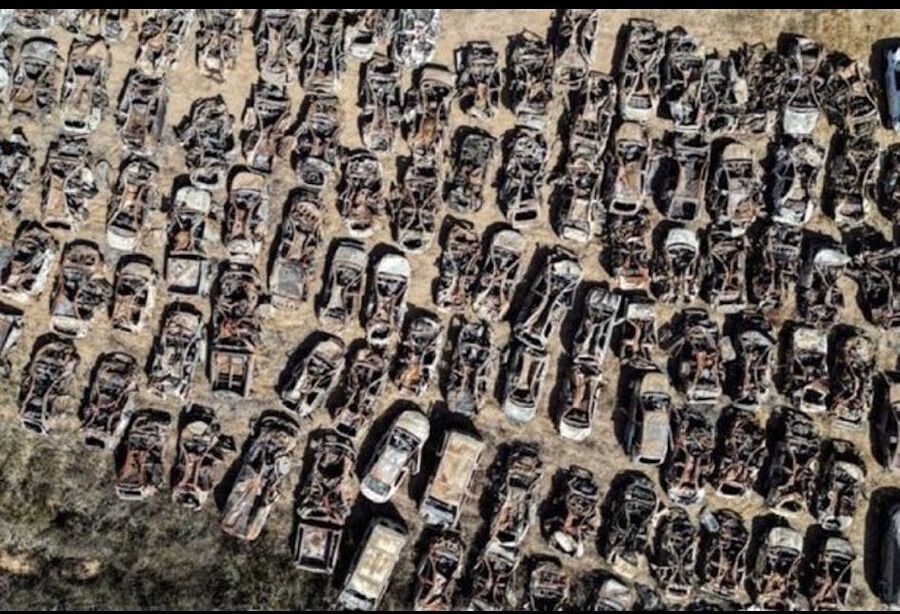
Wreckage of cars after Apache helicopters bombed the Nova Music Festival the morning of October 7, 2024 in accordance with Israel's Hannibal Directive doctrine
One might think that the last twenty-five years of global volatility would have given globalism's biggest promoters some measure of pause as the "end of history" arrived and passed. But Western "elites" generally suffer from cerebral deficiency, shameless incuriosity, and pathological stubbornness. According to the blue bloods on both sides of the Atlantic — such as Canada's banker-turned-prime-minister Mark Carney, France's banker-turned-president Emmanuel Macron, Germany's BlackRock-board-member-turned-chancellor Friedrich Merz, and the European Commission's noble-aristocrat-turned-installed-president Ursula von der Leyen — "multiculturalism" is our future, "diversity is our strength," and "cultural nationalism" is a "terrorist ideology" that breeds "hate."
Even after President George W. Bush's failed "nation-building" gambit to bring "democracy" and "women's rights" to Afghanistan and the Middle East, Western globalists insist that civilizational clashes aren't real. Even after the exposure of Muslim "rape gangs" trading local girls as sex slaves in the United Kingdom, the Netherlands, Belgium, Germany, and France, Western globalists insist that "diversity is our strength" and "multiculturalism" is our future. Even after communist China's increasingly provocative saber-rattling regarding Taiwan, pervasive espionage and sabotage within the United States, and public promises of world domination, Western globalists insist on transferring huge sums of national wealth to the Chinese Communist Party in exchange for China's lip service to "international norms." What Talleyrand said of the Bourbons applies equally well to the West's suicidal cult of self-hating globalists: "They have learned nothing and forgotten nothing."
As we enter the second quarter of the twentieth century, the world is about to receive a harsh education in the persistent reality of civilizational conflict. The "end of history" tripe was always a figment of self-deluding theoreticians who envision themselves as philosopher kings. In the real world, values matter. Culture matters. Religion matters. The past matters. Honor matters. Violent conflict does not disappear in a puff of smoke when Marxist-Hegelians hold up their dog-eared copies of Das Kapital and declare it must be so. In the real world — where bullets fly faster than words — theories written on scraps of paper are rolled up into cigarettes or left under a rock near the trench latrine. In the real world, people fight. Cultures compete. And civilizations clash.
Western globalists who refuse to learn the basics won't long last. From the Arctic to the Antarctic, battle lines are being drawn and redrawn everywhere. The past informs the present. The present informs the future. The rest of history is just now beginning.













Comment: And yet it needn't be so. The BRICs and its sister alliances are founded on the premise that each county has the inherent right to govern itself, and must not be interfered with. It is based on the idea that trading fairly and transparently is the foundation of political stability and mutual prosperity.