
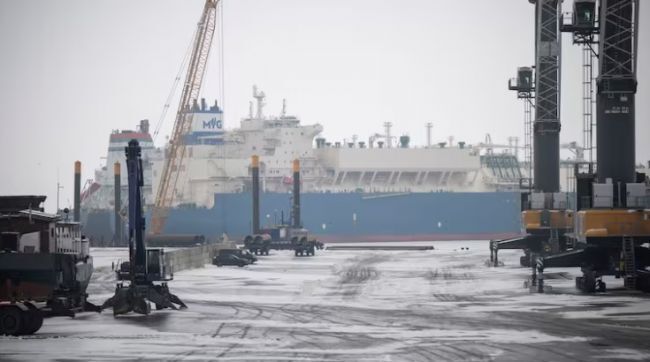
The regasification tanker is empty in the port of Mukran.
Gas reserves in German storage facilities fell to 5.7 billion cubic meters, according to GIE. As of mid-February, these are the smallest volumes in the country's UGS facilities since 2013. With the current selection of more than 100 million cubic meters of gas per day, it remains until mid-April, when the heating season in the northern part of Germany ends.
This winter, the country and the whole of Europe had more frosty weather and there were often periods of calm when it was necessary to increase the capacity of gas generation. However, in February, these are not the only reasons. The largest terminal, Mukran LNG, in the Baltic Sea has run out of gas and has not been supplying fuel to the country's gas transportation system since February 2. As a result, LNG imports fell by more than 40% - from 35 million cubic meters per day to 20 million cubic meters. And in two weeks, German and European companies received less than 2 billion cubic meters.
It is not known when LNG supplies to the terminal on Ryugen Island will be restored, as the gas carrier simply cannot approach the terminal due to ice. For more than two weeks, the Minerva Amorgos tanker has been located near Mukran LNG, but the vessel has not been able to be brought to the regasification tanker in the port of Mukran, which previously served as the base for the construction of Nord Stream 2.
The icebreaking vessel Neuwerk was sent to help the gas carrier from Rostock, however, it broke.
"The icebreaker was disabled due to a malfunction. It was supposed to ensure the unloading of tankers that were stuck in the ice for several weeks," writes the German Ostsee — Zeitung, reporting that the vessel is the largest operating icebreaker of the Federal Office of Waterways and Shipping, capable of breaking ice up to half a meter thick.The publication cites the agency's data that Neuwerk was forced to enter the port of Mukran on February 13 to assess the damage. But, according to AIS vessels, on February 16 the icebreaker has already returned to Rostock.
"Neuwerk is expected to return to service after repairs — the dates have not yet been announced. Until the return of the multipurpose vessel, the ice in front of the port will be broken by the chartered tugboat VB Bremen Fighter," Neuwerk added.According to AIS vessels, the situation has not changed yet and the gas carrier, which transports 100 million cubic meters of gas in the form of LNG, continues to remain at the Mukran port roadstead.
"Who would have thought in the era of "advanced global warming" that in the middle of winter a serious ice sheet could form in the Baltic Sea? This is absurd. Therefore, they were not ready for such a "whim" of nature in Germany," writes Alexey Grivach, Deputy director of the FNEB.






Ghosts of Nordstream coming back to haunt.