
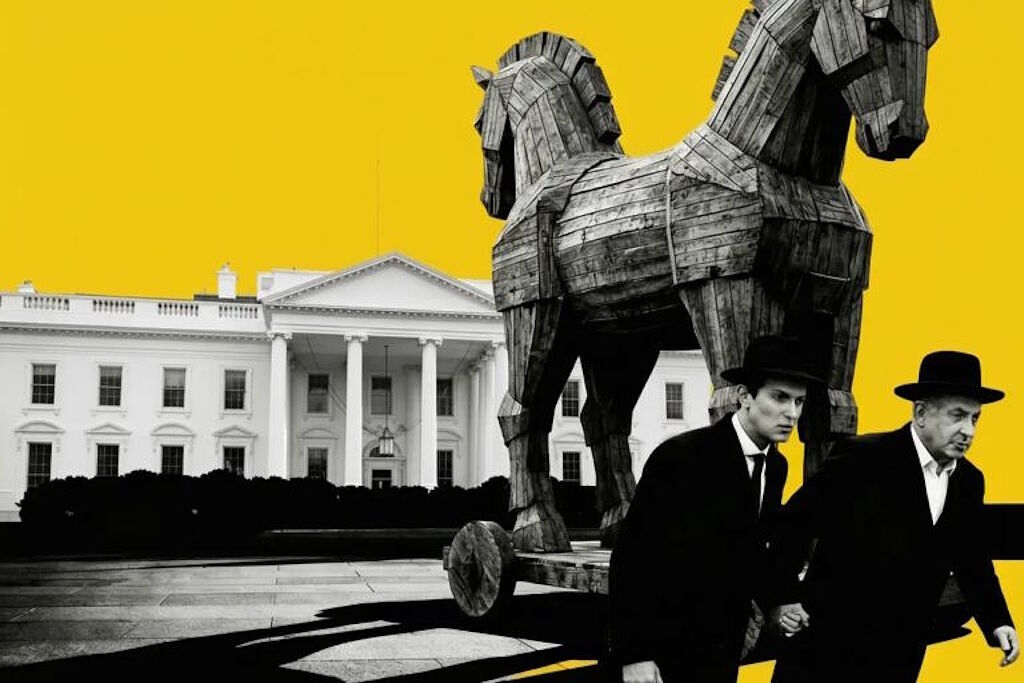
© 21st Century Wire
This is not theatre. Intelligence reporting rarely accuses outright; it maps vulnerability, flags leverage, and exposes the invisible pathways through which foreign influence can seep into the corridors of American power, remaining unnoticed, unchallenged, and structurally unstoppable.
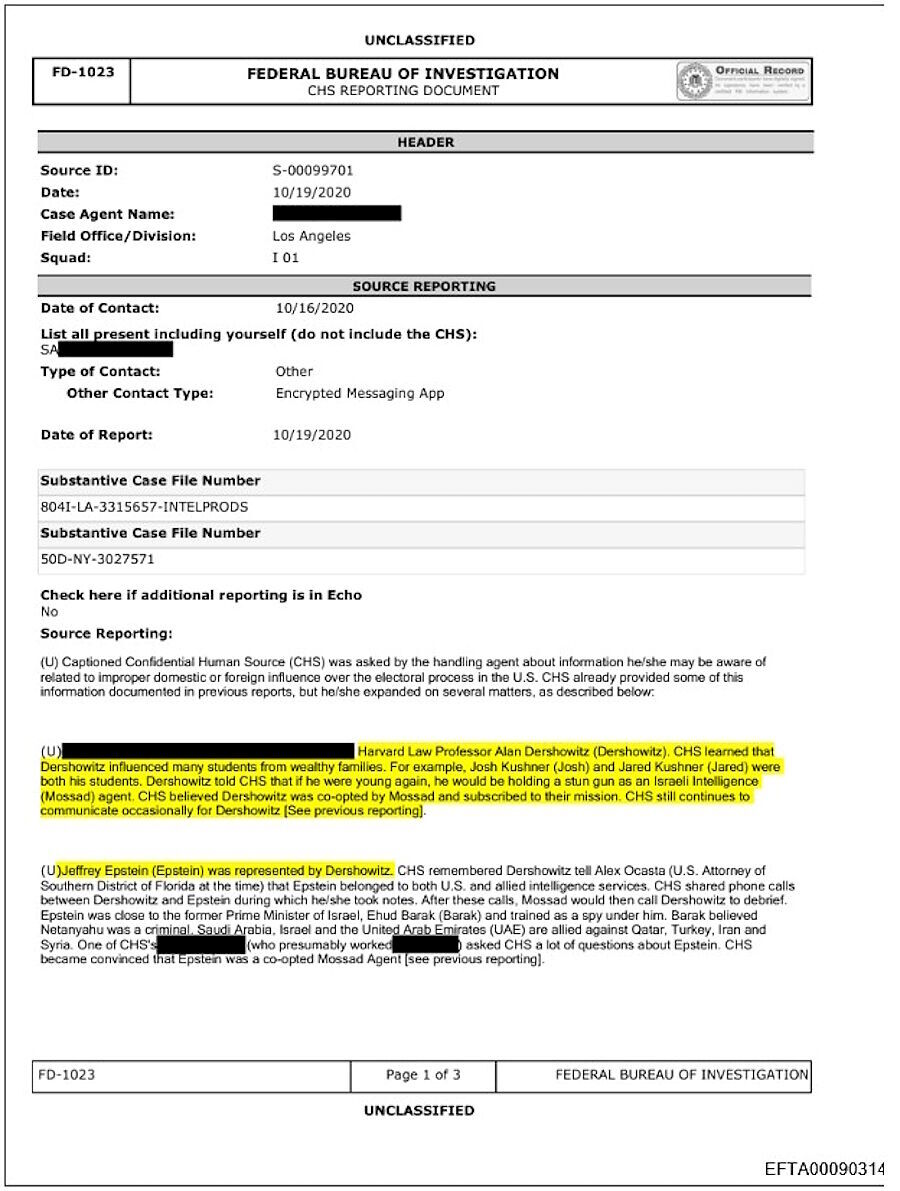
© US DOJDOCUMENT: Federal Bureau Of Investigation (FBI) – CHS Reporting Document, 10/19/2020 (3 pages at source)
A Presidency Rewired from the Inside
Before Jared Kushner ever stepped inside the West Wing, his family's business was deeply enmeshed in a web of international capital and offshore entities. Kushner Companies, the real estate firm founded by his father, Charles Kushner, was burdened with debt following aggressive expansion into Manhattan in the late 2000s and early 2010s. To stay solvent, the business increasingly turned to unusual, opaque sources of capital.
Documents and reporting reveal that Israeli‑linked capital flowed into Kushner‑controlled deals through vehicles like Gaia Investments Corp, headquartered outside of Tel Aviv, Israel, and its U.S. affiliates, such as 65 Bay LLC (+ venture with KABR), originally known as GAIA JC LLC, and whose names would later appear in federal ethics disclosures in ways that triggered concerns about transparency. These investment vehicles were nominally distinct, but were tied through corporate filings and insider networks to Raz Steinmetz, a member of one of Israel's wealthiest families, "The Steinmetzes", whose global interests span diamonds, mining, real estate, and infrastructure. The Kushner Companies seem to have conducted a public "scrubbing" of their connections to Steinmetz. In late 2014, the Gaia name and logo vanished from the list of partners on the Kushner website, where it had been featured since early 2013.

© Everipedia
These are not trivial commercial links. They are financial entanglements that predate public office, involve shell companies and offshore structures that obscure beneficial ownership, often linking back to Israeli billionaires, and reveal how a struggling real estate dynasty came to depend on international investment channels, with their own political and economic stakes.
When Jared Kushner assumed senior advisory roles in the White House, overseeing Middle East policy, diplomacy, and national security advice, he brought with him not only his ideology but a network of corporate and financial dependencies that would remain active, albeit obscured, during his tenure.
Jared became senior advisor to Trump in 2017 and held the position until Trump left office in 2021. He was the primary Trump administration participant for the Middle East Peace Process, authoring the Trump peace plan and facilitating the talks that led to the signing of the Abraham Accords and other normalisation agreements between Israel and various Arab states in 2020. He founded Affinity Partners, a private equity firm that derives most of its funds from the Saudi government's sovereign wealth fund. In 2025, Kushner returned to an informal advisory role in the second Trump administration, serving, along with Steve Witkoff, as a key intermediary in diplomatic negotiations regarding the Israel-Hamas war and the war in Ukraine.
Nowadays, in the dim underbelly of global power plays, Jared Kushner's shadow stretches long, weaving a tangled web around Trump's so-called "Board of Peace", a cabal of insiders poised to carve up Gaza's ruins. It starts with Marc Rowan, the Apollo Global Management mogul, who consulted Jeffrey Epstein on the firm's tax affairs, and who once tossed a lifeline of $184 million to Kushner's faltering family real estate empire, only to turn around and whisper pleas for Federal Reserve bailouts into his ear during crisis hours.

© Win McNamee/Getty ImagesUS Special Envoy Steve Witkoff and Jared Kushner • White House • September 29, 2025
Capital, Policy, and the Shape of Alignment
The post‑government chapter of Kushner's career, encapsulated by the launch of Affinity Partners, did not represent a break from foreign influence; it amplified it. Affinity raised billions from sovereign wealth funds in Saudi Arabia, the United Arab Emirates, and Qatar to invest in American and Israeli companies, including stakes in Phoenix Financial, one of Israel's largest insurance and financial services firms, and in units of Shlomo Group, a diversified Israeli conglomerate with infrastructure and defence-linked assets.
This capital inflow reflected something more than strategic investment; it confirmed a system of alignment that began long before Kushner left office. During his time in government, Kushner pushed policy outcomes that were sharply asymmetrical: recognition of Jerusalem as Israel's capital, the U.S. endorsement of Israeli sovereignty over the Golan Heights, and the sidelining of the Palestinians in peace negotiations. These decisions did little to serve the United States as an impartial actor but conferred enormous political capital on one side of a contested conflict.
Meanwhile, the family's real estate ventures continued to tap global financial networks and offshore vehicles like RealCadre LLC, commonly known as Cadre, a platform Kushner co‑founded in 2014 alongside Ryan Williams, and his brother Joshua Kushner, with a startup capital including a $250 million line of credit from the family of George Soros. Josh Kushner is the founder of Thrive Capital, a venture capital investment firm, and a major investor in Israeli startups. Together, they quietly raised tens of millions from foreign and anonymous sources in jurisdictions like the Cayman Islands, adding layers of opacity to the flow of capital surrounding Jared Kushner's private interests, even as he retained ownership stakes while in government. In 2020, he eventually divested his interest in CADRE, after several investigative media outlets discovered he was channelling funds into Opportunity Zone initiatives that provided tax incentives he had actively advocated for in Washington, which led to backlash over the perception that he was profiting from his position in the White House.
Viewed in sequence, the pattern was not serendipitous. Capital stabilised the Kushner family's finances, access followed, trust was conferred within the White House, policy aligned with external interests, and profit and reinvestment followed. Ultimately, this represents a self‑reinforcing cycle that blurred public duties and private gain, which should have raised numerous red flags.
Vulnerability, Ideology, and the Epstein Context
One of the most revealing episodes of Kushner's transition into public power was the security clearance process. Intelligence officials flagged Kushner's financial entanglements, with entities like GAIA JC LLC and foreign lenders, as a foreign influence risk, a technical term in security vetting indicating potential exposure. Yet that risk was overridden politically rather than resolved through reassessment.
This interlocks with the broader puzzle of the Epstein disclosures not because of proven operational use, but because Epstein's networks exemplified how private wealth, elite access, foreign interests, and institutional resistance to scrutiny co‑emerge. Epstein was protected for years by relationships that cut across finance, politics, and intelligence spheres, and the sources in the FBI reporting linked to him raised warnings about undue influence. The existence of such material, especially when intelligence agencies consider it, becomes part of the strategic environment of leverage even without judicial proof.
In parallel, ideology provided direction. The Kushner family's longstanding philanthropic support for Israeli causes, ties to settlement movements, and personal proximity to figures like **Benjamin Netanyahu, who reportedly stayed in the Kushner home and cultivated personal bonds with the family, meant that when Kushner took charge of Middle East policy, these deeply embedded preferences were not sidelined. They became operational priorities.
This is where the FBI source's assessment gains coherence:
One layer described susceptibility, another structural embeddedness. Susceptibility without structure is weakness; structure without susceptibility is inertia. The combination is policy alignment without accountability.Consent, Sovereignty, and the Lessons of Alignment
The deepest failure here is not legal; it is democratic. Americans did not vote for a presidency conducted through family backchannels and international capital circuits. They did not consent to an arrangement in which an adviser's private financial exposure intersected with public power in ways that shaped foreign policies, geopolitical outcomes, and economic trajectories.
Sovereignty is not merely a slogan. It is about who gets to define interests, set agendas, and negotiate outcomes without public oversight. When an adviser's financial dependencies span borders, involve shell entities and opaque partnerships, and when regulatory protections are overridden politically, the line between personal benefit and public duty becomes indistinct.
"America First" ceased to function as a safeguard. It became rhetoric cloaking alignment — relational, structural, and invisible to the ordinary voter.The pattern we observe, of capital moving through opaque channels into private gain while shaping foreign policy, demands scrutiny, not speculation. Democracy does not fail only when ballots are stolen; it fails when consent is manufactured under premises the public never knew they were endorsing.
If foreign alignment now travels through family ties, private equity, and offshore networks, the urgent question is not whether influence exists. It is whether democratic institutions still possess the tools, transparency, and will to recognise and constrain it. At what point does proximity become governance, and how many warning signs can be overridden before vulnerability is indistinguishable from policy?


Reader Comments
He was involved in the negotiations for the Abraham Accords. Here is Brave AI link: [Link]
" Religious and Cultural Framing : The accords emphasize shared Abrahamic values, such as peace, coexistence, and respect for human dignity. This religious narrative was used to legitimize normalization by framing it as a moral and spiritual duty rather than a political compromise."
" Promotion of Interfaith Dialogue : The accords explicitly call for interfaith and intercultural dialogue..."
"Many signatory states, particularly the UAE and Bahrain, viewed the accords as a strategic move to counter the growing influence of Iran".
Overall: "However, the combination of religious legitimacy, shared security threats, and economic incentives has made the Abraham Accords a durable framework for regional normalization ." Essentially the accords recognized religious views, security and business as the key to an agreement.
This is in addition to possible Epstein-related crimes
Both could reasonably be called traitors, and both seem to prioritise Isreali interests at the expense of US instrests. For Trump, that's impeachment and potentially criminal material, for Kushner probably criminal.