
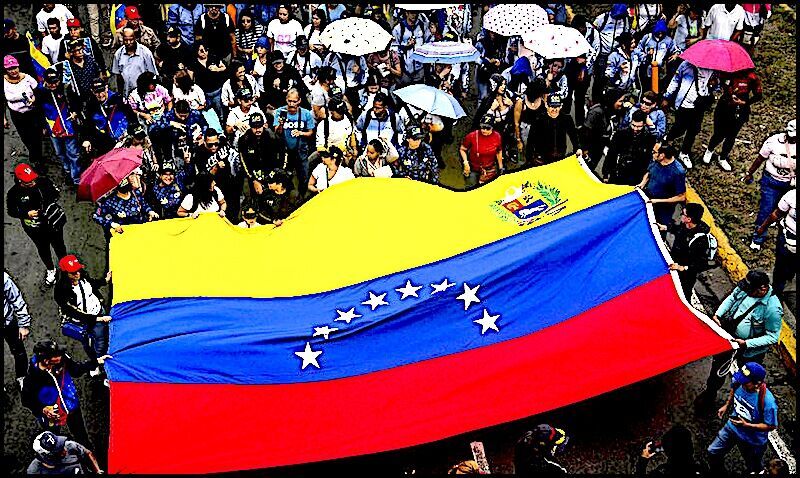
© Carlos Becerra/Getty ImagesDemonstrators protest in support of Nicolas Maduro • January 10, 2026 • Caracas, Venezuela
Everything has gone beautifully in Donald Trump's Venezuela operation. An alleged narcoterrorist dictator was captured and brought to justice in a New York court, and the planet's biggest oil wealth is now owned by the US. At least, according to Trump himself.
"We're in the oil business," he said after declaring billions of dollars' worth of Venezuelan crude was now heading to the US. "You don't talk to the Venezuelans, you talk to me," he told Big Oil executives who gathered in the White House last week.
The trouble is, Big Oil doesn't see it that way. The chief executives of ExxonMobil and ConocoPhillips are not rushing back into Venezuela.
Trump called the oil chiefs to the White House last Friday to urge them to invest $100 billion in upgrading Venezuela's petroleum and gas industries. Decades of US economic sanctions are reckoned to have caused the country's industrial infrastructure to deteriorate.
Venezuela's oil industry was nationalized between 2004 and 2007 by former socialist President Hugo Chavez. This policy continued under his successor, Nicolas Maduro, who was kidnapped on January 3 when US special forces raided his residence in Caracas.
After Venezuela's oil industry was nationalized and run by state-owned Petroleos de Venezuela (PDVSA), the US oil giants Exxon and Conoco quit operations in the country. They later sued in US courts, which ruled that Venezuela owes them $13 billion in expropriated assets. The third biggest US oil company, Chevron, continued to do business in Venezuela in partnership with PDVSA.
At the White House oil summit last week, Exxon and Conoco executives told Trump that they were not ready to return to Venezuela because of the risk to investment.
Exxon boss Darren Woods described Venezuela as "uninvestable":
"We have a very long history in Venezuela... We've had our assets seized there twice. You can imagine to re‑enter a third time would require some pretty significant changes from what we've historically seen here and what is currently the state.The Exxon CEO's comments were echoed by Conoco's boss, Ryan Lance, who said:
"If we look at the legal and commercial constructs and frameworks in place today in Venezuela, today it's uninvestable. And so significant changes have to be made to those commercial frameworks, the legal system, there has to be durable investment protections, and there has to be a change to the hydrocarbon laws in the country."
"We need to be also thinking about even restructuring the entire Venezuelan energy system, including PDVSA."What that means is that Venezuela is far from under US control.
Maduro may have been abducted, but the Venezuelan government continues under interim President Delcy Rodriguez and the same administration as when Maduro was in office. Rodriguez and her top aides, including Defense Minister Vladimir Padrino, have condemned the US aggression and are demanding the safe return of Maduro and his wife.
Venezuela has not collapsed, nor has its socialist government been overthrown. The scores of warships and 15,000 troops, as well as 200 special operations commandos, deployed at an estimated cost of over $600 million to kidnap Maduro, seem to have brought a Pyrrhic victory.
From the viewpoint of Big Oil, it's not mission accomplished. Venezuela is 'uninvestable', which is the capitalist way of saying, there was no regime change to give the oil companies what they want - total control over Venezuela's hydrocarbon wealth.
Big Oil backed Trump's election campaign in 2024. Delivering Venezuela was part of the deal. But, from what the chief executives are telling the president, he failed to deliver enough for them to feel confident about going back into the South American country.
Hence Trump's irritated reaction over the weekend. On returning to Washington from Florida, he was asked by reporters about Exxon's reluctance to stump up $100 billion to go back into Venezuela. His response to reporters on Air Force One: "I didn't like Exxon's response... they're playing too cute." As a sign of his displeasure, Trump said he would block Exxon from returning to Venezuela in the future.
Big Oil just rained on the supposed victory parade about the Venezuela operation.
The spectacular raid did not change the government in Caracas. Independent journalist Camila Escalante, reporting on the ground, says the interim administration under Rodriguez is continuing the policies of Maduro. The Big Oil executives seem to be in agreement with this assessment.
If Trump wants to take control of Venezuela's oil wealth instead of hijacking a few tankers, he will need to send US troops into the country in a large-scale invasion to install a new regime. This will come with huge, likely unbearable political and military costs.


Reader Comments
It's always about, what's never said publicly.
It's a show for us.
[Link]
Predatory Capitalists now rule America. The system began with the Talmudic dispensation of moral and legal prohibitions against usury: Christanity forbids usury though most modern Christians ignore the prohibition.
Confucianism condemns usury, viewing it as exploitative and contrary to the principles of benevolence and righteousness.
Buddhism has a negative view of usury.
Islam forbids the practice.
Hinduism has a complex attitude towards usury, often viewing it as immoral, especially when excessive interest is charged. While some texts permit lending with interest under certain conditions, the practice is generally criticized for its potential to exploit borrowers.
How did a practice condemned by the major religions get to be firmly entrenched in Western economic systems - "baked in the cake", as it were?
It is jealously guarded by the investor class and, like all Ponzi schemes, it needs a constant supply of additional "clients".
Could it be that the unifying thread that connects the U.S./Israel "forever wars" has to do with this basic building block of the economic system?.
Iraq under Saddam Hussein had laws that restricted usury, which is the practice of charging excessively high-interest rates on loans. These laws were part of a broader economic system that aimed to control financial practices within the country.
During Muammar Gaddafi's rule, Libya implemented laws aimed at aligning the legal system with Islamic principles, particularly regarding usury, which is prohibited in Islamic finance.
Syria had laws that regulate financial transactions, including restrictions on usury, promoting fair trading practices instead of interest-based lending.
Venezuela has implemented laws aimed at controlling usury.
Food for thought?
Usury offers the leverage that results in the massive updraught of wealth we have observed over the past decades - the more one has, the greater the opportunity to gain:
The wealthiest 1% held approximately 23% of wealth in the mid-1970s. This rose to over 35% by 2022. The vast majority of this increase occurred among the top 0.5% who enjoy disproportionately more political power than the rest..
Obviously, this is unsustainable but wealth = power in a system that requires massive campaign financing, lobbying etc. so it is unlikely that those who benefit from from it would desire change. In fact, they constantly demand more - more markets for financial instruments that exploit usury and, incidentally, shore up dollar hegemony - just like your average Ponzi scheme.
The American market is sucked dry and on the verge of collapse but there remain large parts of the World governed by dissenting ideologies - the majority of the Muslim World and China for instance.
In short, I am beginning to view current events as a clash of economic ideologies rather than political (democracy/freedom yadayada) or religious - more reminiscent of Cold War thinking: "our system or else!".
It has always puzzled me why all Western countries have such large debt. I mean, who is the ultimate lender? Into whose pocket does the interest on this debt flow? What is the source of their ability to lend? Why is it that all of the sage advice to the individual ("Live within your budget", "Neither a lender nor a borrower be" etc.) does not apply to States?
I suspect that debt is encouraged by those who possess the ability to conjure currency in the absence of a gold standard or similar limits on the issuing of currency.
Why are we constantly told that the Chinese system is a failing model? China's external debt stood at $2.38 trillion in 2023 but the country is also a major global creditor, holding over $5.6 trillion in credits. Is it coincidence that most command economies have a healthy balance sheet while most countries with "independent" central banks are indebted?
I liked this comment...
Christanity forbids usury though most modern Christians ignore the prohibition.
Vatican bank comes to mind.