
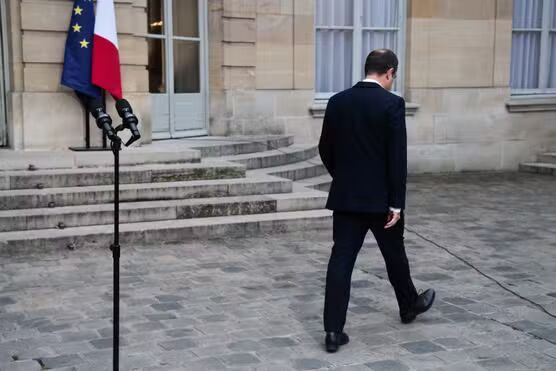
© CYRIL BITTONAu'revoir
On Sunday evening, almost four weeks after his appointment by Macron, Lecornu had unveiled his cabinet, which was almost identical to that of his fallen predecessor, François Bayrou. But cracks were apparent right away, with members of several parties within the governing coalition expressing doubts and criticism about the lack of change.
Lecornu, a former defense minister, had faced the daunting task of finding approval in a deeply divided parliament for an austerity budget for next year.
Lecornu was to make a public statement at 10:45 am (Paris time).
Jordan Bardella, the president of the far-right Rassemblement National (RN), immediately called for snap elections. "There can be no return to stability without a return to the polls and without the dissolution of the Assemblée Nationale," he insisted.
Jean-Luc Mélenchon, the leader of the radical-left La France Insoumise (LFI) party, called to introduce a motion to remove Macron from office. Mathilde Panot, a prominent member of LFI, called for Macron's resignation following Lecornu's resignation. "The countdown has begun. Macron must go," she said, in a post on X.
Macron's seventh PM
In early September, Macron named 39-year-old Lecornu as the seventh prime minister of his presidency in a bid to defuse a deepening political crisis. Macron opted for one of his closest allies rather than seeking to broaden the government's appeal across the political spectrum.
French politics has been in turmoil since Macron gambled on snap elections last summer in the hopes of bolstering his authority. The move backfired, producing a Parliament fractured between three rival blocs.
Lecornu's two immediate predecessors, Bayrou and Michel Barnier, were ousted by the Assemblée Nationale in a standoff over the spending plan. France's public debt has reached a record high, official data showed last week. France's debt-to-GDP ratio is now the European Union's third-highest after Greece and Italy, and is close to twice the 60% permitted under EU rules.
Previous governments had rammed the last three annual budgets through Parliament without a vote, a method allowed by the constitution but deeply criticised by the opposition. But Lecornu promised last week to ensure lawmakers were able to vote on the bill.
For almost a month, Lecornu held a series of consultations with centrist allies and opposition leaders, on both the left and right, aiming to agree on a non-aggression pact in parliament and adopt the budget. No party has enough seats to govern on its own. Most parties on the left had announced plans to back a vote of no confidence, with Marine Le Pen's far-right threatening to back it too.


Reader Comments
Stupid is...as stupid does.