
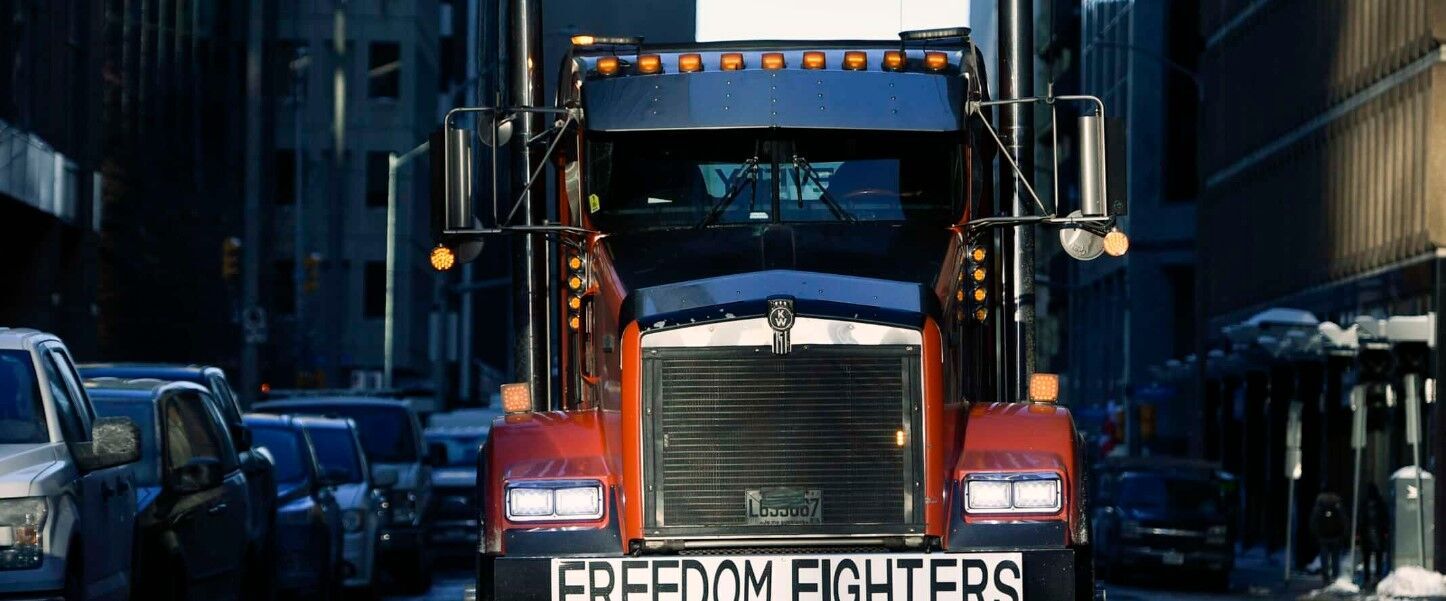
A key thing to remember about the Freedom Convoy protests of January-February 2022 was that they were wholly peaceful. Everywhere the truckers and their supporters travelled - along Prairie highways, through the Maritimes and Quebec, and down small-town main streets - they were greeted with applause and gratitude. Manitoba Hutterite colonies fed them pulled-pork and potato salad. At traffic lights, people passed cookies, pizza, water - and cash. Showers and spare rooms were offered and accepted. Bemedalled veterans saluted as they passed. From one end of this country to the other, ordinary Canadians - amounting to a massive jury of their peers - saw the Freedom Convoy truckers as their long-silenced voices, often treating them like rock stars or even saviours.
Consequently, the drivers who journeyed to Ottawa were not only breathing the heady air of freedom but carrying a burden. British Columbian Bern Bueckert, who was pulling an enormous "Mandate Freedom" sign behind his Peterbilt, later said, "It got to be a bit of a weight on our shoulders. We'd been riding the wave for a couple days, the adrenaline. Look at these people, this is awesome. And then it started hitting home. No, this is not a joyride. This is something this country desperately needs."

“The country needs this desperately”: By the winter of 2022, millions of lockdown-weary Canadians were nearing despair; the Freedom Convoy gave them back a voice. At bottom, B.C. trucker Bern Bueckert’s Peterbilt and its famous sign. (Sources of photos: (top left) Indrid__Cold, licensed under CC BY-SA 2.0; (top right) The Bold Bureau/Shutterstock; (middle left) ThankYouTruckers.Substack; (middle right) GoToVan from Vancouver, Canada, licensed under CC BY 2.0; (bottom) Rumble)
Comment: To quote, that is "one in four," which represents just how dangerously messed up minds had become. The constant 24/7 downloaded programed propaganda, - crafted behavioral modification, took its toll resulting in abject fear and hysteria that had been created. One might almost think that they had had years of planning to achieve the results.
In essence, the federal and provincial governments, along with their minions (including judges with no backbone, legal firm's who opined away the the very idea of human rights, our so-called medical scientific advisors, contract behavioral scientists, the paid for news media and the corporations the got onboard), helped design the images for the background screen in a type of covid Plato's Cave. Thereafter, they simply became ruthless after the covid carrots where dished out, and then they never stopped with the stick until the Truckers carried Canadian hopes with them up to 4,700 km. away to Ottawa. It was only then that the powers that be took notice as the world watched, yet it was not over..
For nearly two years, Canada's truckers had helped keep Canada's economy afloat, unfailingly supplying everything from hospitals to supermarkets while millions of Canadians - including the politicians who imposed the lockdowns and vaccine mandates, and the elites who propounded the official narrative - worked safely from home. They had been lauded as heroes, including by Trudeau. Then, quite abruptly and without real explanation, that same government demanded that all truckers crossing the Canada-U.S. border be vaccinated, threatening to deprive those who could not or would not get the jab of their livelihoods. Their backs were to the wall.
And increasingly, millions of weary Canadians felt the same way. For two years, they had been generally cooperative. Now, they were saying: enough is enough, it's time to move on and get back to normal life. As economist and commentator Bryan Moir, put it: "The Freedom Convoy wasn't just a protest; it was a psychological jailbreak."
My book, Thank You, Truckers! Canada's Heroes & Those Who Helped Them, records the stories of those who got behind the wheel and drove to the nation's capital. The Prairie mother and her 14-year-old daughter who jumped in a red Western Star at the last minute, their truck becoming one of the most photographed of the protest, part of an iconic trio parked on Metcalfe Street a few blocks south of Parliament Hill. The Jamaican immigrant and his Serbian immigrant wife who spent three weeks on Wellington Street in their blue Peterbilt, after they'd both lost their jobs. The Saskatchewan trucker, his wife and their pregnant dog - who later birthed five "freedom puppies" on a side street in the nation's capital. And more.
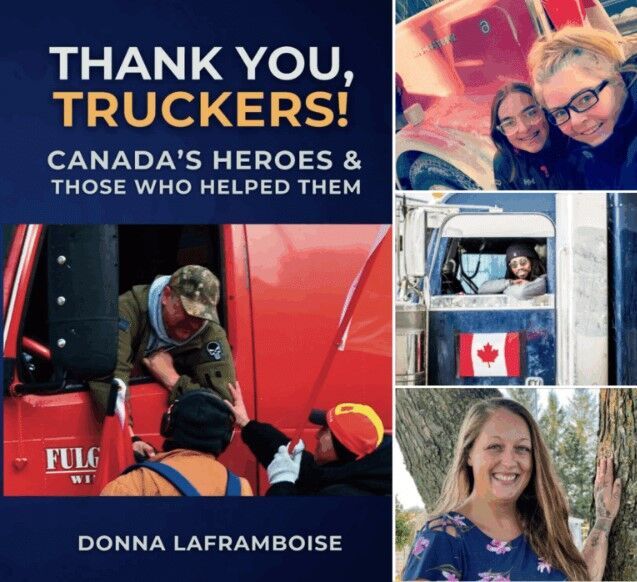
Donna Laframboise has produced a heartfelt tribute to Freedom Convoy truckers and their supporters, including (right, top to bottom) Stephanie and her 14-year-old daughter Kyra, Jamaican immigrant O’Jay, and Quebecker Bianca, who brought the soon-to-be-famous bouncy castles to the protest site. (Sources of right photos: (top) ThankYouTruckers.Substack; (middle) Instagram; (bottom) Donna Laframboise)
Most Canadians don't know the stories of these ordinary folk. Nor do they know, beyond the cases of Lich and Barber, how relentless Canada's justice system has been in seeking to punish them. For more than three years, Freedom Convoy protesters have been pursued in court with unseemly enthusiasm by a system that is woefully short of judges and prosecutors and beset by long delays for cases involving far more serious crimes. Credible news reports suggest that the majority of criminal cases in Ontario aren't even making it to trial, with sexual assault charges dropped because of delays. Yet the Convoy prosecutions continued, come what may. And they are still not entirely finished.
What follows is an extensive excerpt from a chapter telling one such story of a Freedom Convoy protester - including his rough arrest, irregular detention and seemingly endless legal ordeal.
Chapter 10: "The Checkered Flag"
"I wasn't planning on going to Ottawa," explains Guy Meister, a now-retired truck driver. "But my Mack is like the old one in the movie, Convoy." Friends who thought it should put in an appearance, were razzing him. "So I said, 'Well, if it'll start, I'll go. If it don't start, I'll stay home.'"
It took two hours to dig it out of a snowbank, Guy remembers.
"I encouraged him to go," says his wife, Charlene. "It was right after Quebec was talking about giving fines to everybody per month that wasn't vaccinated. My mother's not vaccinated, and she's never gonna get vaccinated. She doesn't have extra income. So then I was thinking, how could I help her pay these fines if they came into being? I could see it going from Quebec to the rest of the country. It was just too much."
Guy soon persuaded Mike Jamieson, a long-time friend with a yellow Freightliner, to come along. Guy was flying a Canadian flag off the back of his truck and says the rockstar treatment from members of the public began almost immediately. His first stop was a service station, five minutes from home, where he put $320 in the fuel tank: "I went in to pay for it. And there was a veteran following, who had pulled in, paid for my fuel, and left. Didn't even say nothing to me."
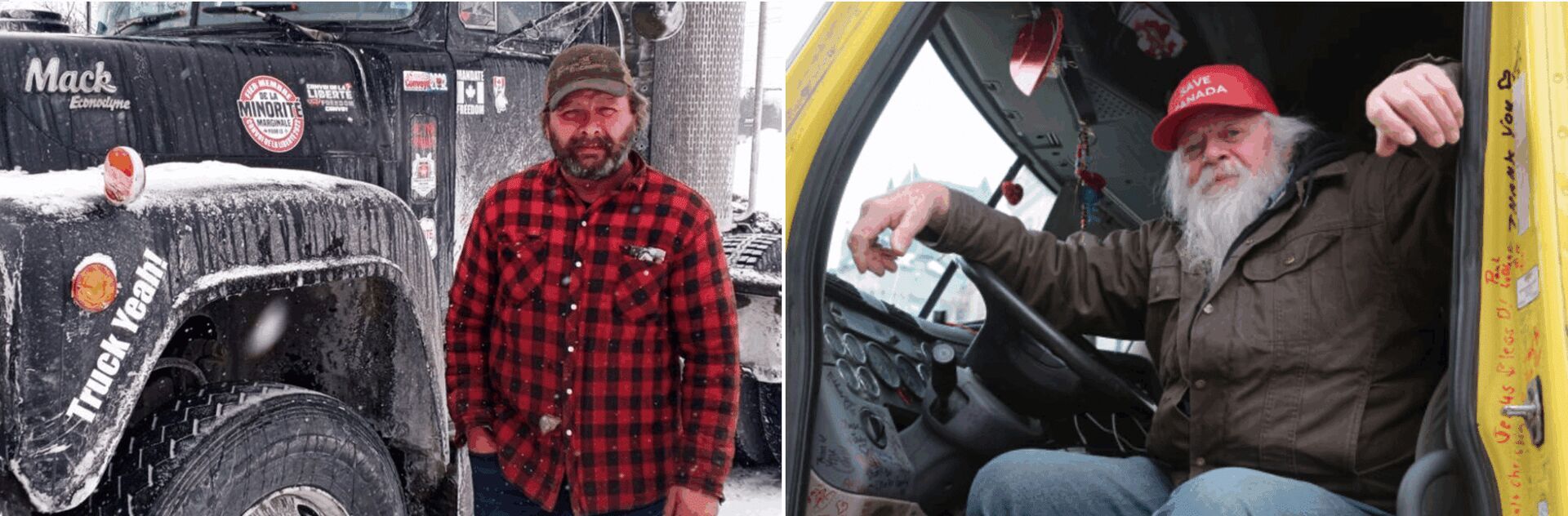
Behind every good man: Guy Meister (left) was persuaded by his wife to drive his vintage Mack to take part in the Ottawa protests, where he was joined by his long-time friend Mike Jamieson (right). Even before the truckers arrived in the capital, Meister recalls, supporters gave them the rockstar treatment. (Sources of photos: (left) Justice Centre for Constitutional Freedoms; (right) Richard Moore/The Epoch Times)
After police guided their arm of the Convoy to the parking lot at Ottawa's baseball stadium, Guy and Mike were among the big rigs that snuck into the downtown overnight, eventually securing spots at the Rideau and Sussex intersection, where a New Brunswick trucker, Travis, was also parked.
Huge Nova Scotia and New Brunswick flags were secured to Mike's dazzling Freightliner. His jolly demeanor and snow-white Santa Claus beard attracted attention. So did Guy's vintage Mack sporting a duck hood ornament instead of the traditional bulldog - just like the truck in Sam Peckinpah's 1978 action comedy, Convoy.
Guy expected to be kicked out of the city after a couple of days. When that didn't happen, he says, "we started taking it serious." Both men permitted well-wishers to write messages inside their trucks - on the roof, the doors, the windshield. "Free Canada! We support you. God bless you. Thank you for standing up. You rock!" After a while, says Guy, "I got tired of hugging people. So I said, 'Just hug my truck.'"
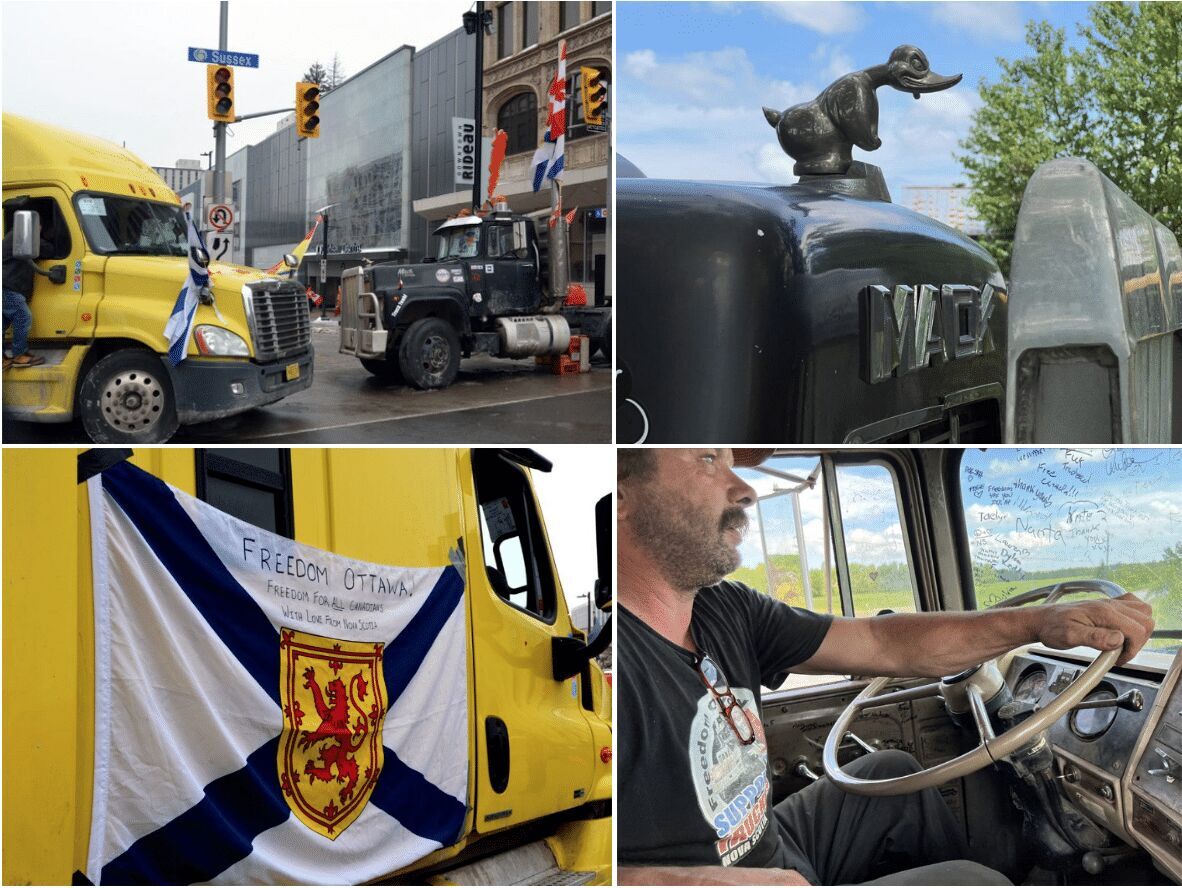
Protest as tourist attraction: Parked at Ottawa’s Rideau and Sussex intersection, the trucks (top left) became popular with photographers and well-wishers. Shown at top right, duck hood-ornament on Meister’s vintage Mack; at bottom left, Jamieson’s yellow Freightliner adorned with a slightly modified Nova Scotia flag. (Source of photos: ThankYouTruckers.Substack)
By the time the truckers arrived in Ottawa in late January 2022, Guy says some local residents were in a bad way: "People, they'd come outta their apartment and they'd peek around the corner. So I went up to this lady, I said, 'No one's gonna bother you. Why aren't you coming out to talk?'"
"She said, 'We'll get arrested if we're outside without an essential reason.' Right in Ottawa. Another lady came up the first night and asked, 'What do you take in your coffee?'"
"And I already had like five coffees in the truck. I said, 'Ma'am, I got too many now.'"
"She says, 'This is the first time in two years I've been to Tim Hortons without a mask, I'm gonna go get you one anyway.'"
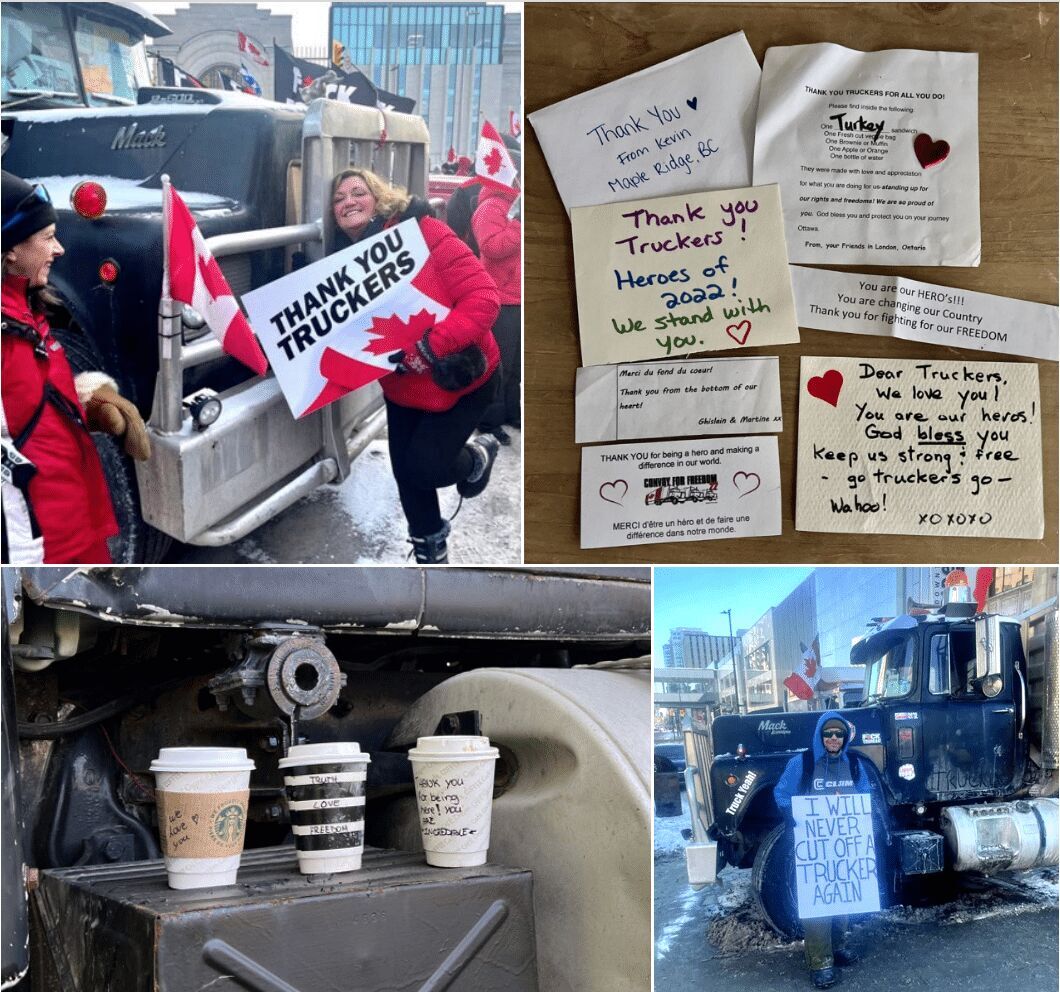
“We support you. God bless you…You rock!” From coffee and food to hugs and money, Meister recalls the overwhelming support he and so many other truckers received. (Source of photos: ThankYouTruckers.Substack)
He pauses, "I don't think none of what the news says is true." In fact, he relates a shocking story about the media. One day, a friendly police officer advised him, "In fifteen minutes you're gonna see [a major Canadian news network] come down here and set up. Then you're gonna see two fellas walk down the road and stand in front of your truck. And those guys are gonna start arguing about you blocking the road for an ambulance."
Guy says he personally witnessed this charade three times: "They wanted to stage it. So, I'd see the news turn up there and I'd see the two fellows start fighting about us blocking the road. I'd go stand near the truck and they'd start yelling at me. Then I'd see the ambulance come, and I'd back the truck up. It would never go by, just to where the truck was, and no farther. They done it three times with ambulances."
Slightly before noon on Friday, February 18, [2022], Guy was in Mike's passenger seat. Police in helmets, carrying shields and batons, were lined up across Rideau Street, methodically advancing from the east. "We were eating Big Macs," Guy remembers. The truckers had been advised, in case of emergency, to sound their horn to attract attention. "Mike held his horn on for half an hour. He looked at me and said, 'This ain't working. Nobody's coming.'" Guy laughs heartily. "Because everybody was running, right? It was funny."
A snowbank had been constructed by the protesters. After surmounting it, the riot police approached the yellow Freightliner. "They said, 'Get outta your truck.' Mike went to pull the handle, but before his hand got there, they beat the window out. There was broken glass all over him. Then they unlocked it and drug him out."
"The other ones were walking around the front. And I thought, 'Well, it's stupid to sit here, cuz they're gonna beat this window out, too.' I just got out and stood there and an officer arrested me."
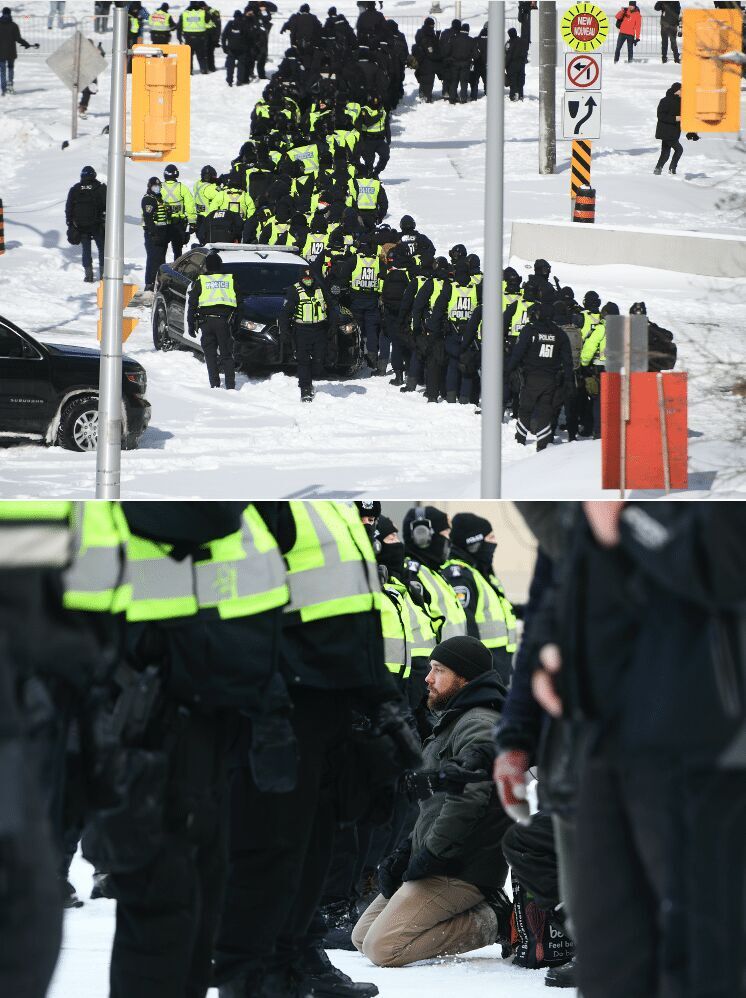
Get outta your truck”: Meister was one of many truckers arrested on February 18, 2022. Like others, he accuses police of shameful and unconstitutional treatment, in particular denying them their lawful right to “retain and instruct counsel without delay,” and spending hours in custody without access to basic needs such as water and washrooms. Shown: (top) a lineup of police officers assembles on Colonel By Drive, February 18, 2022; (bottom) arrested protester. (Source of photos: The Canadian Press/Justin Tang)
By the time he was fingerprinted, his hands were so swollen and numb he required assistance. "They were blue, because they had the cuffs on so tight. When they undid 'em, the policeman had to lift my arm up. Because I couldn't." Video footage which wasn't disclosed at his trial by the Crown but surfaced later shows Guy Meister rubbing his right shoulder and cradling his right wrist in the police processing trailer. Indeed, a document filed by his lawyer Brian Doody, reveals that Guy was detained "without access to food, water, washrooms, medical care or legal counsel."
Despite his Charter[of Rights and Freedoms] right to "retain and instruct counsel without delay," during the nearly five hours he spent in police custody, he didn't speak to a lawyer. The police say he was offered an opportunity to do so hours into his detention but declined. Meister remembers nothing of the sort.
Comment: Concerning the Charter of Rights and Freedoms (the U.S. has their Bill of Rights, and so on and so forth around the world), to make them truly Rights and Freedoms, a Charter needs the legal authority and will to enforce it. During covid, the powers that be had simply withdrawn the enshrined legal requirement to enforce peoples' rights and freedoms. As tyrants go, they were clearly saying, you have no rights and freedoms.
During his trial, Justice Jonathan Brunet agreed a "considerable delay" had occurred, but concluded the police had done their best under "unusual circumstances."
Initially, Guy was charged with public mischief. Four additional charges were added later, including resisting arrest. At least eight officers, from three different police forces, interacted with him during his time in custody.
Guy and Mike were released, which meant being sent out into the cold at the works yard. Disoriented, they had no idea where they were.
Officials for the city of Ottawa spent three weeks urging Freedom Convoy truckers to go home. Yet, after they were arrested, Guy and Mike were unable to return to Nova Scotia for another week. It apparently wasn't sufficient to remove the trucks from the downtown core. The city then kept them locked up, inaccessible for a full seven days while charging their owners storage fees in the neighbourhood of $200 per day. That's seven days to the hour. Don't come by the impound yard looking for your rig at 9 a.m. if it was seized in the afternoon.
The night of their arrest, they stayed with an Ottawa resident, a federal government employee and a "really nice lady," remembers Guy. Another woman they'd met during the protest also stepped up. "When they took our trucks, they took everything we had," says Guy. "Well, this other lady, she went to the store and bought us knapsacks, pants, deodorant, everything. If the rest of the world was like this lady, there'd be no trouble in the world."
The day he retrieved his Mack from the impound lot, Guy recorded a video. "Now this is how respectful these cops are," we hear him mutter. "They broke my f — ing flag on the back." The red-and-white maple leaf that had travelled with him from the Maritimes was gone. So was his Nova Scotia flag. He says a police officer there at the impound told him they'd been "thrown in the dumpster with the other garbage."
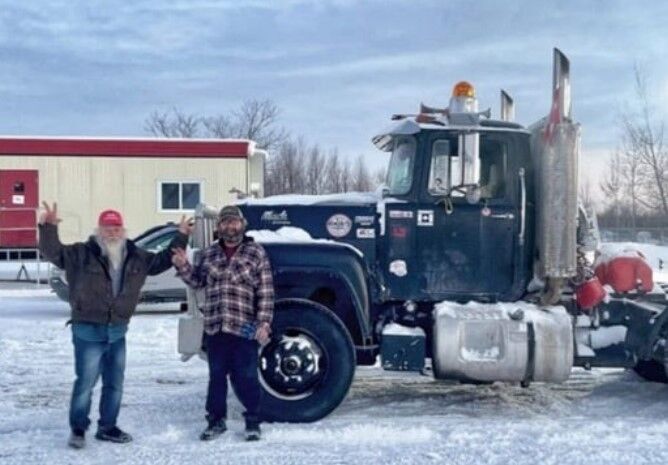
Now, who would rip off a Canadian flag? As Jamieson and Meister went to retrieve Meister’s Mack from the impound lot, they found the truck in need of repair and the red-and-white maple leaf missing; a policeman told them it had been thrown into the garbage. (Source of photo: ThankYouTruckers.Substack)
Sam recalls, "We got there and I put a battery on the passenger floor" (of Guy's truck). "Got the headlights going, got a blower motor. We took two litres of water out of the air tank."
Late the next day they arrived at a family-run garage in Quebec, an hour past Montreal. Guy explains, "They're Mack people. When they buy a new Mack, they take the floor mats out and put other floor mats in cuz they don't want your feet on a Mack emblem. And these guys are precise." The garage "took the wiring harness out," says Sam, and "went over to a brand spanking new truck that had never seen the highway. They colour matched, and [they] put Guy's Mack right back to factory layout." Guy smiles, "All my gauge lights work now; all the switches work proper."
On their way to that Quebec garage, Mike's Freightliner developed its own mechanical issue. The Mack people responded by hiring - and paying for - a service truck. They couldn't get the part it needed so "the guy made the part in the palm of his hand," Sam recalls. "Couldn't speak a lick of English. I got pictures of him and his son. He brought his son on the repair because, you know, wee hours of the morning, trying to get us back on the road so we could finally get home to our own families."
When Guy, Mike and Sam returned to the highway, Guy was flying a new flag. The checkered black and white. In racing circles, it means a vehicle has triumphantly crossed the finish line. He explains: "I put that on for the drive home because the mask mandates and other things started to change. I considered that a victory. The funny thing is people were asking if there's anything we needed. I mentioned to a couple people that I'd like to have a checkered flag that we can use if we win. I actually have about fifteen more checkered flags because people just started bringing them."
To the riot police who smashed his window
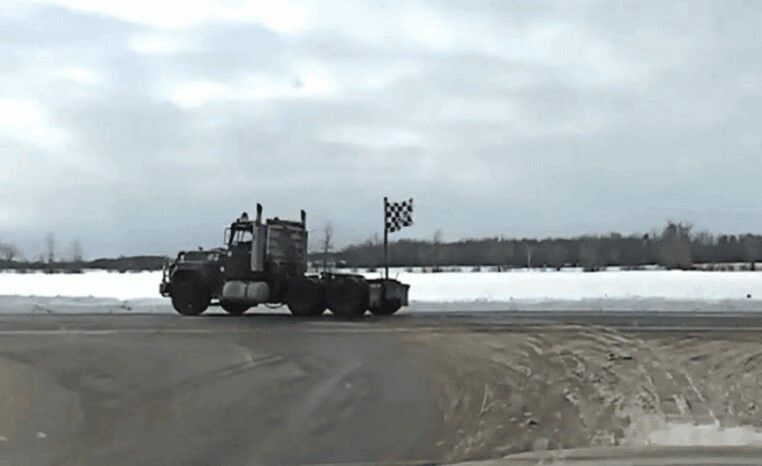
A victory won, at great cost: Although no-one in any government ever admitted it, the Freedom Convoy protests prompted the unwinding of many pandemic measures. As Meister headed for home, he flew a checkered flag to signal a figurative crossing of the finish line. (Source of photo: ThankYouTruckers.Substack)
Eighty-two days after they were arrested, in May 2022, Guy spoke to Mike over the phone for the last time. It was about five in the evening. Mike went through a toll booth around ten, he says, but he didn't make his delivery the next morning. "I knew where all of his resting spots were," says Guy. "I found him up in the Cobequid Pass," forty minutes northwest of Truro. "We opened up the truck and he was cold." At the age of sixty-eight, Mike had died of natural causes.
As word of his death spread, singer-songwriter Jake Smith described it as "a huge loss to our music community."
Mike had a right to peacefully protest the government's Covid measures, and to have those views taken seriously. Instead, he was contemptuously dismissed by his own government. The sound engineer was deemed unworthy of being heard.
End of excerpt to "The Checkered Flag"
The Ordeal Continues
The judge who presided over what became the nation's longest-running mischief trial is now scheduled to sentence nationally known protest leaders Tamara Lich and Chris Barber on October 7. The Crown prosecutors' demand that Lich be sentenced to seven years' imprisonment in a federal penitentiary and Barber to eight years - as well as to forfeit his emblematic truck Big Red, with which he earns his living - triggered shock and disbelief not only in Canada but around the world. An overview of the marathon trial and closing arguments can be read in this C2C article.
A day after the lawyers finished debating Lich and Barber's fate, Meister received his own sentence in a courtroom a few doors down the hall. He and his black vintage Mack truck had spent three weeks parked at the intersection of Rideau Street and Sussex Drive. After his arrest during Trudeau's declaration of the Emergencies Act, Meister's court case then dragged on for over three years. At trial, Meister's arresting officer described him as "extremely compliant".
Justice Jonathan Brunet eventually acquitted Meister of obstructing police, a relatively serious charge that carries a maximum sentence of not more than two years in jail. Nevertheless, the judge found him guilty of mischief, remarking that he "was not a mere bystander" but had clearly taken part in a protest that had interfered with "the lawful use, enjoyment, or operation of property as contemplated at s. 430(1) (c) of the Criminal Code."
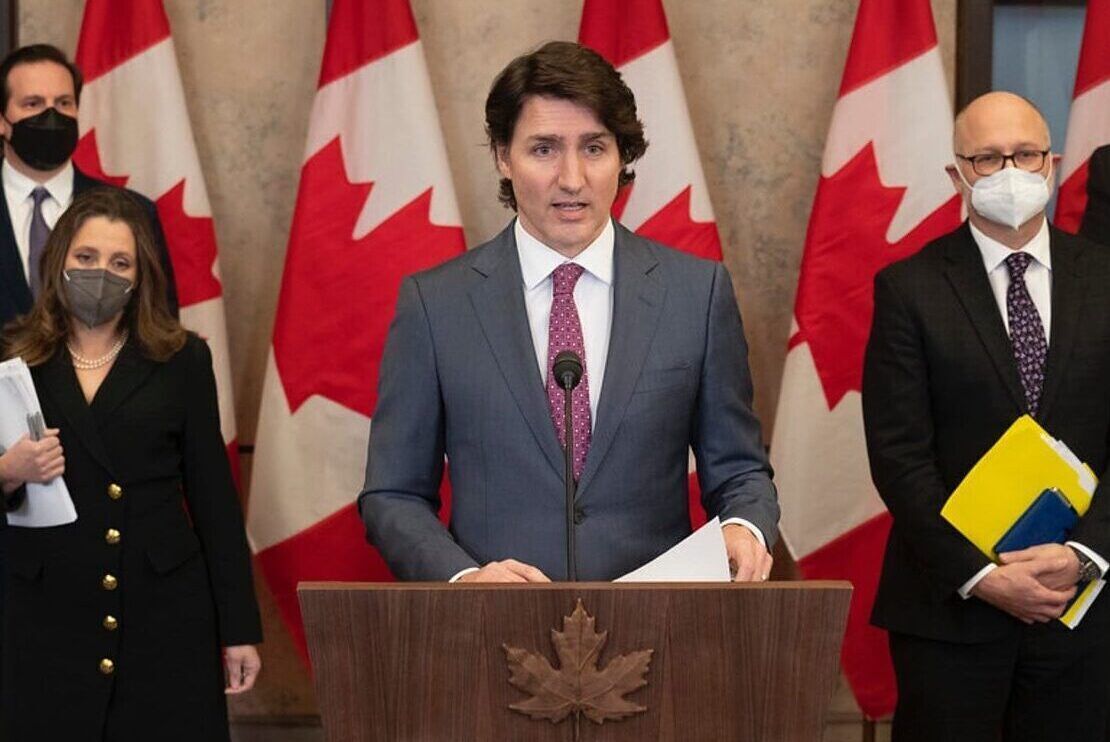
© UnknownPrime Minister Justin Trudeau chose Valentine’s Day 2022 to invoke the Emergencies Act, Canada’s equivalent of marshal law, conferring enormous and normally unlawful powers on the federal government. Meister was arrested four days later, but his legal ordeal would run for well over three exhausting – and expensive – years.
While that is a vastly better result than it could have been and must come as a huge relief to Meister and his friends and family, it should be noted that for him and all the other defendants, the process itself became a severe punishment. For example, when Meister opted to participate in one court appearance via Zoom, the connection was lost and he failed to hear the judge's ruling on an important matter. Accordingly, he ended up travelling from Nova Scotia to Ottawa and back more than a dozen times, at considerable financial expense. Thankfully, his legal fees of over $30,000 were funded by the Justice Centre for Constitutional Freedoms.
In addition, protesters who have endured the stress of a trial and been acquitted have still not always walked free and clear, because the Crown has often insisted on filing appeals. As a result, defence lawyers routinely advise Freedom Convoy protesters that their legal nightmare isn't actually over until an additional 30 days have come and gone. In one instance, the Crown waited until the last afternoon of the last permissible day to file its appeal.
Meister, acquitted on the one charge in May, won't know his own fate until August 25. Until then at least, the legal machinery of the state, like a demented dragon, will continue its years-long pursuit of him.
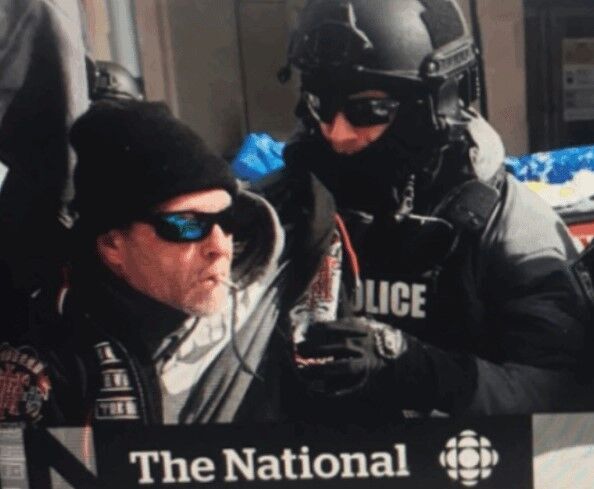
Robert Dinel, a heavy equipment operator from Quyon, Quebec, was arrested at gunpoint and, like Meister, handcuffed, confined for hours in a cramped police trailer and denied his constitutional right to speak to a lawyer. (Source of screenshot: Facebook)
Although Section 10 of the Charter says everyone has the right, upon arrest, "to retain and instruct counsel without delay," video footage confirms that while in the processing trailer on the outskirts of town, Dinel repeatedly told police he was in no fit state to be making decisions and wanted to speak to a lawyer before signing any paperwork. Police officers, who outnumbered him ten-to-one in the trailer, kept pushing paperwork on him, telling him it was just an undertaking that he wouldn't return to the protest area. Dinel, who speaks calmly and is handcuffed throughout, insists, "I want to talk to a lawyer," and, "I want to know what I'm signing." That never happened.
Video also shows Dinel asking for a medical assessment and being tended by a female paramedic for 30 minutes. She advises him, "Your blood pressure's high, which is totally understandable," and urges him to relax and breathe deeply. In a later video, Dinel is seen without handcuffs entering the back of a police cruiser. After a short drive, he later recalled, they "threw me on the side of the road, into the snow, with no phone."
Dinel was charged with mischief and obstructing police. In July 2023 his mother died and, a week later, he suffered the first of what would be four strokes. It had been a stressful year, with numerous court appearances and daily visits to his mother in hospital. During a video interview, Dinel upended a bag of pill bottles and began counting: "This is what I take every day, 12, 13, OK, 15 different medications." One day in court Dinel suffered a medical emergency. "My whole face just seized up," he recalled. "I had another stroke. My whole face drooped, then the judge freaked right out." An ambulance was summoned and Dinel's trial was adjourned. "I hate court," he says. "It's hard, you know. It's stressful, it's exhausting."
After that episode, Dinel had a service dog sit beside him. One day, a spectator in court witnessed Dinel's face turn dark red mid-session. Afraid Dinel was about to experience a cardiac event, the spectator recalls urging him, "Pet the dog, Robert, pet the dog." The trial wrapped up on April 11 of this year, but Justice Matthew Webber isn't scheduled to deliver his verdict until September 4, which means Dinel will have spent five more months in uncertainty.
The record of Canada's legal system clearly shows that mischief charges are routinely withdrawn before scarce and expensive court time is expended on relative trivialities. But when it comes to the truckers, the Crown attorneys at the Ottawa courthouse - employees of the Government of Ontario, not the federal government - appear to have lost all perspective. They are on a mission.
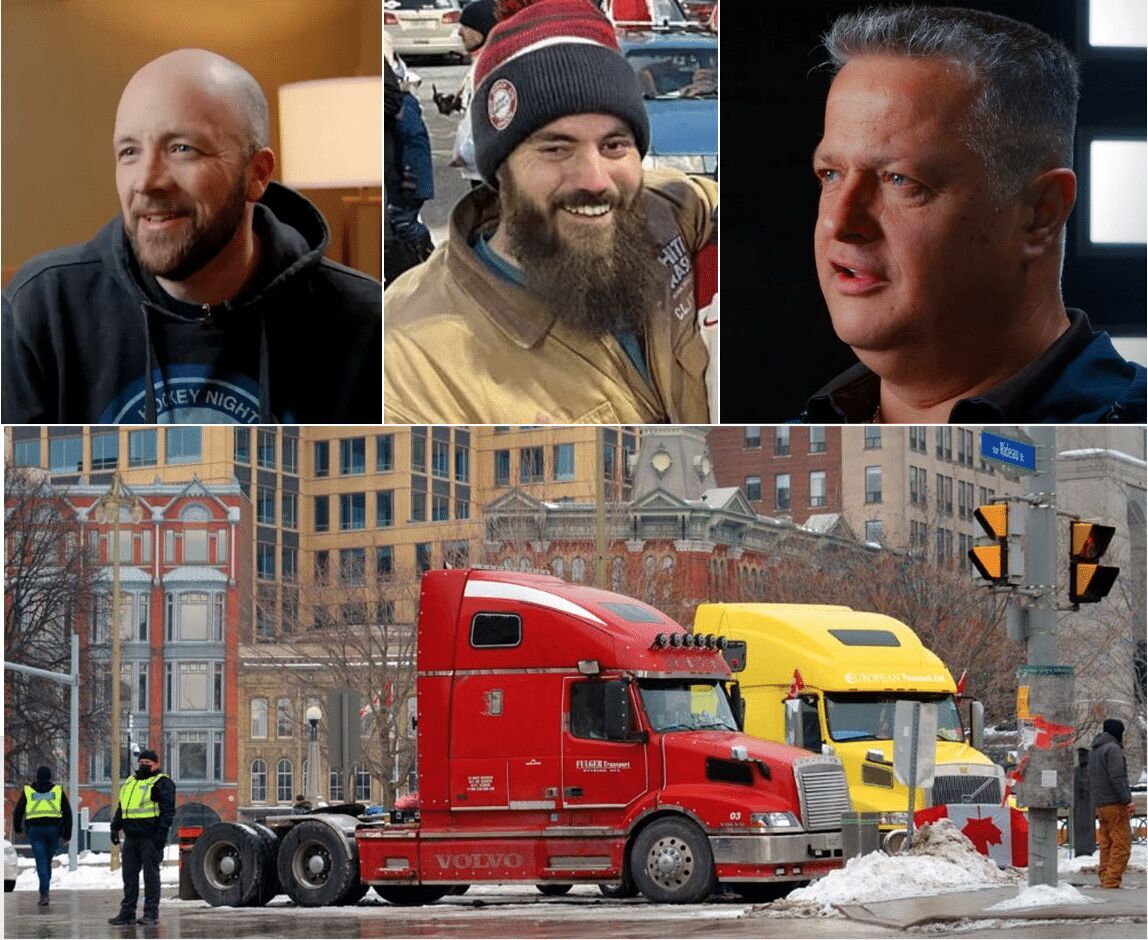
While thousands of serious criminal cases across Canada are dropped merely due to delays, many Convoy-related prosecutions on trivial charges continue more than three-and-a-half years later. The cases of Freedom Convoy truckers (left to right) Bern Bueckert, Clayton McAllister and Csaba Vizi (whose Volvo is shown at bottom) are still not fully resolved. (Sources of photos: (top left and right) screenshots from documentary Unacceptable?; (top middle) ThankYouTruckers.Substack; (bottom) Donna Laframboise)
Clayton McAllister, from London, Ontario, was arrested after passively lying down in the snow in front of a police line in a classic instance of peaceful civil disobedience. Initially, he was offered a plea deal that stipulated six months in jail. Later, that got reduced to two months in jail, then house arrest. In November 2024 he agreed to a one-year peace bond, in addition to writing a 100-word statement on the difference between criminal mischief and peaceful protest.
And on September 8 Windsor, Ontario trucker Csaba Vizi will appear in court for the first time - three years and seven months after he voluntarily exited his truck and knelt down in the snow. (Much of this delay, he admits, is due to difficulties with lawyers hired to defend him.) His assault by multiple police officers during his arrest was broadcast around the world. So far, he has spent $63,000 on legal fees and needs to raise a further $18,000.
Protests and picket lines are one of the few ways
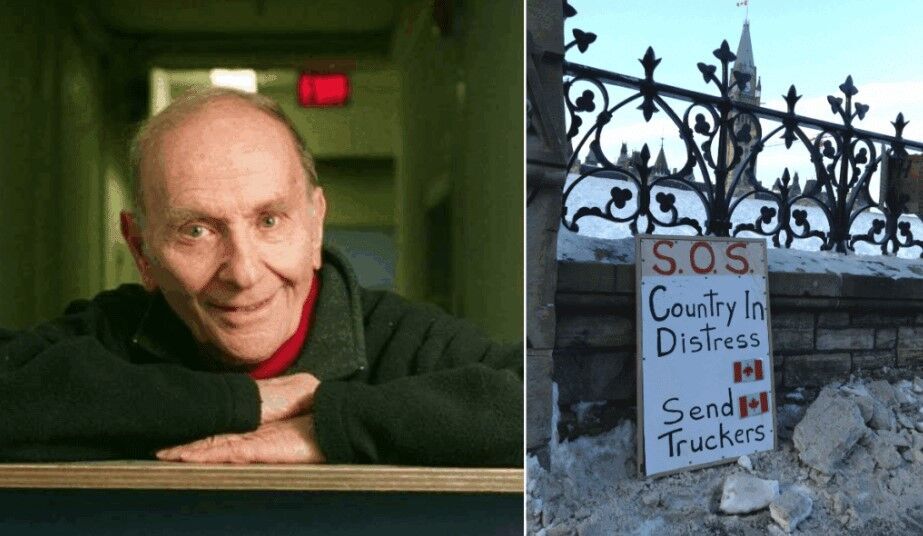
“A necessary weapon of the disadvantaged”: Alan Borovoy, former general counsel of the Canadian Civil Liberties Association, asserts that the right of protest represents a crucial means for the working class to challenge unjust government actions. (Sources of photos: (left) BCCLA; (right) Emilijaknezevic, licensed under CC BY-SA 4.0)
But democratic safeguards collapsed during the pandemic. Smugly, relentlessly, a uniform message was broadcast: obey the government. Trust the experts. Alternative perspectives are misinformation and deserve no platform. But people grow tired of being disrespected and abused. At some point, voices that have been systematically silenced will insist on being heard. As Dinel puts it: "Freedom is like a muscle. If you don't exercise it, you lose it."
Donna Laframboise is an independent journalist and photographer. A former vice-president of the Canadian Civil Liberties Association, she was part of the National Post's founding team, and is the author of five books.
Source of main image: The Canadian Press/Justin Tang.







Comment: May societies around the world will remember these brave truckers and the people who endured freezing winter weather with their fearless support. May people will also never forget the oppressed (humanity itself) and the oppressors that caused this.