

© D Duarte et al/Heriot-Watt UniversityThe 'mud waves' discovered off the coast of Africa, under the Atlantic Ocean, are hundreds of feet high and almost a mile long.
The discovery of buried "mud waves" off the coast of western Africa reveals that the Atlantic Ocean was born at least 4 million years earlier than scientists previously thought.
These waves, each hundreds of feet high and over half a mile (1 kilometer) long, were caused by the mixing of extremely salty water from the southern hemisphere with less-salty water from the northern hemisphere as South America and Africa tore apart 117 million years ago, forming the Atlantic, according to new research published in the June issue of the journal Global and Planetary Change.
Previously, the Atlantic was thought to have finished opening between 113 million and perhaps 72 million years ago.
The giant waves were found in sediment cores drilled from 0.6 mile (1 km) below the seabed about 250 miles (400 km) west of Guinea-Bissau in 1975, as part of the Deep Sea Drilling Project. The ocean-drilling project confirmed that Earth's surface is broken into rafts of ever-moving tectonic plates.
In further studying these cores, Heriot-Watt University geologists Débora Duarte and Uisdean Nicholson found evidence of huge mud waves in this region, which would have been the last spot to pull apart when Africa and South America split.
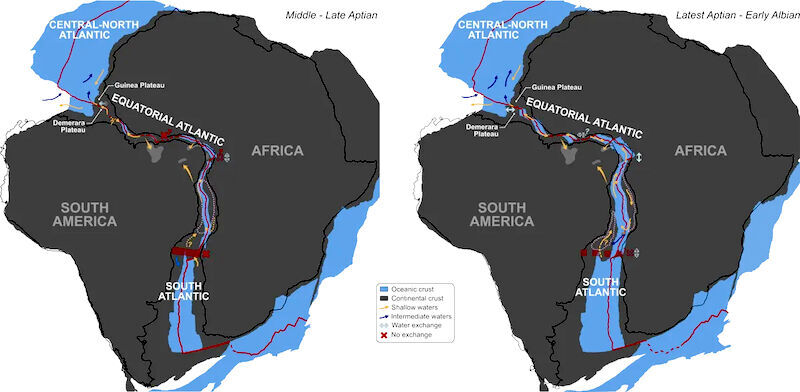
© D. Duarte et al/Heriot-Watt UniversityThe mud waves formed when water from the north and south, with very different salinities, were mixed together following the final split of South America and Africa.
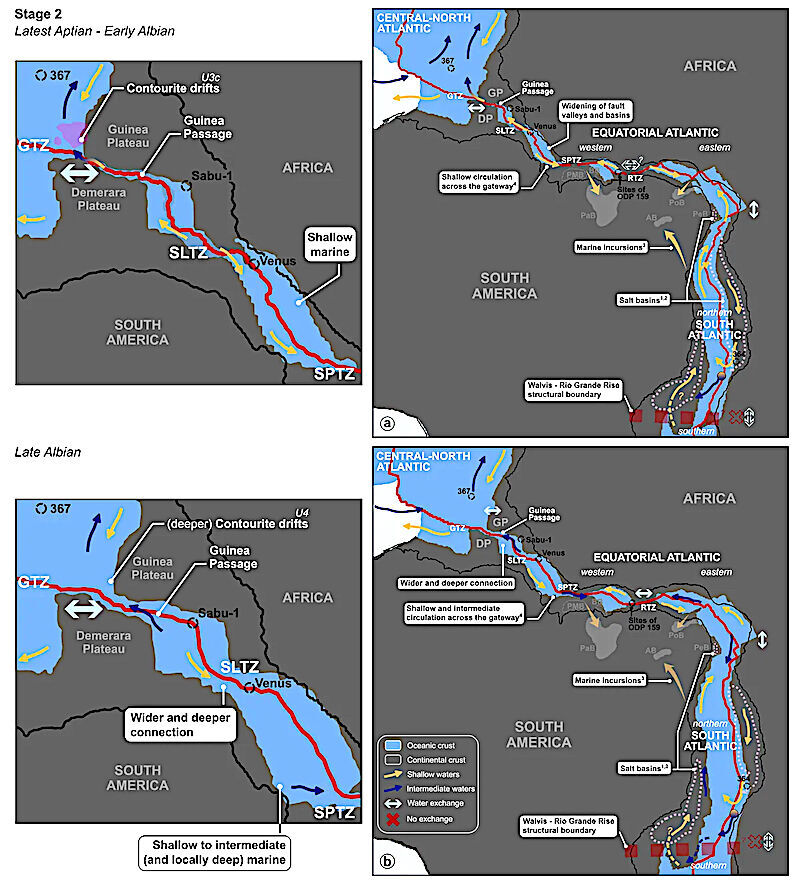
© D Duarte et al/Heriot-Watt UniversityReconstruction of the final stages of the separation of Africa and South America, with a series of basins between the North and South Atlantic.
At that time, the South Atlantic was rich in salt deposits that made its water very saline, while the North Atlantic was less salty. This difference in salinity caused huge currents when the northern and southern Atlantic waters mixed. The currents, in turn, created the enormous mud waves along the seabed.
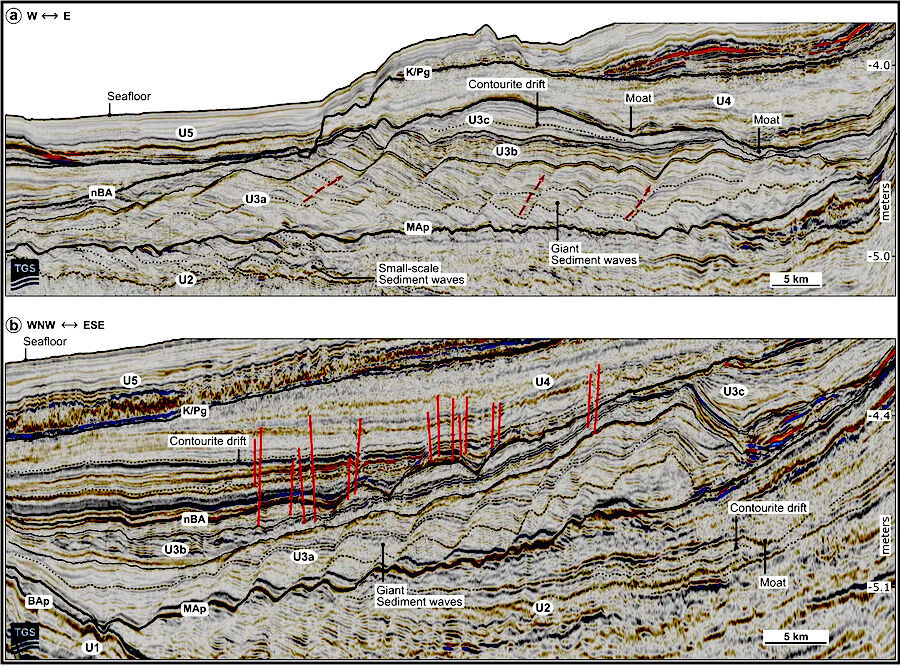
© D Duarte et al/Heriot-Watt UniversityThe mud waves were buried beneath sediment over 117 million years, the researchers found.
The existence of these waves 117 million years ago also suggests that the opening of the Atlantic caused Earth's climate to warm, Duarte said.
The basins that flooded in the final rifting of South America and Africa were rich in carbon, and the birth of the ocean would have made the sequestering of carbon less efficient. This reduced efficiency led to a period of warming between 117 million and 110 million years ago, the researchers said. After that, the ocean currents that circulate throughout the Atlantic stabilized, leading to a period of cooling.
"This shows that the gateway played a really important role in global climate change," Duarte said in the statement.



Reader Comments