
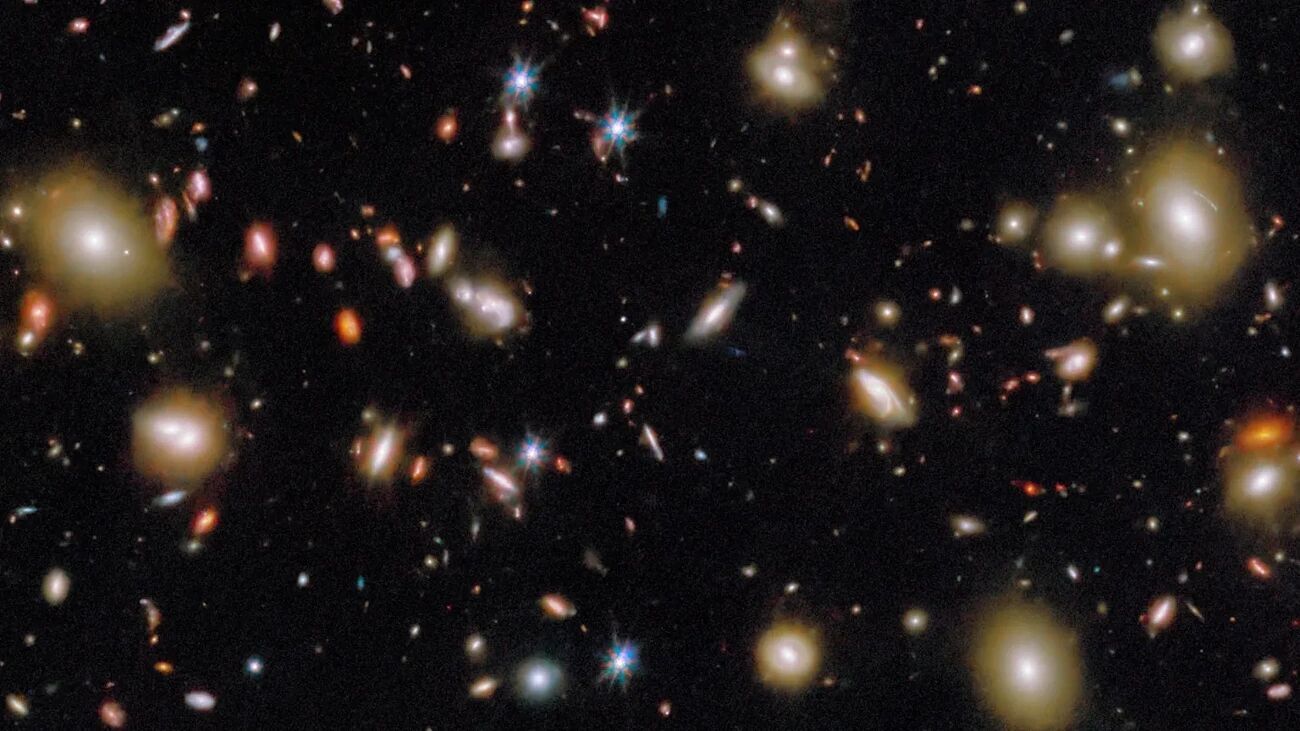
© ESA/Webb, NASA & CSA, G. Gozaliasl, A. Koekemoer, M. Franco, and the COSMOS-Web teamThis deep-field view of the Universe showcases a portion of the COSMOS-Web field acquired with JWST. In this field are a wide variety of galaxies, where the reddest, most dot-like galaxies represent some of the most distant, earliest galaxies ever seen. By examining a large number of galaxies, both dust-rich and dust-poor of a variety of masses, from the first ~1.5 billion years of cosmic history, we've been able to finally understand how galaxies form and grow up in our Universe.
Back when the James Webb Space Telescope (JWST) first opened its eyes on the Universe, there were a number of observations that delighted astronomers. Star-forming regions came into view crisper than ever, revealing gas, dust, knots, and the sites of new stars, protostars, and planets at a deeper level than ever before. Planetary features within our own Solar System appeared sharper than any remote observatory had ever revealed. Features around recently deceased stars showed up in ways we had never seen before, allowing us to view accelerated electrons and heated dust in unprecedented fashions. And galaxies, both near and far, were seen as never before, including from supermassive black hole activity.
But in the ultra-distant Universe, a great surprise awaited. Almost as soon as we began observing galaxies found at the greatest cosmic distances, we discovered that there were more of them than we had anticipated. Not only were there more of them, but specifically the ones that stood out were the:
- brightest,
- highest-mass,
- and most evolved
Many, initially, claimed that this "broke the Universe" or that this "demonstrated the standard model of cosmology was unsalvageable." But JWST didn't break our Universe; it simply revealed it. Now, nearly three years after JWST began its science operations, we finally understand what occurred.
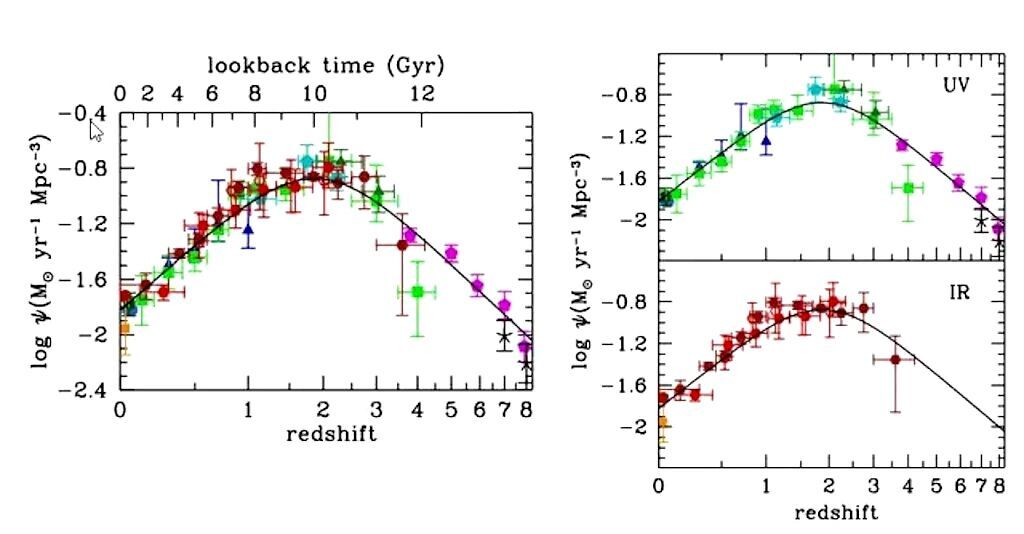
© P. Madau & M. Dickinson, 2014, ARAAThe star-formation rate in the Universe is a function of redshift, which is itself a function of cosmic time. The overall rate, (left) is derived from both ultraviolet and infrared observations, and is remarkably consistent across time and space. Note that star formation, today, is only a few percent of what it was at its peak (between 3-5%), and that the majority of stars were formed in the first ~5 billion years of our cosmic history. Only about ~15% of all stars, at maximum, have formed over the past 4.6 billion years.
As we look to earlier and earlier times, however, we see that the star-formation rate was smaller in the past, and we can measure this remarkably well back to about a redshift of z = 6, corresponding to a time when just under a billion years had elapsed since the onset of the hot Big Bang.
But to look beyond that epoch, to even greater distances and even earlier times, we would have to gather new data, and data from JWST is exactly the type of tool needed to reveal it. The big question was what that curve looked like at the extreme high-redshift, early-time end. Did star-formation:
- continue to fall off, consistent with the previous curve?
- or did it fall off more severely, like something early on suppressed it and it only "rose" once enough time had elapsed?
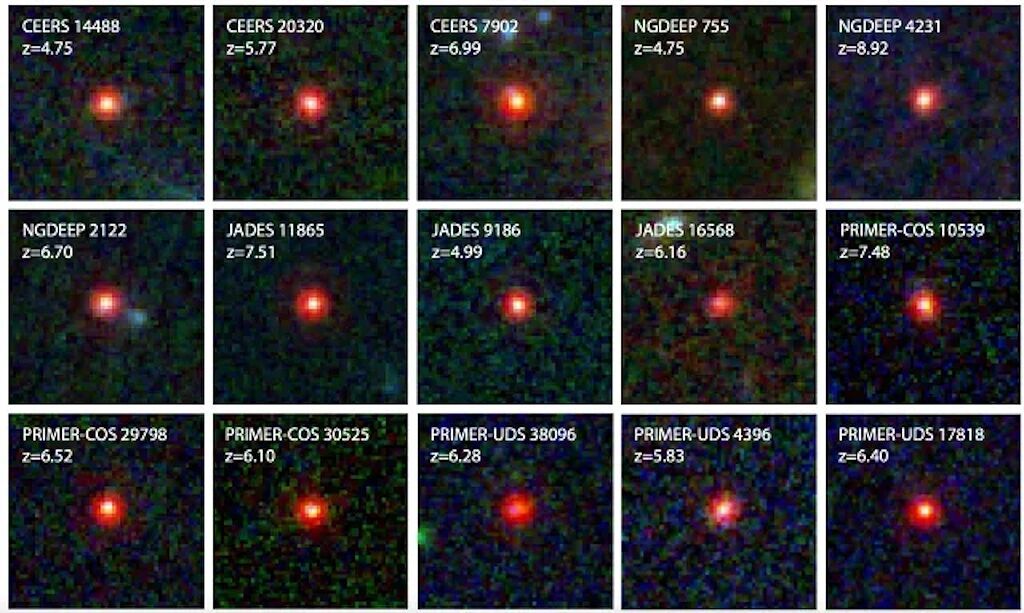
© D. Kocevski et al., Astrophysical Journal Letters accepted/arXiv:2404.03576, 2025This image shows 15 of the 341 hitherto identified "little red dot" galaxies discovered in the distant Universe by JWST. These galaxies all exhibit similar features, but only exist very early on in cosmic history; there are no known examples of such galaxies close by or at late times. All of them are quite massive, but some are compact while others are extended, and some show evidence for AGN activity while others do not.
Of course, we always question our assumptions in light of new, superior data, but we also don't throw out what's already known and established just because we've gotten a surprise. Astronomers got to work attempting to puzzle out exactly what was going on.
Almost immediately, it was discovered that part of the reason there were more bright galaxies at great distances than we anticipated was because of JWST itself. Clean room technology, used by NASA and Northrop Grumman in the construction and testing of JWST, had advanced so significantly that the optical systems of JWST were kept cleaner than anyone could've anticipated. Many "cleaning" technologies that were developed turned out to be superfluous and unnecessary. JWST was kept so clean that it exhibited what astronomers called an "optical overperformance," basically keeping and maintaining more light, from the moment it hit the primary mirror to the moment it was analyzed by JWST's instruments, than scientists had realized.
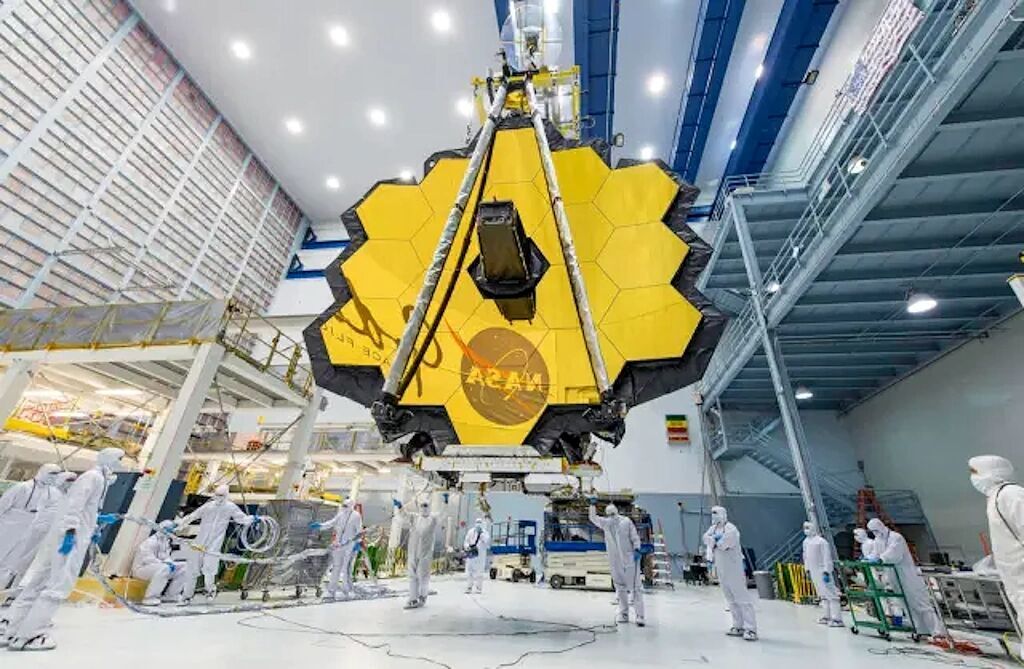
© NASA/Desiree StoverShown during an inspection in the clean room in Greenbelt, Maryland in late 2021, NASA's James Webb Space Telescope was photographed at the moment of completion. Only weeks later, it would successfully launch and deploy, leading to an unprecedented set of advances in astronomy. From mirrors to instruments, it was kept cleaner, from start to finish, than any observatory ever.
Shortly thereafter, people began taking a look at the simulations that had been run to predict the abundance of these bright, early galaxies. What they found was a little surprising. The simulations that were run on the largest cosmic scales were only at medium resolution, not at very high resolution, which meant that a certain class of region was omitted: the regions that began with the highest initial densities on the smallest of cosmic scales, or what they called "rarepeak" regions. There are only a few of these regions with extreme initial overdensities, but because they start out with the greatest densities, they attract additional matter into them more efficiently than any other similar region of space.
When that was accounted for, it helped us understand that these bright, early galaxies really should be more abundant than we had previously realized: by another factor of a few. (More than a factor of 2, but less than a factor of 10.) This was another important piece of the puzzle, but even when combined with the knowledge of JWST's cleanliness, it still couldn't account for the extreme abundance of these "little red dot" galaxies in full.
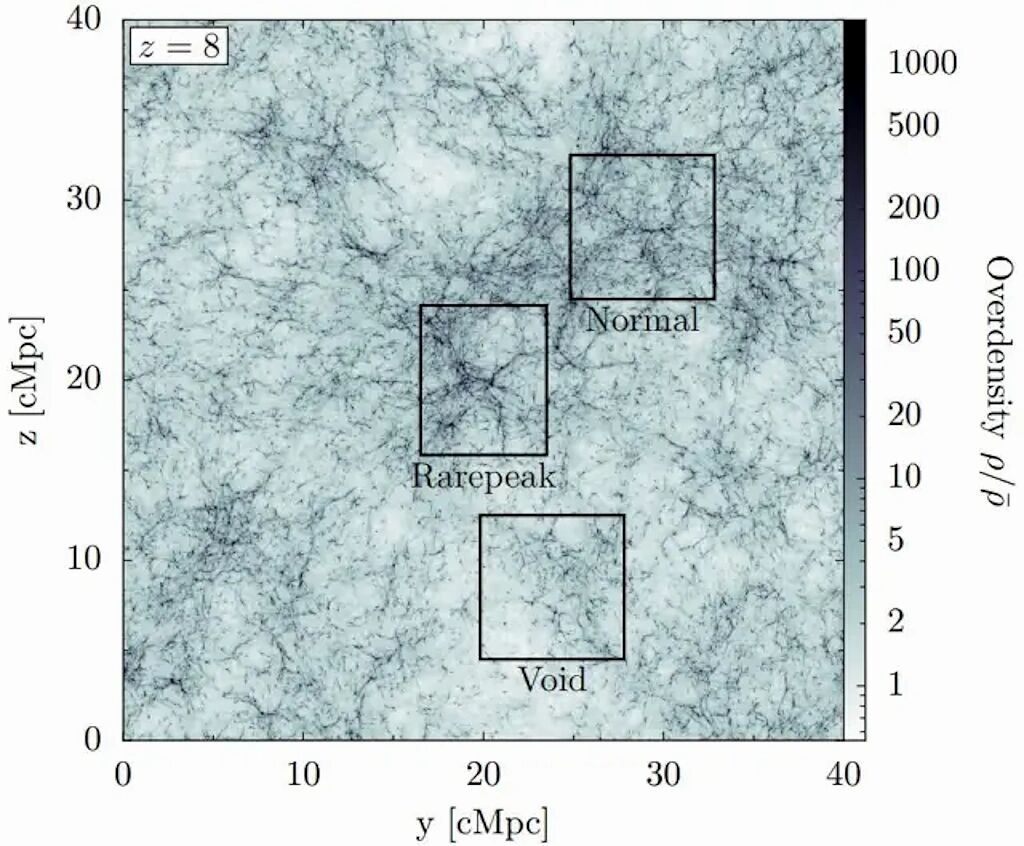
© J. McCaffrey et al., Open Journal of Astrophysics (submitted), 2023Regions born with a typical, or "normal" overdensity, will grow to have rich structures in them, while underdense "void" regions will have less structure. However, early, small-scale structure is dominated by the most highly peaked regions in density (labeled "rarepeak" here), which grow the largest the fastest, and are only visible in detail to the highest resolution simulations.
That would require a careful survey and analysis of the properties of these galaxies that we were seeing. That meant looking at the ultra-distant little red dot galaxies, the analogous ones at less severe distances, and the populations of other galaxies we were finding: faint ones, closer ones, more evolved ones, etc. There was something, clearly, going on with these ultra-distant galaxies, but in order to untangle the full context of what was at play, we'd have to not just examine the ones we were newly seeing, but we'd need to compare them with the more abundant, closer, later-time galaxies that were more familiar to us.
One important contribution was recognized in late 2023: the fact that star-formation didn't occur in the way that most astronomers naively assumed. There's a maximum rate at which astrophysical processes can sustainably occur in the Universe, from black hole growth to stellar luminosities to galactic star-formation rates: the Eddington rate. We had assumed that galaxies would form new stars continuously at this rate and no higher, and that the cumulative amount of stars formed within a galaxy would be reflected by whatever galaxy we observed at whatever time we observed it.
But this isn't how actual galaxies work: they form stars in punctuated, often super-Eddington bursts known as starbursts. While today, starbursts mostly occur in small regions of galaxies during galactic mergers, early on, entire galaxies frequently undergo starbursts, and only for brief amounts of time at that.
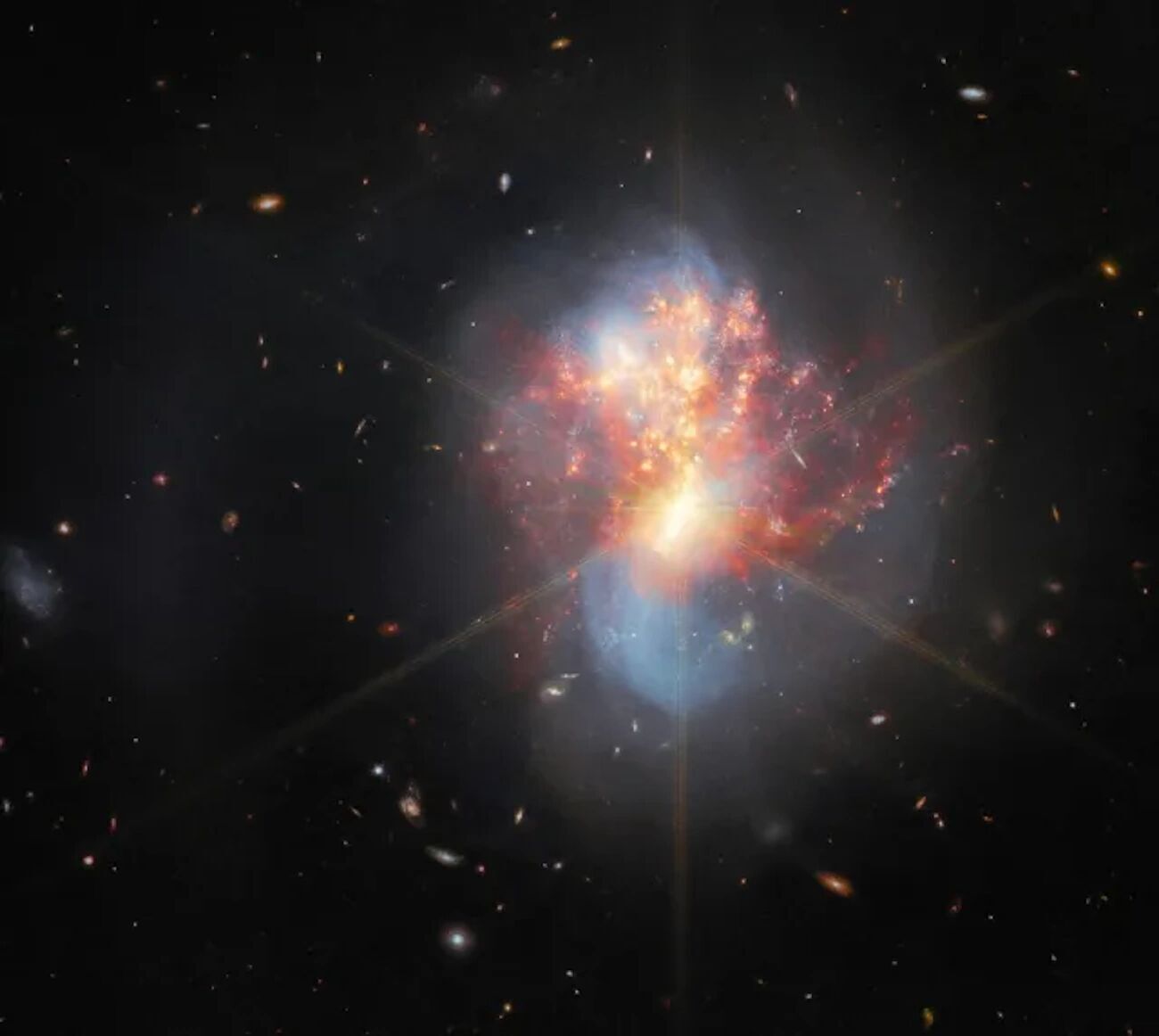
© ESA/Webb, NASA & CSA, L. Armus & A. Evans; Acknowledgement: R. ColombariThe pair of interacting galaxies in the process of a merger, known as IC 1623, is imaged here by JWST. Data from a trio of JWST's instruments, MIRI, NIRSpec, and NIRCam, were used in the construction of this image. The ongoing starburst at the center produces intense infrared emissions. In galaxies in the early Universe, the entire galaxy itself can undergo a starburst, where stars form all at once over the entirety of a galaxy, albeit only for a brief period of time.
Then, at last, in August of 2024, scientists from the CEERS (Cosmic Evolution Early Release Science) team identified a fourth contributor: light that's emitted in a burst not from stars, but from active supermassive black holes found at the centers of these galaxies. Today, supermassive black holes comprise no more than about 0.1% of the total stellar mass (i.e., the total amount of mass found in the form of stars) within a galaxy. But early on, as previous JWST observations revealed, black holes can be ~1%, ~10%, or even ~100% as massive as their host galaxy's stellar mass. In other words, they can be "overmassive" for the galaxies that house them, and as a result, overluminous as well.
These overmassive, active black holes are transient — i.e., they only shine very brightly for a short while — but while they are active, they consume gas from their surroundings and heat it up by a remarkable amount. That now-heated gas can then emit infrared, visible, ultraviolet, and even X-ray light. It was only by accounting for the contributions of active supermassive black holes in many of these little red dot galaxies that, at last, the early galaxies we were seeing finally made sense in the context of the JWST era.
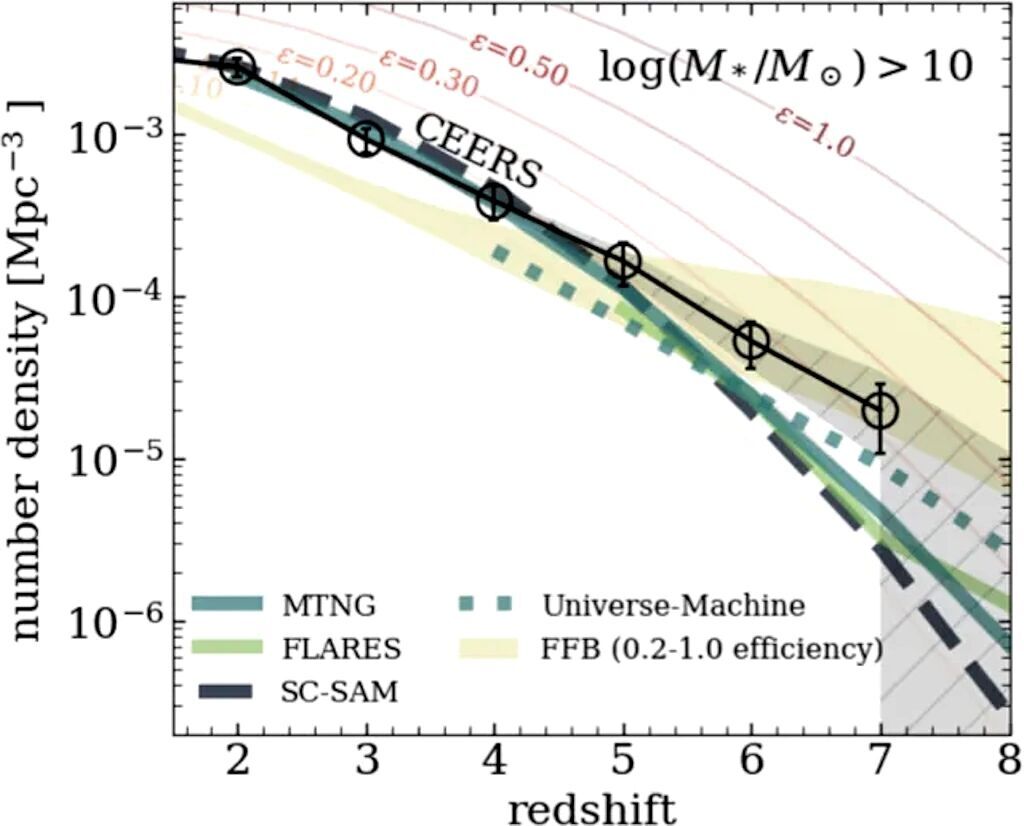
© K. Chworowsky et al., Astronomical Journal, 2024When the light from not just stars, but also from the central, supermassive black hole is also included, the additional brightness over what's expected from these early galaxies can finally be explained. This additional piece of information can explain the observed abundances of these little red dot galaxies, but not their nature; that remained a problem that would need to be addressed by future research.
- JWST's optical overperformance,
- an underestimate of the galaxies formed from the greatest seed overdensities,
- the fact that star-formation is bursty rather than continuous,
- and the fact that many of these little red dot galaxies are brightness-enhanced not by their stars, but from the activity of their central black holes.
But the new puzzle that arose was significant. What we're seeing in the JWST era is that these little red dot galaxies fall into two populations:
- a population that's extremely low in dust attenuation, that are bright largely because of bursty star-formation happening inside and that appear more point-like,
- and a population that's more dust-rich, that are bright largely because of supermassive black hole activity, and that appear to be more extended in the sky and less point-like.
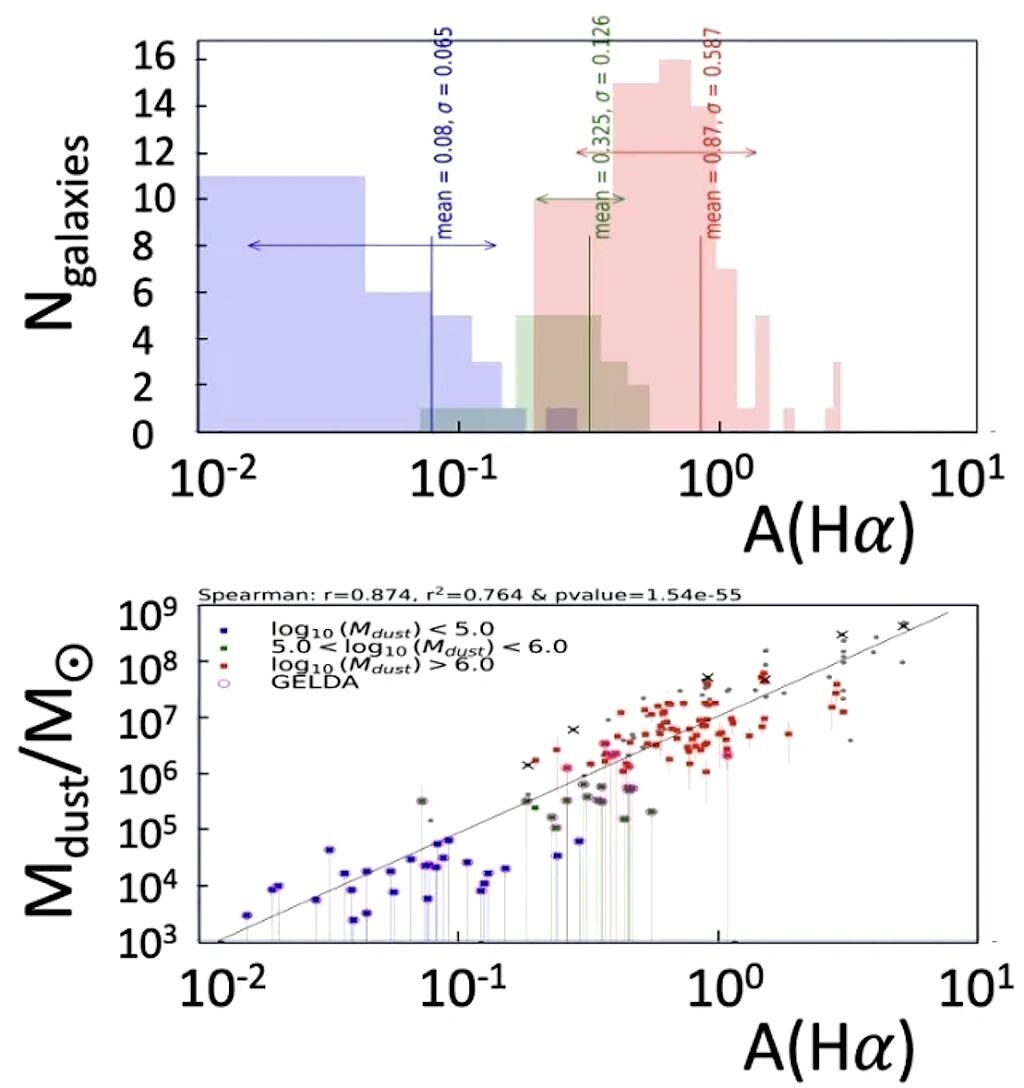
© D. Burgarella et al., Astronomy & Astrophysics accepted/arXiv:2504.13118v2, 2025Galaxies can be sorted by the amount of dust compared to the amount of stellar mass present as a function of the strength of their Balmer-series emission lines. What we find is that there are multiple populations: low-dust (blue points) galaxies and high-dust (red points) galaxies, where the larger amounts of dust are predominantly found at later times and the dust-poor ones are largely found at earlier times.
What we have to remember is that the Universe wasn't born with any dust at all; dust requires the existence of heavy elements (carbon, oxygen, silicon, etc.), and those elements are only formed once stars have already formed. Sure, the galaxies we're seeing have all formed stars before, but we need a sufficient number of generations of stars to live, die, and have their dust transported from the region around where those stars live-and-die to the interstellar medium.
What the scientists working with these early JWST galaxies found, quite remarkably, is that the low-dust galaxies, which the researchers call GELDAs (for Galaxies with spectroscopically-derived Extremely Low Dust Attenuation), represent a whopping 83% of all galaxies found at times earlier than 550 million years, but only ~26% of galaxies found from between 550 million and 1.5 billion years.
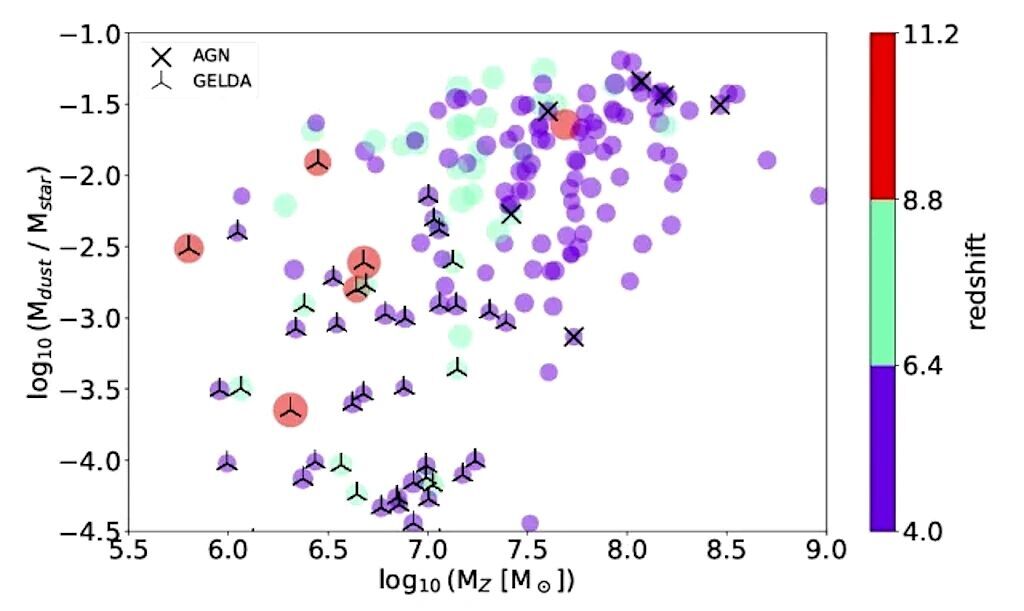
© D. Burgarella et al., Astronomy & Astrophysics accepted/arXiv:2504.13118v2, 2025This plot shows galaxies from the first ~1.5 billion years of cosmic history, color-coded by redshift and plotted by their metallicity (x-axis) as a function of the dust-to-stellar mass ratios (y-axis) found within them. The majority of low-metallicity galaxies are also dust-poor and are known as GELDAs, dominating the very early Universe, while later-time, more dust-rich galaxies are much more enriched in heavy elements.
- are powered by active supermassive black holes,
- have much higher metallicities (are richer in heavy elements),
- and primarily (but not exclusively) appear at later cosmic times.
When stars first form, they don't have any dust surrounding them: just neutral atoms, mostly hydrogen and helium. The first few generations of stars form, live-and-die, and produce the first signs of cosmic dust: stellar dust production. It isn't until more than 100 million solar masses worth of stars are produced, however, that the amount of stellar dust produced becomes able to start building up and growing dust grains in the interstellar medium, meaning that those galaxies with only small amounts of stellar mass will be relatively dust-free, and are represented by these GELDA galaxies: galaxies seen predominantly over the first ~550 million years of cosmic history, but that are also present (as a much smaller fraction of the total number of galaxies seen) over the next ~1 billion years as well.
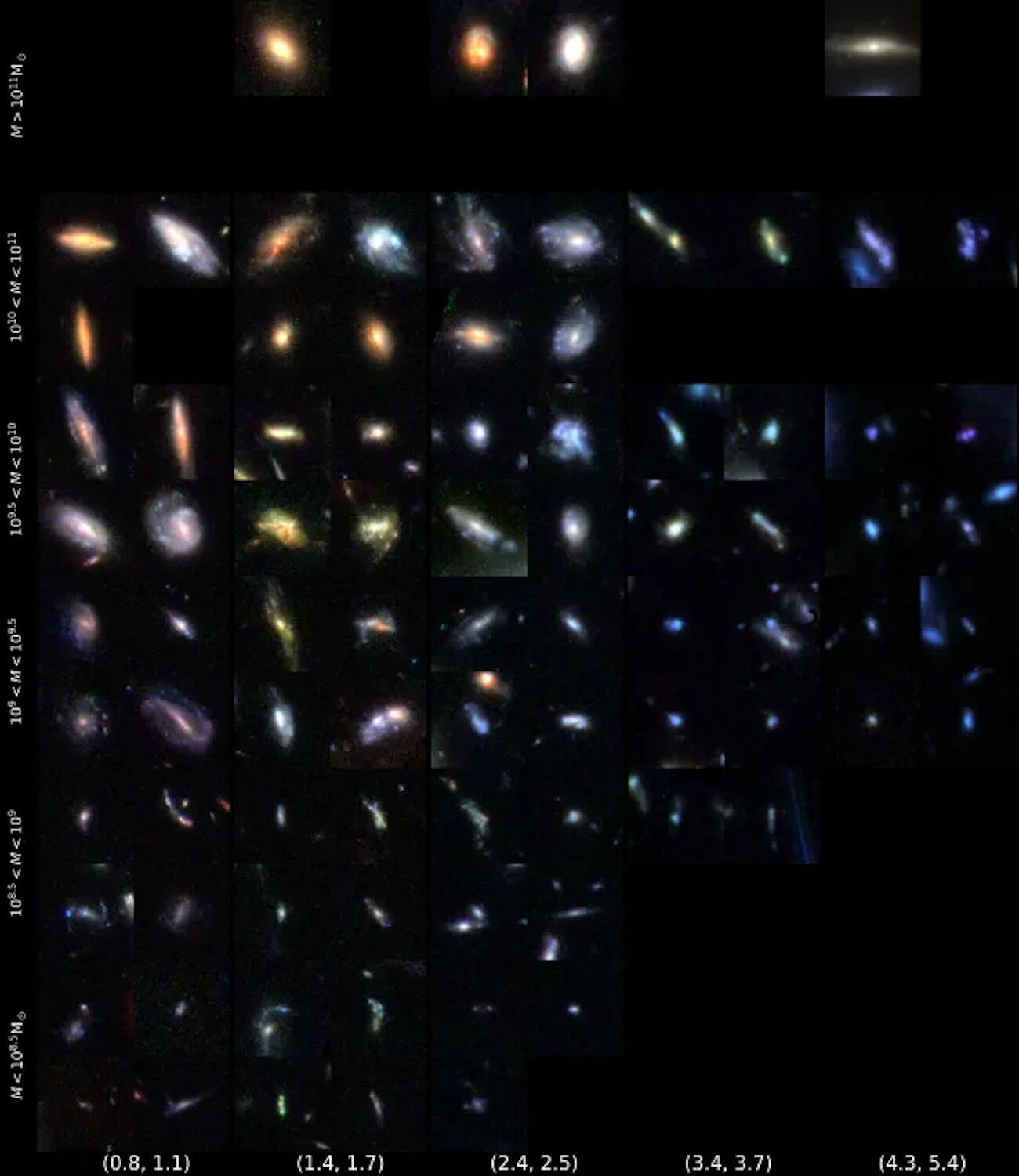
© C. Jacobs, K. Glazebrook et al., arXiv:2208.06516, 2022The early results of the GLASS Early Release Science program reveal over 200 sources that span a variety of ranges in redshift and mass. This helps teach us what shapes galaxies take on over a range of masses and stages in cosmic time/evolution, revealing a number of very massive, very early, yet very evolved-looking galaxies. The lowest-mass galaxies at the greatest redshifts/distances represent a relatively unique population that was unknown prior to the onset of the JWST era.
This, for the first time, suggests a complete end-to-end picture for how galaxies form and grow up in the Universe. You start dust-free and star-free; the first ~100 million stellar masses worth of stars that you form make heavy elements and begin stellar dust production, however long it takes to get there. This "stage" represents most very early galaxies, and may explain the origin of the excess of bright, early galaxies spotted by JWST. Once you form more stars than that, however, dust grains begin forming and growing copiously in the interstellar mediums of these galaxies, marking the transition to the modern, late-time galaxies we're more familiar with, including most active galactic nuclei (AGN) containing galaxies.
There are still, somehow, people writing papers promoting alternative cosmologies based on the assertion that JWST's early galaxies broke the Universe, and did so irreparably. But JWST didn't break the Universe; it simply revealed it as it's always been. Now that we're seeing it, it's up to us to do our science properly, enabling us to make sense of all that's out there.
Ethan Siegel acknowledges Dr. Steve Finkelstein's plenary talk at the 246th meeting of the American Astronomical Society as an invaluable synthesis of information, enabling this article to be written.



However...
When I was young, I studied magic, misdirection and human psychology, intensely. Seems like the physicists of today studied it even more intensely than the young 'me'.
The question remaining from all cosmological and physics conclusions/discoveries (and still never asked publicly to this day) is: "What came 'before' that?", with before indicating ' sequentially ', not as a reference to time. Said differently, there is no physics that is philosophy-free. 'They' don't want to talk about that. Their answer always is: "Since we can't measure it, there is no there there."
Come on guys, up your game. The correct answer is right in front of you, but it is mind boggling, and yet does not require any belief in anything.
Hmm...