
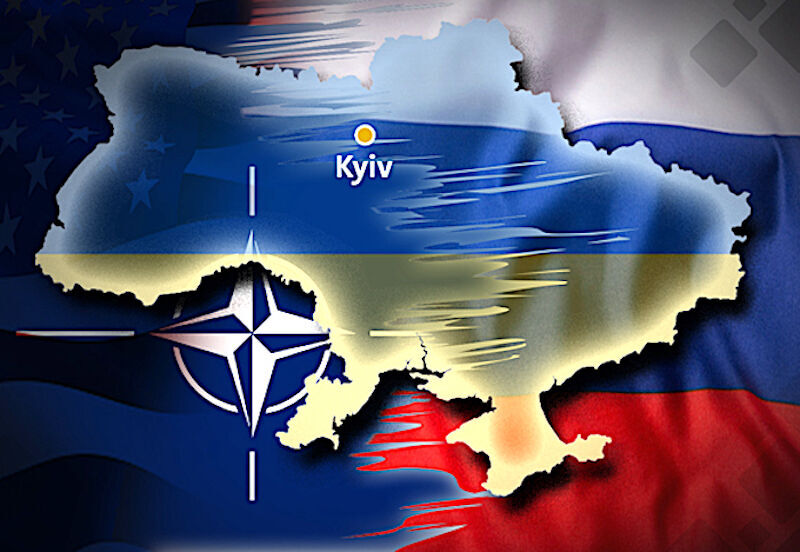
© dohainstitute.orgRussia • Ukraine • NATO
This week, I take up the same elements, and many others that followed, to show that the divorce of Europeans from each other and of the EU from the United States has become a reality.
There is no more time to procrastinate: the old world has just been destroyed. If we do not position ourselves immediately, we will be swept away with it. However, for the moment, the United Kingdom and France are competing to take the place of the United States on the continent and not to reform themselves.
The last two weeks have seen a turning point in history comparable to the Battle of Berlin in April-May 1945, when the Red Army took Berlin and overthrew the Third Reich: this time, it is the Trump administration that has definitively sent the European Union back to the ropes.
So far, the EU, the G7 and the G20 have not been dissolved, but these three structures are already dead. The World Bank and the United Nations could follow.
Let us look back at these events, which happened so quickly that almost none of us followed them and understood their consequences.
Wednesday February 12
The major European powers (i.e., Germany, Spain, France, Italy, Poland, the United Kingdom, and the European Union), who were afraid of what the Trump administration might decide, met in Paris on February 12 to develop a common position on the Ukraine conflict. In this case, they agreed to continue what they have been doing for three years:
- deny having violated the commitments made during German reunification not to extend NATO to the East,
- deny that Ukraine is in the hands of "integral nationalists" (i.e. the party of Nazi collaborators)
- and continue World War II, no longer against the Nazis, but against the Russians.
Meanwhile, in Kyiv, Treasury Secretary Scott Bessent presented the bill for US aid: $500 billion and proposed to pay it by exploiting the rare earths that the country prides itself on. I have already explained that this proposal was just a tit for tat response: Ukraine had falsely claimed to offer, in the long term, to the West to exploit these riches that do not exist. However, from a European point of view, what was being plotted was frightening: if the United States seized these supposed riches, they excluded the Europeans from benefiting from the sharing they had agreed upon. Without informing their fellow citizens, they had divided up Ukraine during its reconstruction: to the British, the ports, to the Germans, the mines, etc. They had already done this during the invasions of Iraq and Libya and during the war against Syria.
Above all, while Washington and Moscow were exchanging prisoners, the presidents of the United States, Donald Trump, and Russia, Vladimir Putin, spoke by telephone for an hour and a half. This summit had been preceded by a conversation, in the Kremlin, between President Putin and Steve Wilkoff, President Trump's special envoy who had come to organize the prisoner exchange. Wilkoff had given his president a report on his mission that debunked everything NATO claimed to know about Ukraine.
The two bosses now had the same information.
The direct line between the White House and the Kremlin had just been reestablished.
Thursday February 14
On February 14, US Vice President JD Vance addressed the EU's diplomatic and military elite at the Munich Security Conference. He indicted the autism of European leaders: They refuse to address their citizens' concerns about freedom of expression and immigration. But if they are afraid of their people, the United States will not be able to do anything for them, he said, bringing the conference chairman, German Ambassador Christoph Heusgen, to tears.
Monday February 17
A second meeting was held on 17 February, also in Paris, with the same participants, plus Ursula von der Leyen, President of the European Commission, and Mark Rutte, Secretary General of NATO. They agreed to stand together against Donald Trump and not to accept any questioning of Western policy towards Russia.
Olaf Scholz, the outgoing German chancellor, said after the summit:
"There must be no division of security and responsibility between Europe and the United States. NATO is based on the fact that we always act together and share the risks [...]. This must not be called into question."Donald Tusk, Polish Prime Minister, said:
"No matter what each of us may say to each other, sometimes with brutal words [...], there is no reason why the Allies should not find a common language among themselves on the most important issues. [It is] in the interest of Europe and the United States to cooperate as closely as possible."Also on 17 February, the Ukrainian army attacked US, Israeli and Italian interests in Russia. It bombed facilities partially owned by Chevron (15%), ExxonMobil (7.5%) and ENI (2%). About twenty drones caused serious damage to the Caspian Pipeline Consortium (CPC), which supplies Israel with Russian oil.
The Europeans did not react to this operation any more than when the CIA sabotaged the Nord Stream gas pipeline (26 September 2022), which is owned not only by the Russian Gazprom (50%), but also by the Germans BASF/Wintershall and Uniper, the French Engie, the Austrian OMV and the British Royal Dutch Shell. This sabotage threw Germany into an economic recession, which continues to have a knock-on effect on the rest of the EU, not to mention the increase in energy prices for all EU households.
In both cases (the Nord Stream sabotage and the CPC attack), the Europeans were unable to defend their interests. They successively let their main ally harm them, and then their allies fight against each other.
Tuesday February 18
The European powers learned with astonishment that, at their first meeting in Riyadh (Saudi Arabia) on February 18, the US and Russian delegations agreed:
- to denazify and neutralize Ukraine,
- to respect the commitments made during German reunification, and
- to withdraw NATO troops from all countries that joined the Atlantic Alliance after 1990.
President Trump had suddenly abandoned the plan of General Keith Kellogg, his special envoy for Ukraine, as published in April 2024 by the America First Foundation. Instead, he used the plan of his friend Steve Witkoff, special envoy for the Middle East, who had met Vladimir Putin in Moscow through the Saudi Crown Prince Mohammed bin Salman (known as "MBS"), hence the choice of Riyadh for these negotiations. Kellogg reasoned with NATO ideas, while Witkoff listened, heard and verified the validity of the Russian position.
The European powers were quickly able to verify that the order to withdraw had been transmitted to some US troops in the Baltic countries and in Poland. The security architecture in Europe, that is to say the system ensuring peace, was destroyed. Of course, there is no immediate threat of invasion, Russian or Chinese, but in the long term and given the time required for rearmament, everyone must, immediately, prepare for the best or the worst.
Wednesday February 19
On 19 February, EU ambassadors approved the 16th package of unilateral coercive measures against Russia (misleadingly called "sanctions" by Atlantic propaganda). It was to be officially approved on 24 February by the Foreign Affairs Council on the occasion of the third anniversary of the Russian special military operation in Ukraine. In addition, the EU decided to disconnect 13 banks from the Swift system and to ban three financial institutions from trading. In addition, 73 ships of the Russian "ghost fleet" were sanctioned, and 11 Russian ports and airports that circumvent the oil price cap were banned from trading. Finally, 8 Russian media outlets also had their broadcasting licenses in the EU suspended.
Meanwhile, on the same day, February 19, President Donald Trump vented his anger at his unelected Ukrainian counterpart, calling him a "modestly successful comedian" and an "unelected dictator," and then accusing him of provoking the war. Meanwhile, General Kellogg, the White House's special envoy to Kiev, canceled his press conference with Volodymyr Zelensky.
The Trump administration had broken with the Kiev government that the Biden administration had praised to the skies.
Thursday February 20
Libertarian Senator Mike Lee (Utah) introduced a bill in the Senate on February 20 to completely withdraw the United States from the United Nations. Representative Chip Roy (Texas) introduced the same bill in the House of Representatives the following day.
If President Donald Trump is a "Jacksonian" (i.e. a disciple of Andrew Jackson, who wanted to replace war with business), Washington is now committed to "American exceptionalism." This is a political theology according to which the United States is a chosen people who must bring the light they have received to the rest of the world. As a result, they do not have to negotiate anything with others and especially not be accountable to them.
"American exceptionalism" should not be confused with the "isolationism" that led the Senate to refuse to join the League of Nations in 1920. This organization, unlike the UN that succeeded it, had provided for military solidarity between states that recognized international law. Consequently, the United States would have had to maintain troops to maintain peace in Europe and the Europeans could have intervened in Latin America (Washington's "backyard" according to the "Monroe Doctrine") to maintain peace there.
Saturday February 22
Without waiting, Polish President Andrzej Duda went to Washington uninvited on February 22. He managed to meet President Donald Trump for ten minutes, not at the White House, but on the sidelines of the Conservative Political Action Conference (CPAC). He asked him not to withdraw US troops from his country, giving Poland time to complete its military restructuring. Since Warsaw has already initiated a profound internal revolution by reestablishing universal military service and building a very large army, he managed to get him to, not cancel, but postpone his order.
Andrzej Duda is the Polish president, at least until the May elections. Constitutionally, he does not exercise executive power, but he is nonetheless the head of the armed forces. His Prime Minister, Donald Tusk, had promised in Paris not to negotiate separately with the United States.
So, whatever anyone says, the united front of the Europeans was broken. It had lasted only ten days.
Monday February 24
On the third anniversary of the Russian special military operation in Ukraine, on 24 February, Roberta Metsola, President of the European Parliament, António Costa, President of the European Council and Ursula von der Leyen, President of the European Commission, issued a completely out-of-place joint statement. In it, they called for "a comprehensive, just and lasting peace based on the Ukrainian peace formula", meaning they stuck to the old narrative: there are no Nazis in Ukraine and Russia is the aggressor. In doing so, they contradicted not only the facts, but also the recent statements of their economic and military overlord, the United States.
On the same day, French President Emmanuel Macron traveled to Washington, on behalf of all Atlanticist Europeans. Before receiving him, President Donald Trump had his chief of staff drive him to a wing of the White House to participate in a G7 video conference that he was chairing... from another room.
For two hours, the heads of state and government of the G7, plus the Spanish Prime Minister and the unelected Ukrainian President, tried in vain to make their overlord give in. He would not budge: the Ukrainian conflict was not started by Russia, but by the Ukrainian fundamentalist nationalists hiding behind Zelensky alone. In any case, as a matter of principle, it is not possible to defend people who have just attacked US interests, even if they are located in Russia. To make himself clearly understood, Donald Trump refused to sign the final communiqué prepared by the Europeans and announced to them that, if this text were published (it had already been distributed under embargo to journalists), he would deny it and his country would leave the G7 .
It was only after this scandal that he received President Emmanuel Macron. The latter chose not to confront him, but to celebrate transatlantic friendship. At the joint press conference, he interrupted his host when the latter repeated that Ukraine, not Russia, had provoked the war, but ultimately he did not dare contradict him.
Meanwhile, in New York, the UN General Assembly was debating a resolution proposed by Ukraine. It denounced the "full-scale invasion of Ukraine by the Russian Federation" and demanded that it "immediately, completely and unconditionally withdraw all its military forces from the territory of Ukraine within the internationally recognized borders of the country and immediately cease hostilities by the Russian Federation against Ukraine, in particular all attacks against civilians and civilian objects."
For the first time in history since World War II, the US delegation voted against a text, along with Russia, and against those of Canada, the Europeans and Japan, who approved it.
Then, the United States itself presented a second resolution calling for "an end to the conflict as soon as possible." This text aimed to align the General Assembly with the position of the US negotiators in Riyadh. But Russia voted against it because the text "advocates for lasting peace between Ukraine and the Russian Federation" and not for "lasting peace within Ukraine." As a result, the United States, considering that it had poorly drafted its proposal, abstained on its own text, while Canada, the Europeans and Japan condemned it.
Tuesday February 25
Kaja Kallas, the EU's High Representative for Foreign Affairs and Security Policy, travelled to Washington to meet with Secretary of State Marco Rubio. The meeting, which had been announced for a long time, was cancelled at the last minute by Mr Rubio's secretariat, officially due to his overbooked schedule. Kallas said that instead she would meet "with senators and (...) members of Congress to discuss Russia's war against Ukraine and transatlantic relations".
After EU members voted against the US at the UN, the Secretary of State refused to meet his European counterpart.
Wednesday February 26
At a press conference in kyiv, Volodymyr Zelensky assured on February 26 that without security guarantees from the United States and NATO, any peace agreement will be unfair and there will be no real ceasefire.
Thursday February 27
Before leaving Washington, Kaja Kallas, the EU's High Representative for Foreign Affairs and Security Policy, gave a lecture at the Hudson Institute on February 27. She said: "We need to put pressure on Russia so that it also wants peace. It is in a position where it does not want peace."
British Prime Minister Keir Starmer, meanwhile, travelled to the White House, bearing an invitation from King Charles III for a second state visit to the United Kingdom. Her Majesty's diplomats believe that President Trump greatly enjoyed the first one and that, given his pride, he would be sensitive to the pomp of the Crown.
During the two leaders' press conference, President Trump claimed not to remember calling Volodymyr Zelensky a "dictator" ("Did I say that? I can't believe I said it!"). He also expressed openness to the idea that the 25% tariff hike would not apply to the UK and to London returning the Chagos Islands (including the Diego Garcia base) to Mauritius.
On the substance, Keir Starmer has managed to renew his country's "special relationship" with the United States . This includes the "Five Eyes" global interception and espionage system and the delegation of the strike force (remember that the British atomic bomb could not work without the support of US military scientists).
Meanwhile, US and Russian negotiators met for six and a half hours at the US Consulate General in Istanbul for a second round of negotiations, at a "technical level". The aim was not to advance on the substance, but to resolve issues that had been addressed by the ministers in Riyadh. Namely, the operating conditions of the respective embassies in Washington and Moscow, which President Joe Biden had significantly regulated and to which Moscow had responded in kind.
Friday February 28
The unelected Ukrainian President Volodymyr Zelensky visited the White House on February 28. President Trump and Vice President Vance received him, not to hear his side of the story, but to sign a deal on rare earths that Ukraine claims to possess. Of course, it couldn't be, since they don't exist, but it was a way for the Trump administration to show the man who is no longer clear whether it considers him a "democrat" or a "dictator" that it no longer had any cards in its hand.
The welcome press briefing will be remembered. The Western press was shocked by the altercation between President Trump and his guest. Here, we must be wary of images: they do not say the same thing at all if we stick to a selected excerpt or if we listen to the entire exchange. In an excerpt, we remember the arguments that are stated, while overall, we understand why they are stated.
During the fifty minutes of this press briefing, President Donald Trump constantly recalled that he was not aligned with either side, Russian or Ukrainian, but that he was negotiating with Russia to defend the interests of his country and, ultimately, for all of Humanity. As President of the United States, he speaks with everyone, is careful not to insult anyone and recognizes the positive points of each. On the contrary, Volodymyr Zelensky has not stopped accusing Russia of aggression since 2014, of murders, kidnappings and torture. He even claimed that President Vladimir Putin had violated his own signature 15 times.
Contrary to what the Western press saw, this press briefing did not focus on military aid, rare earths, and even less on a division of territories. It degenerated when Vice President Vance noted that his host's narrative was "propaganda" , then returned to the charge by declaring about both versions of the facts: "We know you are wrong!" Ultimately, President Trump noted that Ukraine was in bad shape and that his guest was not only not grateful for US support, but did not want a ceasefire. Exasperated, he observed that Vladimir Putin had never violated his signature, neither with Barack Obama nor with him, but only with Joe Biden because of what the latter did to him. He then recalled the repeated false accusations launched against Russia by President Biden.
The full meeting:
British Prime Minister Keir Starmer said Europe is "at a crossroads of history" as he welcomed to Downing Street the leaders of Ukraine, France, Germany, Denmark, Italy, the Netherlands, Norway, Poland, Spain, Canada, Finland, Sweden, the Czech Republic and Romania, as well as the Turkish foreign minister, the NATO secretary general and the presidents of the European Commission and European Council.
The United Kingdom and France are competing to replace the United States and guarantee peace on the European continent . Both countries would be ready to guarantee the security of others with their nuclear weapons. However, no one seriously considers that these would be enough to ensure peace in the absence of serious conventional forces, which neither London nor Paris has. At most, Warsaw began, more than two years ago, the reorganization of its armies and the generalization of military service for its young people, but it still does not have weapons in quantity.
Following the meeting, which aimed to create a "coalition of the willing", Keir Starmer said on behalf of all participants:
"Today I welcomed to London counterparts from across Europe, including from Türkiye, as well as the Secretary General of NATO and the Presidents of the European Commission, the Council of the EU and Canada, to discuss our support for Ukraine.The participants in this summit have not changed their analysis of the Ukrainian conflict at all. They remain deaf to the United States and, as a result, no longer understand it. They have managed to unite not to deploy a peace stabilization force in Ukraine, but to protect critical infrastructure in western Ukraine or in similar strategic areas. They have agreed not to make fragmented national efforts, but to leverage the economic power of the European Union (EU) by redirecting its recovery funds . So they have convened a special European Council on March 6.
Together, we reaffirmed our determination to work towards a permanent peace in Ukraine, in partnership with the United States. The security of Europe is our responsibility above all else. We will tackle this historic task and increase our investment in our own defence.
We must not repeat the mistakes of the past when weak agreements allowed President Putin to invade again.
We will work with President Trump to secure a strong, just and lasting peace that guarantees Ukraine's future sovereignty and security. Ukraine must be able to defend itself against future Russian attacks. There must be no talks on Ukraine without Ukraine.
We agreed that the UK, France and others will work with Ukraine on a plan to end the fighting, which we will discuss further with the US and move forward together (...) In addition, many of us have expressed our readiness to contribute to Ukraine's security, including through a force of European and other partners, and will intensify our planning.
We will continue to work closely together to advance next steps and take decisions in the weeks ahead."
But to transform the EU from a common market into a military alliance, they will need not a majority, but the unanimity of the 27 member states, including Hungary and Slovakia. However, Hungarian Prime Minister Viktor Orbán has already responded to the draft final declaration of the European Council by stressing that there are "strategic differences" between EU states. He therefore advocates for there to be no written conclusions, because "any attempt to do so would project the image of a divided European Union."









Comment: Meyssan distills the daily play-by-play of recent political events creating a seamless thread of information, provocations and outcomes over the past month of February 2025 as related to the Ukrainian conflict - a great summation with insight.