
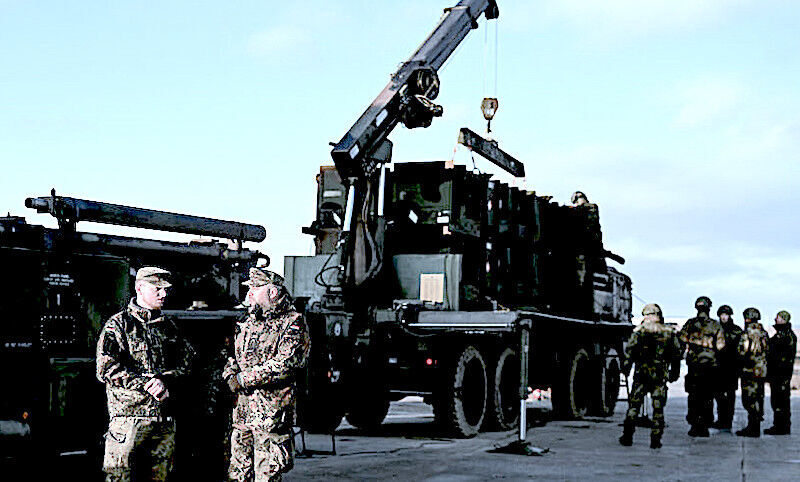
© Omar Marques/Getty ImagesUS-made Patriot air defense system • Jasionka, Poland • January 23, 2025
According to Kuper, an unnamed "prominent Eastern European politician" said, without elaborating: "
"The perceived pivot toward Moscow by US President Donald Trump has brought back the geographical distinctions of the Cold War, namely the idea of 'Eastern Europe' and 'Western Europe', where one sees Russia as an existential threat and the other isn't that bothered. We know that's why some of our countries are asking, 'Why don't we attack Russia now, instead of sitting waiting for it to attack us?'"Since the escalation of the Ukraine conflict in 2022, Poland and the Baltic States have claimed that if allowed to win, Russia might attack them next. Moscow has consistently denied the claims, with President Vladimir Putin even describing them as "nonsense."
Countries in Eastern Europe were historically often part of larger empires - Russian, German, or Austro-Hungarian - and frequently lost their sovereignty. Czech writer Milan Kundera described this vulnerability as "a small nation can disappear, and it knows it."
These nations have recently displayed the strongest anti-Russian sentiment and are among the most vocal in calling for bolstered defenses. EU top diplomat Kaja Kallas, a former prime minister of Estonia, is known for her hawkish views on Russia.
The report comes as Russia and the US reestablished contacts last month and held high-level talks in Saudi Arabia. Brussels, however, is insisting on continued military support of Kiev.
In response to Trump's reported halt of American military aid to Ukraine aimed at forcing Kiev to negotiate, EU leaders, led by European Commission President Ursula von der Leyen, agreed on a €800 billion plan to "rearm Europe" and maintain support for Kiev.
Moscow has pledged to take measures to safeguard its security amid the "militarization" and "confrontational rhetoric" coming out of the EU. It has also long warned against Western arms shipments to Ukraine, arguing that they only prolong the conflict without altering the outcome, while increasing the risk of a direct clash with NATO.











"The U.S. military's F-35 Lightning II fighters have failed to meet their readiness goals for six consecutive years, according to a recent report from a congressional watchdog.The Government Accountability Office's Oct. 21 report also determined the F-35's results followed the nation's military spending more than $12 billion to sustain the fifth-generation aircraft.GAO's report about the U.S. military's tactical aviation readiness additionally found that none of the F-35's three variants met their desired mission-capable rates in fiscal years 2018 through 2023."
You and what army?