
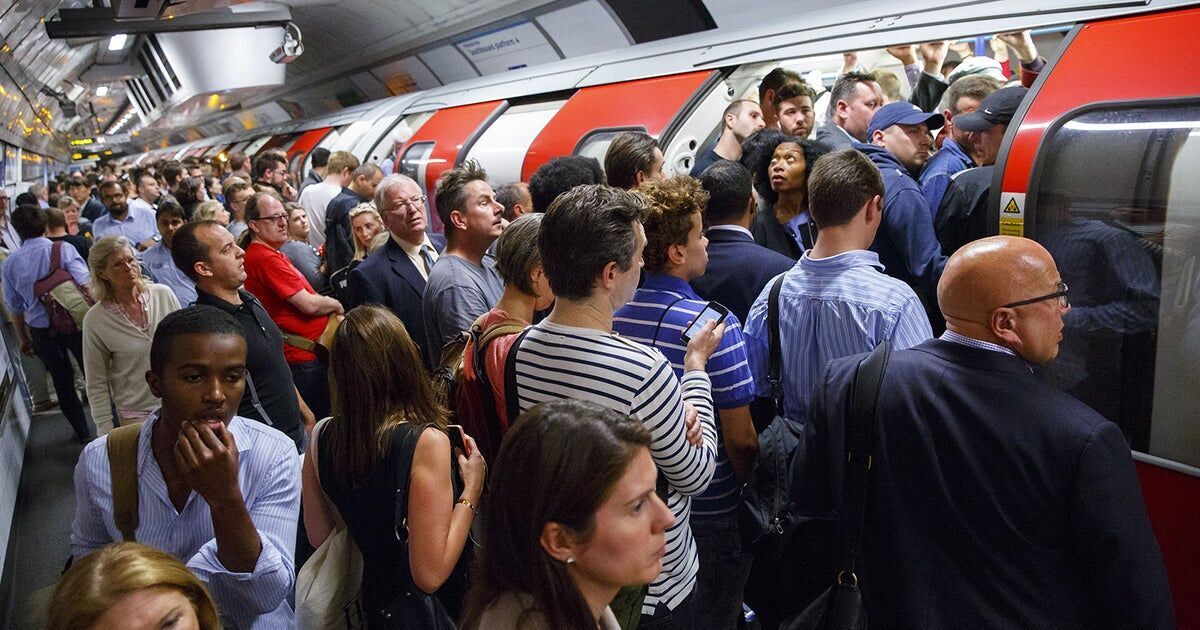
You're not imagining things
The 2001 census, already hopelessly out of date and easy to avoid for those who find filling in forms a trifle inelegant, numbered us at a little under 59 million. But as statistics go, that one's most definitely a damned lie.
My sources for the above statement are good, but scared of admitting the truth for fear of incurring the wrath of Whitehall. It's like the best way of monitoring illegal drug consumption: forget the pious statements from ministers - the foolproof method is to sample our water and the effluent in it. That's easily the best way of monitoring what the nation has been consuming.
Consumption - that's the thing. Based on what we eat, one big supermarket chain reckons there are 80 million people living in the UK. The demand for food is a reliable indicator; as Sir Richard Branson says, you can have all the money in the world but you can only eat one lunch and one dinner.
The supermarket in question was privately lobbying the Competition Commission to let it grow its market share. The argument, reasonably enough, was that the market was far bigger than the regulator realised, so expanding the network was fair.
I have a second, respectable, source. A major, non-commercial agricultural institution reckons there are 77 million of us in the UK. Again, its reckoning is based on what we eat.
That faint background noise you're hearing as you read this is the sound of everyone slithering off the record. Why? In political terms, standing behind these figures would be to toss a hand grenade into a vat of gasoline. People would be hounded out of a job for scaremongering.
The Office for National Statistics' figures, published last week, predict a population of 75 million by 2051. It's an honest estimate but horribly wide of the mark because number counting doesn't work effectively. If you want to know how many there are of us, ask a food firm.
If the true numbers were revealed, the Little Englanders and xenophobes would come out in force about the evils of immigration. But that's what made America great in the 19th century, and it's a driving force of our economy right now. It's also anti-inflationary.
Comment: In other words, the commoners are correct, and it's why Brexit happened (which voters for leaving the EU naively assumed would mean proper controls being re-instituted at UK border check-points), and it's why Nigel Farage is so popular, and it's why the permanent bureaucracy in Whitehall is working overtime to suppress his influence.
It's also at the root of the recent UK riots. People know something is seriously wrong with the 'manufactured consensus' of reality, and they're being subject to intense gaslighting about it.
But the UK's 'deep state controllers' don't care because, as long as the UK is so tied-at-the-hip to US economic largesse, then the more people they stuff into the country, the merrier. But should the US dollar ever fall from its perch, it's curtains...
David Buik, a money manager with broker BGC Partners, was talking of "one million Eastern Europeans unaccounted for in London" on television last week. I suspect he's right, if somewhat conservative in his estimate. How many do you see working in the construction industry and waiting at tables?
And when I say "anti-inflationary", I mean they are getting rotten wages. Dignified by the term "cheap labour", the hidden hordes will do well for the services sector, among others. People are assets - to maintain and to be maintained - so we are wealthier as a nation.
All of which is reflected in strong economic demand and markets see-sawing between optimism over what we all see on the streets (that 77 million figure feels right to me) and the possibility of something nasty if the Bank of England credit-crunch prognosis is correct (to echo last week, I think next spring will be unpleasant).
As for housing, property magnates and chief executives of housing associations alike say the expanding population means serious demand for the foreseeable future, credit crunch or no. Next week, I'll look at the detail of this argument.










Comment: Well, the financial crisis resulting from that 'credit crunch' in 2007 came and went, and the UK regime survived with its 'Big Lie' intact.
If the UK's real population was 77-80 million people 17 years ago, what is it today? 90 million? Officially, it's just 67 million, yet its existing transport infrastructure cannot cope with the huge numbers of people, and the UK - among developed countries - is second only to South Korea in population density.
Given that such a population boom isn't coming from the native-born population, whose birth rates have collapsed, people aren't imagining things when they sense that their country's being "flooded" with immigrants.