
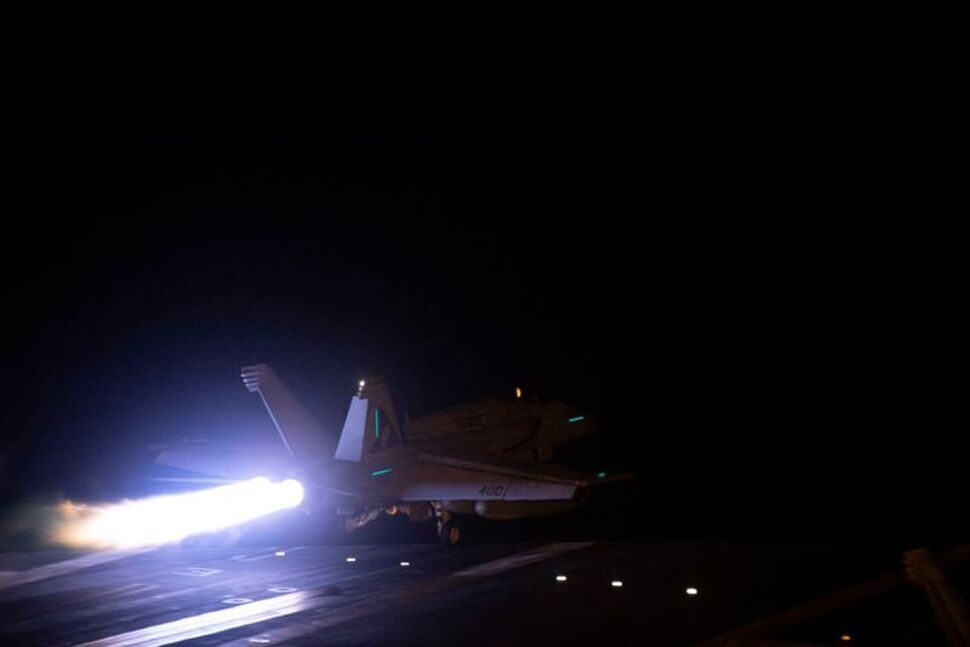
© US Central Command via X/Handout via REUTERSAn aircraft takes off to join the U.S.-led coalition to conduct air strikes against military targets in Yemen from an undisclosed location, in this handout picture released on January 12, 2024.
Raising concerns about a possible inflation shock for the world economy, Brent crude prices jumped by about 4% to a high of $80.75 a barrel on Friday, while US West Texas Intermediate crude also increased after US and UK airstrikes against Houthi rebel sites in Yemen.
The overnight strikes were in response to attacks on shipping in the Red Sea and the missiles, drones and rockets fired by the Yemeni group at US and UK warships, as tensions mount in the region during the Israel-Gaza war.
Comment: Yemen started the blockade of Israeli shipping in response to Israel's unprecedented slaughter of Gazan civilians.
The world's largest shipping lines have paused shipments through the Red Sea, diverting container freight around the Cape of Good Hope on the southern tip of Africa - adding thousands of miles to journeys, driving up costs and delaying deliveries of vital components and consumer goods to Europe.
Economists warn that disruption to shipping and higher oil prices, if sustained, could undermine progress to continue bringing inflation back down from the highest levels in decades after the Covid pandemic and energy price-shock exacerbated by Russia's invasion of Ukraine in February 2022.
Comment: The energy crisis was largely brought about by the West's sanctions on Russian energy products, as well as their destruction of the Nord Stream pipeline; it's possible that these factors will also contribute to any spike in oil prices brought about by the West-Israel's Red Sea disruption.
Jamie Dimon, the chief executive of the US bank JP Morgan, said the wars in Ukraine and the Middle East had the potential to disrupt energy, food markets, migration and military and economic relationships. "These significant and somewhat unprecedented forces cause us to remain cautious. While we hope for the best, the past year demonstrated why we must be prepared for any environment," he said.
Comment: Knowing how it will impact all of the above makes it all the more suspect why the US & UK - whose economies are fragile as it is - would choose to attack Yemen, because, prior to this escalation, it was only Israel ships that were targeted by the Houthis; the remit for barred ships just expanded significantly.
Ana Boata, the head of macroeconomic research at Allianz Trade, said the disruption could push inflation up by 0.7 percentage points in Europe and the US while sapping a similar amount from economic growth on both sides of the Atlantic.
"Should this crisis last for several months, global trade growth in volume would be impacted ... increasing the risk of a delayed rebound from the 2023 recession," she said.
Sources close to the UK Treasury said it had modelled various scenarios for the potential impact on Britain, in details first reported by the BBC, including crude oil prices rising by more than $10 a barrel and a 25% increase in natural gas.
Ministers are concerned that disruption to shipping could damage Britain's economy as it struggles for growth momentum amid pressure on households and businesses from the cost of living crisis.
Official figures on Friday showed the UK economy grew by 0.3% in November - after shrinking by 0.3% in October - propped up in part by Black Friday spending. Economists cautioned that figures published next month could show the UK slipped into recession at the end of 2023, despite growth in November.
The chancellor, Jeremy Hunt, has warned that the shipping disruption "may have an impact" and that the government is watching developments closely.
The rerouting of shipments from the Red Sea to around the coast of Africa adds about 10 days longer to journey times, adding to the cost of deliveries and causing delays for manufacturers and retailers in Europe.
However, while shipping costs have almost tripled since late November, they remain only a quarter of the peak recorded in 2021, when the pandemic and blockage of the Suez canal by the Ever Given container ship caused chaos for international trade.
Meanwhile, the global economy is in a weaker position amid faltering consumer demand, with households under pressure from elevated living costs and higher central bank interest rates.
Although oil prices have risen sharply, they remain significantly lower than in the autumn of 2023, and almost $60 below near-record levels reached in March 2022 after Russia's invasion of Ukraine.
John Glen, the chief economist at the Chartered Institute of Procurement and Supply, said: "The global economy isn't growing as fast, and the volumes of sea freight are down significantly from where they were 12 months ago. And the key issue is inflation is going to be driven by what's in the box, rather than the cost of transporting it."
However, economists say sustained disruption or further escalation in the Middle East conflict could have a bigger impact.
"The really scary thing would be in the Gulf of Oman and the strait of Hormuz, given its importance for oil and gas. That'd be a different kettle of fish altogether," Glen said.






May the best ideas prevail and may all the zigaboos one at a time reap what they have sown.
May they die individually in a manner similar to the babies in Gaza as they took their last breath in the rubble of destruction from which they are and were completely innocent in contrast to the zigaboos who literally killed them. They literally chose to kill babies.
Justified Retribution is swift and ruthless.
BK