
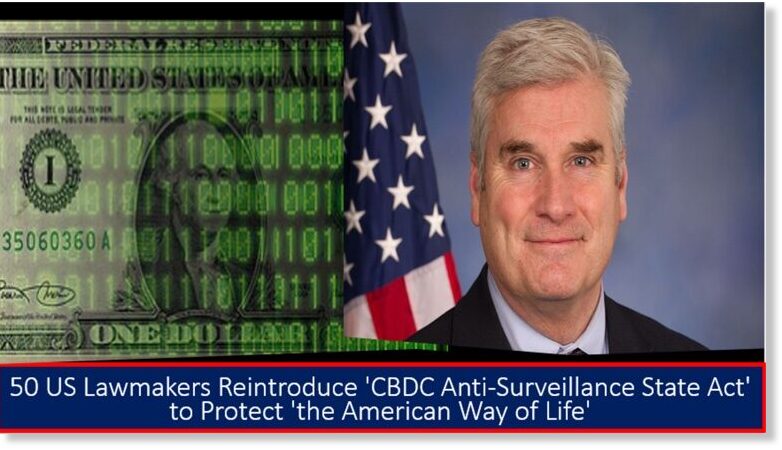
U.S. Congressman Tom Emmer (R-MN) who has been a longtime advocate that any Fed-issued digital dollar (central bank digital currency) remain open, permissionless, and private announced on Tuesday that he and 49 other lawmakers have reintroduced the CBDC Anti-Surveillance State Act "to halt the efforts of unelected bureaucrats in Washington D.C. from issuing a Central Bank Digital Currency (CBDC) that dismantles Americans' right to financial privacy."
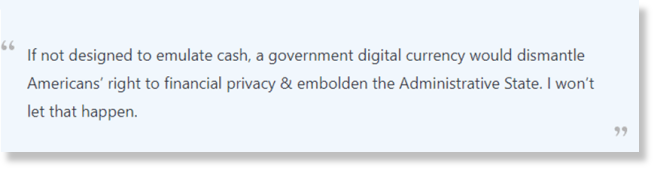
"If not open, permissionless, and private — like cash — a CBDC is nothing more than a CCP-style surveillance tool that can be weaponized to oppress the American way of life." argues the congressman, "President Biden is willing to compromise the American people's right to financial privacy for a surveillance-style CBDC. I don't believe in compromising Americans' rights," he added.
CBDC Power
In many Western countries, including England, the USA, and Australia, banks are continuing to push towards the goal of Central Bank Digital Currencies as the only money as they plan to completely phase out cash use before the end of 2024. Individuals may argue that they already mostly use digital banking and debit or credit cards.
However, we have witnessed the freezing of the bank accounts of protesters in 2022 by Canadian PM Justin Trudeau simply for standing against the tyrannical restrictions of the plandemic, and hundreds of personal bank accounts were frozen under special powers.
Although yes, banks already have the power to close your account if they deem it necessary at the moment there is a small number of people already dealing with this, with their only offence being buying Bitcoin or questioning why the banks need to know what we're doing with our money or questioning the banks ever tightening rules about holding an account with them, imagine what's going to happen with CBDCs as the only legal currency says Brad Bleckwehl author of from the gutter up.
He continues:
"If you think the careers, contracts, and accounts of famous people getting canceled for saying or doing something that offends has nothing to do with you.. think about how ever-tightening PC culture is growing, and how authoritarian our Western governments have been becoming in recent years."The news of this pushback against the authoritarian control of our finances is huge.
"They're literally trying to pass misinformation and censorship bills so they can legally control what we're allowed to talk about. Combine the loss of freedom of speech with the ability to blackball us financially by freezing CBDCs, and we're headed to a very bleak time for society. It's not just going to be what is currently considered socially acceptable or not, it's going to be forced behavior, forced ways of thinking. Look at how they bullied us with covid vaxxes." (source).
CBDC Anti-Surveillance State Act Updated, Reintroduced
Congressman Emmer posted on social media platform X: "Today, with 49 of my Republican colleagues, I reintroduced the CBDC Anti Surveillance State Act." (source)
Emmer had already announced in February 2023 that he had introduced the Central Bank Digital Currency (CBDC) Anti-Surveillance State Act in the House of Representatives. The recently elected House Majority Whip tweeted: "Today, I introduced the CBDC Anti-Surveillance State Act to halt efforts of unelected bureaucrats in Washington, DC from stripping Americans of their right to financial privacy." https://x.com/GOPMajorityWhip/status/1628397390024638466?s=20
He explained that the bill "does three things" by amending the Federal Reserve Act. "Firstly, it "prohibits the Fed from issuing a CBDC directly to anyone," the lawmaker wrote. Secondly, it "bars the Fed from using a CBDC to implement monetary policy and control the economy," and thirdly, it "requires the Fed's CBDC projects to be transparent to Congress and the American people."
He noted that "America remains a technological leader not because we force innovations to adopt our values under regulatory duress, but because we allow technology that holds these values at their core to flourish," Congressman Emmer stressed: "Any digital version of the dollar must uphold our American values of privacy, individual sovereignty, and free market competitiveness. Anything less opens the door to the development of a dangerous surveillance tool." (source)
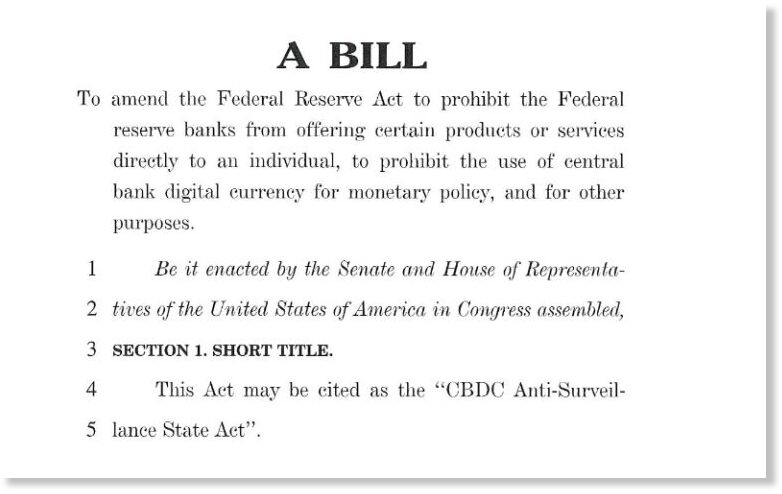
"My updated bill prohibits the Fed from issuing a retail CBDC while protecting innovation and any future development of true digital cash," Emmer clarified. "This bill puts a check on unelected bureaucrats and ensures the U.S. digital currency policy upholds our American values of privacy, individual sovereignty, and free-market competitiveness."
Majority Whip Emmer first introduced the bill to address central bank digital currency concerns in January 2022. The bill is now co-sponsored by Emmer's Republican colleagues, including Representatives French Hill (R-AR), Warren Davidson (R-OH), Byron Donalds (R-FL), Pete Sessions (R-TX), Young Kim (R-CA), William Timmons (R-SC), Ralph Norman (R-SC), Barry Loudermilk (R-GA), Bryan Steil (R-WI), Scott Fitzgerald (R-WI), Mike Flood (R-NE), Bill Posey (R-FL), Mike Lawler (R-NY), Andy Ogles (R-TN), and Ann Wagner (R-MO).
Rep. Emmer stressed: "The administration has made it clear: President Biden is willing to compromise the American people's right to financial privacy for a surveillance-style CBDC. I don't believe in compromising Americans' rights."
"Bottom Line: If not open, permissionless, and private — like cash — a CBDC is nothing more than a CCP-style surveillance tool that can be weaponized to oppress the American way of life," the lawmaker concluded,
The House Financial Services Committee will consider his bill this month.



Reader Comments
People need to keep using cash. If the governments manage to get rid of cash, it's over.