
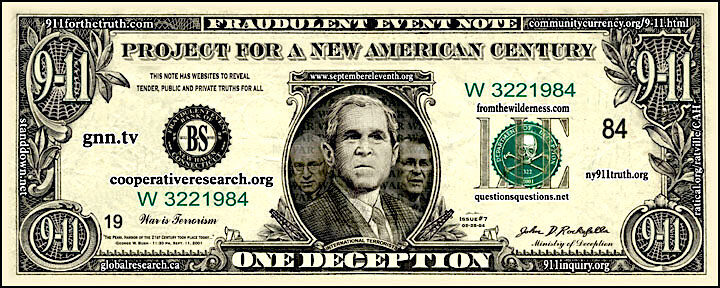
© oilempire.us/pnac
Even if history truly does come as tragedy and repeat as farce, the neoconservatives' re-emergence is extraordinary, because Iraq isn't the only tragedy, or farce, on their sixty-year record. This record has nothing to do with the hard-nosed, practical, anti-communist, and anti-Iranian outlook with which it's sometimes associated — one shared by many Republicans. Instead, it flows from a broader foreign and domestic project of power accrual and social control driven by ideologues and administrators in Washington, D.C. The project's effects reach wide and deep: though the Center for American Progress and Democracy: A Journal of Ideas feed the Biden White House personnel and policies, their insider playbook was created by the neocons, whose think-tanks and magazines laid the groundwork for an insulated class of political ideologues to wreak their will on the rest of us.
Why do their moves keep working? And how can we minimize their influence?
Begun in the 1960s by a loose collection of Democratic intellectuals, academics, and administrators like Irving Kristol, Donald Kagan, James Q. Wilson, and Daniel Patrick Moynihan disillusioned by urban and campus unrest, neoconservatism's commitments were formed in the university seminar and its influence in Washington's bureaucracy. Unlike most Republicans, neocons' solution to turmoil on the ground wasn't to relocate power there. Instead, they wanted to replace top-down social programs with top-down moral reforms, "the more orthodox and traditional, the better," to rescue America from decline.
Next to the strange extremes of the 1970s left, this approach passed for realism, but at bottom it was lifted from the clean lines of a seminar run by intellectuals or believers — an extension of the uncompromising, hermetic ideological battles that Irving Kristol, an ex-Marxist, first waged decades before. Its priorities amounted to supporting a "free market" of deregulations and mergers that disciplined people with productive work, using national enforcement against populations that refused to be disciplined, and uniting a fragmented country to pursue our values and interests against totalitarian enemies abroad.
In practice, the approach was messier. "Free trade" after 1990 immiserated laboring populations and put too-big-to-fail American investment banks in hock to China. The Iraq War and post-9/11 administrative growth ballooned the deficit, enriching military contractors and creating a Department of Homeland Security now being turned on Americans. Republicans developed a reputation as racists thanks to militarized law enforcement and rhetoric blaming the effects of outsourcing on genetic or moral failure — a legacy the party is overcoming with its growing appeal to a multiracial working class.
Finally, progressivism came to power, directly and indirectly, off neoconservatism. The staffers of the Obama and Biden White Houses came from the defense, administrative, and academic sectors neocons helped grow. The invasion of Iraq was used immediately by progressives as an excuse to question America's alliance with Israel, and its long-term failure gave the Obama White House room to launch a pro-Iranian pivot that continues today. And the new war on white nationalism, supported by Bush administration alumni, is the mirror image of the War on Crime, where blue-collar conservative whites are labeled, as black Americans distrustful of the system once were, as backward and morally decayed.
How does a movement with this many failures keep influence? The answer is the neocons' tactics. Operating out of magazines like The Public Interest and The Weekly Standard and think-tanks like the American Enterprise Institute and the Project for the New American Century, they seeded the bureaucracy with allies or acolytes and ran insider plays from there. William Kristol, Irving Kristol's son, is the obvious example. A former official in George H.W. Bush's White House, Kristol pushed the invasion of Iraq from his Century Project and featured John DiIulio, a student of James Q. Wilson, urging a "war on crime" in his magazine The Weekly Standard. But he also used the Sunday talk shows to help another insider, George Conway, break the Lewinsky affair: a crusade against immorality that, whatever its merits, featured the government leaks, FBI overreach, and prosecutorial attacks against "misinformation" that we're experiencing in hyperdrive today. Ten years later, Kristol made another doubtful play: pushing the nomination of Sarah Palin for vice president, in what most observers saw as a ploy to get populist votes without delivering populists a real candidate.
During those years, a host of neoconservatives made their bones in these establishments, and they've expanded their connections since, spreading a gospel of top-down moral reform despite lacking a constituency. This year alone, you can read David Frum on how "the Next American President Will Need to Defeat Isolationism"; David Brooks on "How to Restore Morality"; Bret Stephens on how "Angry populism is a force that can only be stoked, never assuaged"; and Robert Kagan, Donald Kagan's son, on how our values and interests are inextricable and demand aiding Ukraine. Meantime, ex-representative Liz Cheney traverses the think-tank circuit, and Victoria Nuland puts her ideas into practice at the highest levels of administration.
These ideas seem to be working. Ukraine has become a more lethal version of the corporate-and-administrative confluence Dick Cheney and Donald Rumsfeld created in Iraq. Debt increases, along with potential threats, and contractors are enriched, but unlike in Iraq, American casualties are nonexistent, which limits public anger, so the war can go on, imaginably, forever. This isn't a conspiracy; it's the inertia of vested interests acting for their own benefit. Meantime, America is nominally unified around the war by SNL tributes to Ukraine, the silencing of artists with other political commitments, administration-backed Tiktok campaigns, and calls to sustain the "post-World War II American-backed international order."
What none of the neocons speak about, except as "Americans' preference to ... avoid ... costs, responsibilities and moral burdens," is on-the-ground consequences of their crusades. Those questions are left to the non-governing professionals — in this case, a Republican Party defined by Moms for Liberty; the Florida state Legislature; and anti-debt, pro-small business successors to the Tea Partiers. This ground is the wave of the political future because, as even some of the neocons' sometime-allies once recognized, politics is a different sphere from business or academia. It doesn't depend on acumen or expertise; it depends on understanding and representing, sometimes creatively, the will of the people. The point of that exercise in America, as Madison laid it out, is to let public opinion guide government in a country large enough where politicians could follow the public's general will without being in hock to its specific effects.
The neocons are what happens when that order is overturned — when politicians, more subject to think-tanks and interest groups than legislatures and associations, don't just try to cool public opinion, but to subvert it. Dick Cheney's famous "So?" when he was told that two thirds of Americans opposed the Iraq War is the most brutal possible summation of their creed — and today's progressives, an equally insular and moralistic clique made in academia and fortified in bureaucracy, are their fitting successors. In an era where operators in the existing order are calling on-the-ground Republicans threats to democracy, we need to remind the public that ours is the opposite of neocons and their ilk — ours is the party of the people.



Reader Comments
The Obama administration simply brought liberals on board to the Neo-Con project, normalizing and continuing it with Libya, Syria and his drone program. Trump may have been less enthusiastic about it, but he surrounded himself with people like Pompeo who made sure that the whole Neo-Con paradigm stayed in place,
The War Party - BBC Panorama
[Link]
(1) The Neocons are overwhelmingly Jews, with a few Goyische hangers-on like John Bolton and Liz Cheney, who would sell their mothers into prostitution in exchange for being patted on their little wooly heads by the Master Race.
(2) The Jews have controlled money in the world for thousands of years, if we read the writings of all commentators that have survived to the present day. They employ this money to totally control those who need money, such as politicians, or who lust after it, such as most of us Goyim, and are willing to sell their souls to the Jews for it.
(3) The Jews control 90% of the world's media - TV, movies, magazines, newspapers, social media, radio, and agencies such as Reuters and the Associated Press, which many news outlets rely on for their content. As such, Jews totally control the message that the public sees and hears, both the content of the news and the interpretation of what it means. Public opinion is totally controlled by Jews, of whom the Neocons are a small but very influential part.
(4) The Talmud preaches the destruction of Christianity and Christian civilization. It says that Jesus' mother Mary was a whore who slept with hundreds of men, that Jesus was a bastard, a deceiver, magician and a sorcerer, who is being punished by being boiled in a vat of shit in Hell for all eternity, and that all non-Jews are evil, mere anmals on two legs, and that only Jews are truly human. As such, the deaths of billions of Goyim are irrelevant, meaningless, of no more consequence than the deaths of billions of cockroaches.
(5) The Jews and their totally-controlled media organs have used the alleged "Holocaust" ™ to suppress freedom of speech, which has been expanded from making it illegal to even discuss the "Holocaust" ™ to even pointing out that someone is a Jew. The very word Jew cannot be used, or the media will howl stridently about "Anti-Semitism," which has eclipsed the Seven Deadly Sins in horribleness.
(6) That is why the Jewish Neocons do not give a damn whether America becomes bankrupt, or destroys itself and Christian Russia in a nuclear war, or ends up killing 5-6 billion Goyim in a nuclear Armageddon. All of it is totally meaningless and irrelevant, so long as Eretz Israel survives. The rest of the world - all the Goyische animals - have been trying to exterminate the Jews for 5,000 years, and have not succeeded so far, so they are very confident that their tribe will also survive a nuclear war.
(7) THAT is what this article SHOULD have said and did not.
There is not a new birth of neocons, it is simply what Klaus stated 2 years ago, the WEF needed a "Great Narrative", and the "great narrative" has always been the war narrative. This is why there is no difference between Dems and Reps, they are both the same globalist controlled.
Why is the "war narrative" effective? It promotes "patriotism" and "fight against tyranny". It has always been a psyop for any country promoting war. However, in our current time the corruption that is rampant everywhere is being revealed. Let's send billions to Ukraine and $700 to Hawaiians as we steal their land.