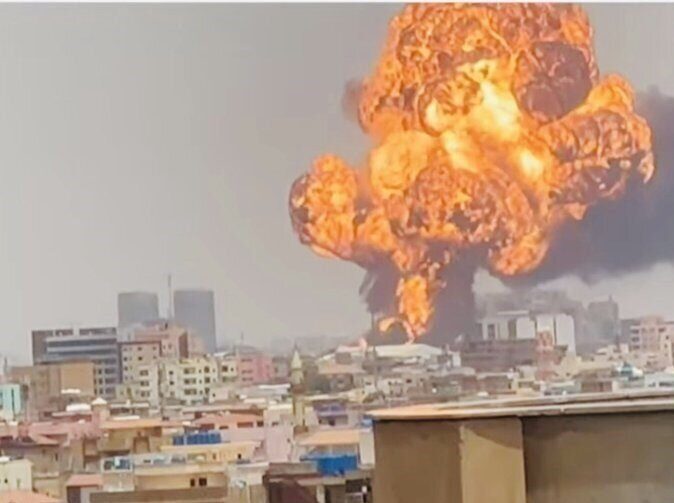
The Sudanese news sources reported an explosion of the fuel tanks of airplanes at Khartoum Airport amid the tensions in the African country.
A source in the Sudanese army has announced that the explosion occurred when the
weapons warehouse of the rapid reaction forces was targeted by an air strike.
The cities of Khartoum and Omdurman in recent days have witnessed a fierce conflict between the army forces and the Sudanese rapid reaction forces.
It is said that
seven civilians were killed in today's clashes.
Since the beginning of the war between the Rapid Support Forces (RSF) and the Sudanese Armed Forces (SAF) on April 15, thousands of people have been killed, and more than 4 million have been displaced, especially in Khartoum and Darfur state.
Comment: Footage of the blast:
Some data on the RSF from Al Jazeera:
How was RSF formed?
The group evolved from so-called Janjaweed militias, which fought in a conflict in the 2000s in the Darfur region, where they were used by the government of long-ruling President Omar al-Bashir to help the army put down a rebellion.
An estimated 2.5 million people were displaced and 300,000 killed in the conflict.
International Criminal Court prosecutors accused government officials and militia commanders of genocide, war crimes and crimes against humanity in Darfur.
Over time, the militia grew. It was made into the RSF in 2013, and its forces were used as border guards in particular. In 2015, the RSF along with Sudan's army began sending troops to fight in the war in Yemen alongside Saudi and Emirati forces.
[...]
In October 2021, the RSF was involved in another coup with the army, halting the transition to a democratically elected government. The move triggered new mass pro-democracy rallies across Sudan that continue until today.
What are the source of tensions between army, RSF?
The army and pro-democracy groups have demanded the RSF's integration into the regular armed forces. Adel Abdel Ghafar, a fellow at the Middle East Council, said the RSF "has resisted integration into the army, understanding it would lose its power."
Negotiations on integration been a source of tension that has delayed a final signing of a new transition agreement, originally scheduled for April 1.
Dagalo and al-Burhan reportedly remain at odds over who would be the commander-in-chief of the military during a multiyear integration period. The RSF said the commander should be the civilian head of state, a situation the army rejects.
And from
TASS:
The situation in Sudan escalated amid disagreements between the army chief, Abdel Fattah al-Burhan, who also heads the ruling Sovereignty Council, and the head of the paramilitary Rapid Support Forces (RSF), Mohamed Hamdan Dagalo (known as Hemedti), who is al-Burhan's deputy on the council. The main points of contention between the two military organizations pertain to the timeline and methods for unifying the armed forces of Sudan, as well as who should be appointed as commander-in-chief of the army: a career military officer, which is al-Burhan's preferred option, or an elected civilian president, as Dagalo insists. On April 15, armed clashes between the rival military factions erupted near a military base in Merowe and in the capital, Khartoum.
See also:




Sudan is the East end of the currently turbulent Sahel zone, not too far from Niger.
The evil empire is bleeding to death by a thousand cuts, it seems.