
But in a city where leaders are constantly groping for solutions, some residents still feel afraid to walk home alone or lock their bikes downtown. A sweeping poll commissioned by The Chronicle drew sobering results: Nearly half of respondents said they were victims of theft in the last five years, while roughly a quarter were physically attacked or threatened. The majority had negative impressions of law enforcement.
The SFNext poll asked a random sample of 1,653 city residents more than 90 questions about numerous aspects of life in San Francisco. It was conducted in late June and July, and respondents reflect the city's demographics. More details on the survey's methodology are available here.
It comes at a tense moment, when videos of unchecked shoplifting or unprovoked street violence are ricocheting on social media, and confidence in police and other city leaders is dwindling.
Forty-five percent of people surveyed for the poll said they had an item stolen within the last five years. Proportionally, Black and mixed-race respondents felt a more severe impact than other groups, with a majority — 54% of Black respondents and 55% of mixed-race respondents — reporting they had suffered theft. Property crime rates were lower for white residents, 43% of whom had a possession swiped within the time period.
"I think that's extraordinarily high," former city supervisor Michael Yaki, who is now a political analyst, said of the overall numbers. While personal property theft may not elicit the same degree of terror as a violent attack, it still affects people's feelings of security, he said.
"When a car is broken into, and things have been stolen, there's a sense of personal violation — especially if it occurred on the street that you live," Yaki said. "The fact that you could have been out there when it happened, and what if you had interrupted it? Those things go through people's minds."
But observers did not interpret the figures uniformly. Others saw the percentage as low, given how prevalent property crimes appear to be in San Francisco.
"I was surprised," said Anni Chung, president and CEO of Self-Help for the Elderly, an organization that works with Asian American seniors. "If 75% had said they had something stolen, then I would say 'yes, that's pretty common.'"
To Tinisch Hollins, executive director of Californians for Safety and Justice, an organization dedicated to criminal justice reform, the breadth of property crime documented in the poll correlates with another finding, that San Francisco residents are disenchanted with police.
Eighteen percent of residents surveyed said police are doing a good or excellent job, while 41% gave a poor or very poor rating. Dissatisfaction was highest among respondents who identified as mixed-race, 52% expressed disappointment with police, and those who identified as Latino, 45% of whom gave the department a negative review. These two groups also reported the highest rates of threats or physical violence in the past five years.
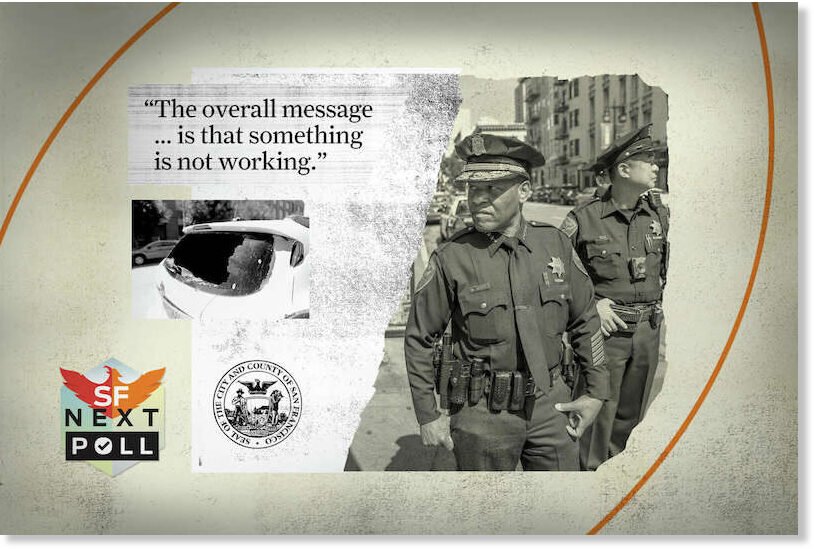
"The overall message for me is that something is not working," Hollins said. "Our communities that have been overburdened with experiencing crime and violence could have told anyone that."
Comment: If it weren't so serious, it would be hilarious.
Sgt. Adam Lobsinger, a spokesperson for the Police Department, said he was pleased to see that respondents seemed to favor police over other city leaders, including the Board of Supervisors, which had good or excellent ratings from 12% of people surveyed, and the School Board, which polled at 11%.
Still, the numbers showed "a lot of room for improvement," Lobsinger said. He was also troubled by racial disparities highlighted in the survey, with certain communities experiencing higher levels of property crime and physical abuse.
Comment: Could it be that minorities would actually appreciate a police force that does its job? No, that's heresy.
Hollins views the poll data as evidence that the traditional legal system has failed to create a safe environment, and that San Francisco should invest in alternatives, such as substance abuse treatment or civilian responders for low-level crimes. The city was among many that tried a series of reforms after George Floyd's murder in 2020, though it seemed to retreat two years later, most notably with the recall of progressive district attorney Chesa Boudin.
The recall came as San Franciscans' perspective on criminal justice appeared to be shifting, buffeted by a rise in home burglaries and petty thefts that made many residents feel unsafe, even as crime dropped overall. Pandemic lockdowns seemed to push crimes into wealthier neighborhoods, where residents saw garage break-ins and packages lifted from porches, while a dip in tourism led to fewer car burglaries downtown.
Police Department statistics reveal a combined surge in burglaries in the westside neighborhoods of Richmond, Ingleside and Taraval, from 1,707 incidents in 2020 to 1,923 last year. This change in crime patterns may have contributed to Boudin's ouster: ballot box data showed high voter turnout west of Twin Peaks and in the Sunset, which heavily voted to support the recall.
Poll participant Stan Zhang, a 24-year-old resident of the Ingleside neighborhood who commutes to work in SoMa, counted himself among the theft victims.
Two years ago he parked his bike outside a grocery store at Sixth and Howard streets. When he came out of the store 15 minutes later, someone had stolen the quick release from his bike's front wheel - a small enough caper that Zhang never filed a police report, though he said it made his commute home more cumbersome. He said, moreover, that several of his friends have had bikes stolen or cars burglarized, and he's seen reports of street violence - all of which create an atmosphere of anxiety and discomfort.
Politicians and other public officials ignore those numbers and personal anecdotes "at their peril," Yaki said.
Rates of physical and verbal assaults appear to be lower than property crimes, the poll indicated, with roughly a quarter of respondents — 24% — saying they had been threatened or attacked.
Notably, Latino and mixed-race respondents reported higher rates of attacks, at 36%, while Asians reported the lowest rates of any group, at 19%, which conflicts with other data sets and media reports depicting a wave of violence against Asian Americans.
Comment: That's not necessarily an accurate reading of the data. If crimes against Asians are the same or lower than prior periods, sure. But the wave may be real, if the rate increased from 9% to 19%, for example. This poll doesn't provide that level of data. Further possibilities follow:
Zhang and another poll participant, who both identify as Asian, raised questions about the results, suggesting they may not have captured the full picture of malicious behavior and aggression towards Asian Americans.
"There may be a degree of selection bias," Zhang said, theorizing that the poll might not have reached older monolingual speakers in Asian immigrant communities. Zhang said his family members who immigrated from China tend to consume Chinese newspapers and radio.
The poll was conducted in Cantonese, upon request, and 92 people completed surveys in Cantonese.
Zhang and Victoria Ku, a 35 year-old resident of Ingleside, emphasized that some Asian Americans - particularly immigrants or elders - may also be reluctant to share their experiences.
"Culturally, people tend to shelter themselves," Ku said, invoking a history of misrepresentation and mistreatment of Asian Americans in news outlets and popular culture, which erodes trust in mainstream media.
Yaki, the former supervisor, pointed out that many immigrants may lack confidence in law enforcement or have difficulty navigating the justice system, and thus be hesitant to report crimes, either to police or to pollsters.
Frustration with cultural and language barriers helped drive the Stop AAPI Hate movement, which has helped put a spotlight on crimes perpetrated against Asian Americans, while encouraging victims to speak out. The grassroots coalition Stop AAPI Hate has documented more than 11,500 hate incidents against Asians nationally from March 19, 2020 through March 31, 2022, from data submitted by community members.
"There's always been an understanding that our community doesn't like to talk about" threats or attacks, Chung said. Despite persistent urging from law enforcement and community leaders - and a flurry of news coverage that points to a trend - "the statistics never back it up," she added.
If menacing behavior by strangers is still relatively uncommon, as demonstrated by the poll, both Yaki and Ku have encountered it. Yaki, who is Asian American, said a man chased him down a block in the Tenderloin about five years ago. Ku was walking home from Balboa BART last year when a man threatened to assault her. He ultimately backed off.
"You live in a city, you hear about what's happening in the news — I wasn't surprised," she said. "If anything I was just (thinking), 'let me protect myself.'"
Rachel Swan is a breaking news and enterprise reporter. She joined the Chronicle in 2015 after stints at several alt weekly newspapers. Born in Berkeley, she graduated from Cal with a degree in rhetoric and is now raising two daughters in El Cerrito.



Reader Comments