RTThu, 25 Aug 2022 21:36 UTC
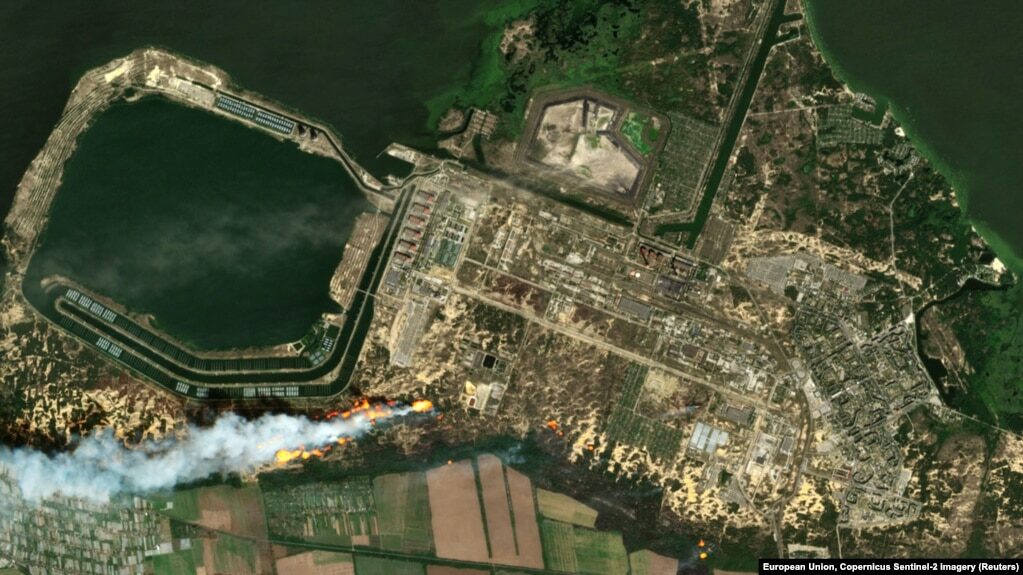
© European Union, Copernicus Sentinal-2 image/ReutersA satellite image of the fires by the Zaporizhzhia nuclear power plant in Ukraine on August 24.
Ukraine has terminated an agreement with Moscow on the operation of the two countries' energy systems, the government's representative to the Rada, Taras Melnichuk, announced on Tuesday.
"The agreement between the Cabinet of Ministers of Ukraine and the Russian government on measures to ensure the parallel operation of the unified energy system of Ukraine and the unified energy system of Russia, concluded on July 12, 2012, has been terminated," he posted on Telegram.
Ukraine was previously part of the Integrated Power System, which includes Russia and Belarus. The deal reportedly stipulated that the countries must ensure the proper technical condition of electrical networks and coordinate the planning of parallel operation of their power grids.
In late February, Ukraine did a test run by temporarily disconnecting from the Russian electrical grid and linked to an electricity grid spanning much of continental Europe. Belgium-based ENTSO-E, which represents dozens of transmission system operators in Europe, said the electricity grid of Ukraine was successfully synchronized with the Continental European Power System on a trial basis.
Comment: RFE/RL adds
more details:
Ukrainian authorities said the last two working reactors at the Zaporizhzhya nuclear power plant were shut down due to fires and damaged power lines, heightening fears of a potential accident as the facility was temporarily disconnected from Ukraine's electricity grid for the first time.
The August 25 announcement by the state energy operator Enerhoatom came as foreign officials warned of a potential catastrophe and continue to push Russian and Ukrainian forces to do more to safeguard Europe's largest nuclear station.
Russia has controlled the facility since about two weeks after invading Ukraine on February 24, but it has allowed Ukrainian engineers to remain and operate the plant, whose first reactor went into operation in 1985.
Fighting near the plant between Russian and Ukrainian forces has stoked worries of an accident. Ukrainian officials have also warned Russia might try to disconnect the plant from the grid, a move that would severely strain Ukraine's battered economy, particularly with winter looming. The plant supplied over 20 percent of Ukraine's electricity needs before the war.
"The actions of the invaders caused a complete disconnection of the [facility] from the power grid -- the first in the history of the plant," Enerhoatom said in a post on Telegram.
Disconnecting the plant is considered potentially dangerous as a failure in backup power systems could lead to a loss of coolant and bring about a melting of the fuel in the reactor core.
In a later statement, the UN nuclear watchdog, the International Atomic Energy Agency (IAEA), said Ukrainian authorities informed it that the last regular power line supplying electricity to the plant was working again after having been cut earlier.
The power line that was apparently affected is different from the one that carries power to run cooling systems for the reactors. A loss of power in those supply lines is a major concern of experts closely watching the situation at the plant.
Ukrainian President Volodymyr Zelenskiy later said that diesel generators had turned on during the power outrage, helping to avoid any prolonged interruption in power supply.
Adding further worries is the fact that some of the radioactive ash heaps on the plant's grounds have been set ablaze by shelling, sending potentially radioactive smoke and dust into the air. Ukraine's military intelligence agency on August 23 accused Russia of purposely striking the ash heaps, and said the smoke was drifting toward the nearby city of Enerhodar.
The Enerhoatom announcement came on the same day the head of the IAEA said Kyiv and Moscow both agree that the UN watchdog's personnel need to go to inspect the situation at Zaporizhzhya.
Everyone know that Ukraine is the one doing the shelling, and that Russia has repeatedly called for inspectors, who refuse to visit because . . . . the plant is being shelled.










Comment: RFE/RL adds more details: Everyone know that Ukraine is the one doing the shelling, and that Russia has repeatedly called for inspectors, who refuse to visit because . . . . the plant is being shelled.