

© NASAHurricane Bonnie off the coast of Mexico on July 4, 2022.
After a pair of western Gulf tropical disturbances failed to develop the past two weekends, we remain stuck on three named storms so far this season: Alex, Bonnie and Colin.
While the number of storms isn't pacing far below the season-to-date average, Colorado State University tropical scientist Phil Klotzbach pointed out it was the first time in 40 years that no named storms formed from July 3 - August 22 in the Atlantic Basin.
Another metric meteorologists use to gauge a season's activity has also flatlined.
As of Aug. 20, the 2022 hurricane season's ACE index is pacing the lowest of any year since 1992, according to Kim Wood, associate professor at Mississippi State University.
Short for Accumulated Cyclone Energy, the ACE index sums up how long storms last and how intense they become, instead of just raw counts of storms. Each of the Atlantic Basin's three storms was relatively weak and short-lived, though Bonnie went on to become a hurricane in the Eastern Pacific Basin.
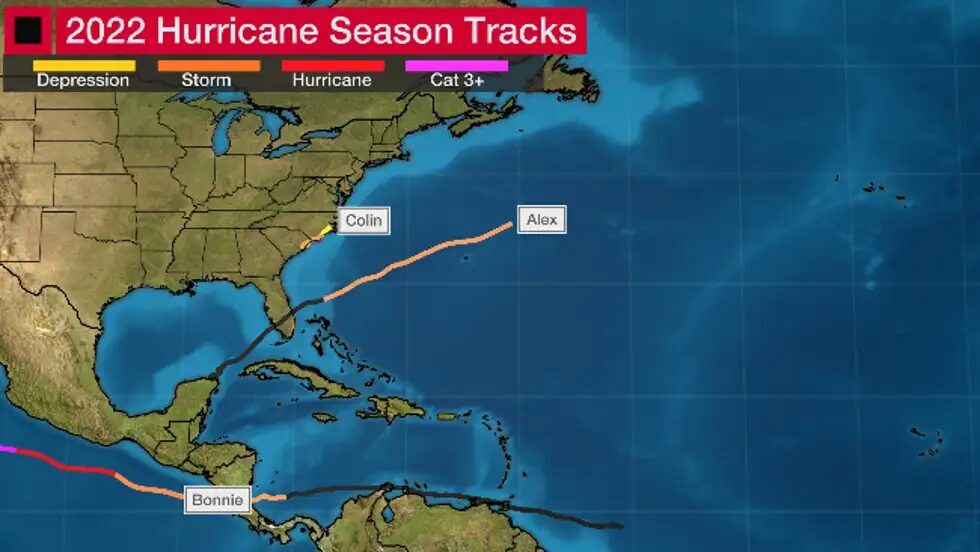
© NOAA/NHC2022 Atlantic hurricane season tracks, through Aug. 22. Black lines indicate when each system was either a tropical wave, disturbance, potential tropical cyclone, or a remnant.
Klotzbach also noted a stubborn TUTT, short for tropical upper tropospheric trough, has been in place over the central Atlantic, providing dry air and wind shear that are both hostile for tropical development.
Notable Storms In Quieter-Starting Seasons
A slow-starting hurricane season does not necessarily mean the rest of the season will be a dud.
Among the five other seasons in the satellite era (since 1966) that were less active at this point than 2022, Wood pointed out one was 1992. By Aug. 22, 1992, Andrew became a hurricane, then slammed into South Florida as one of only four hurricanes to hit the mainland U.S. at Category 5 intensity.
After 1988's slow start, Gilbert became the most intense Atlantic Basin hurricane at the time (later surpassed by Wilma) before slamming Cancún, then northeastern Mexico. That was followed just over a month later by Category 4 Hurricane Joan in Nicaragua.
Hurricanes Diana, Anita and Beulah each developed shortly after early-season slumbers in 1984, 1977 and 1967, respectively, each with impacts in parts of the Caribbean, Mexico and the U.S.
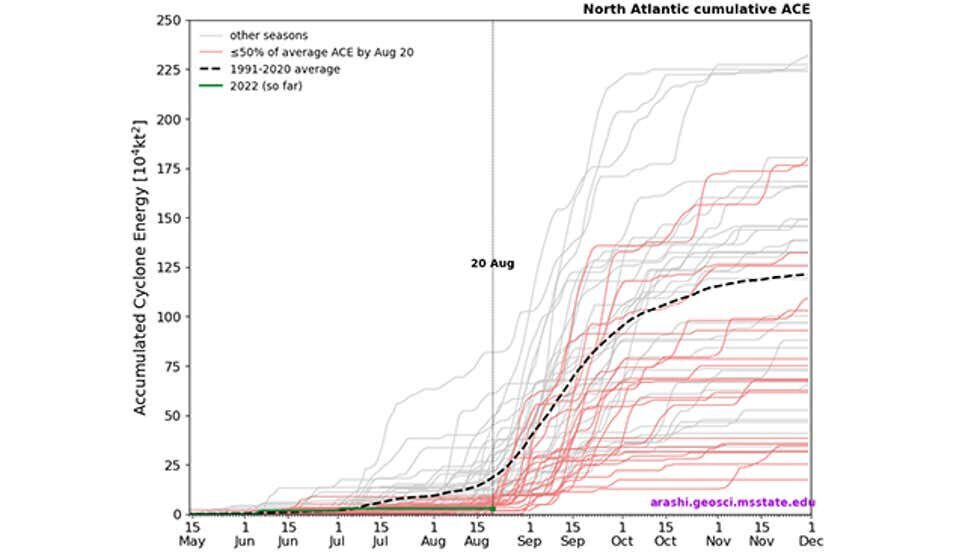
© Kim Wood/Mississippi State UniversityACE index for 2022 (green line) vs. other seasons with less than 50% of average ACE through Aug. 20 in red lines.
Klotzbach pointed out that 90% of all Category 3 or stronger Atlantic Basin hurricanes have happened after Aug. 20.
Last year, 13 of the season's 21 named storms and four of the seven hurricanes formed after Aug. 20. This included Hurricane Ida, which made a Category 4 landfall in Louisiana, then triggered massive flash flooding in the Northeast.
Frequency of named storms (bright red), hurricanes (maroon), and major (Cat. 3+) hurricanes (darkest maroon) through the hurricane season. The yellow line indicates approximately Aug. 22.
One of the stronger August La Niñas in play in 12 years is another reason the season could turn busier soon.
La Niña typically enhances the amount of activity seen during hurricane season compared to its counter-phase, El Niño, which causes stronger shearing winds aloft that limit tropical storm and hurricane growth.
If you're along the East or Gulf coasts, the time to be ready for tropical storms and hurricanes is now. Information about hurricane preparedness can be found here.







Comment: In Earth Changes and the Human-Cosmic, Pierre Lescaudron details how, with the grounding of our planetary current and low solar activity, that drives hurricane activity, this was to be expected, however there's still the possibility that a spike in solar activity could cause a sudden and powerful resurgence: To find out what can cause these spikes, along with much, much more, check out the book, and the following SOTT podcast: Behind the Headlines: Earth changes in an electric universe: Is climate change really man-made?