
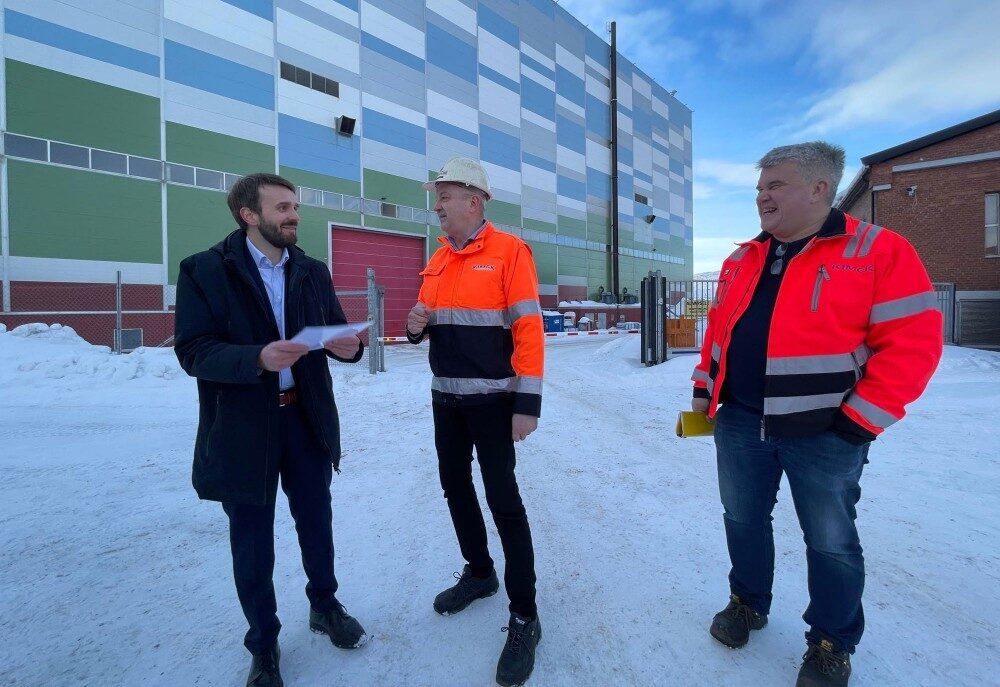
© Atle StaalesenMinister Jan Christian Vestre (left) visits Greger Mannsverk (center) and his Kimek yard in Kirkenes.
Vestre has reason to feel the chill. Only few kilometres east of Kirkenes is a Russia at war. And Norway feels a rapidly growing concern about developments.
Comment: This is actually a proxy war being waged by the establishment in the West against Russia, and Russia has had to respond via its incursion into Ukraine.
The two countries share vast waters in the Barents Sea and have jointly managed the rich cod stocks for more than 50 years. A big number of Russian ships are regularly making port calls in Norwegian towns either to land catch or do ship repair.
This must continue, Minister Vestre told the Barents Observer.
The Norwegian government this week decided to keep its seaports open to the Russians. According to Vestre, the fisheries are utmost important and a ban on Russian ships would have serious consequences for local Norwegian industry.
He argues that the decision will remain in place even if the EU decided to introduce a ban on Russian vessels in European ports.
"If the EU comes to a conclusion that is different from the Norwegian, then that will not automatically mean that the Norwegian government follows the EU," he says.
Comment: It seems the West will have to get used to countries refusing to toe the party line: 'Are we your slaves?' Imran Khan slams West's demands to condemn Russia over Ukraine incursion
However, he admits that his government ultimately will have to reassess the issue if that should happen.
According to Minister Vestre, the Norwegian sanctions against Russia must be aimed against the Putin regime, and not against ordinary Russians.
"We do not want to harm our good friends, the Russians. It is Putin's regime and it is his war and that is where the sanctions must hit," he said, and underlined that Norway must be prepared for a Post-Putin period.
"We must remember that there comes a time after Putin and after the war [and] then we want interaction and trade and coexistence and good cooperation and friendship across the border to Russia."
Comment: Whilst the minister is attempting to separate Russian citizens from the President, these same citizens have voted Putin into power, in some form or another, for the last 22 years. There is no leader in the West that enjoys the support of the electorate as Putin does with his. Moreover, Russia's incursion into Ukraine appears to have strengthened Putin's position, with a recent poll showing support for the government at 71%. And it's looking like Putin will continue to have a significant influence in Russia even after his Presidency.
"We must not burn the bridges to the Russian people," he underlined.
The statements are well perceived by Greger Mannsverk, the owner of the local Kimek ship repair yard in Kirkenes.
"For Kirkenes it is of decisive importance that Russian ships can continue to visit Norwegian ports. Otherwise, the local economy will kneel. We are fully dependent on the Russian fleet and its continued possibility to use Kirkenes as port and base. Without that everything would be pitch dark," Mannsverk says.




Comment: See also: Russia's judo kick to the western financial gut
Bearing in mind the announcement above, the following report from January 2022 may become relevant in the future: Undersea cable in Norway damaged, antenna station provides unique support to polar-orbiting satellites