
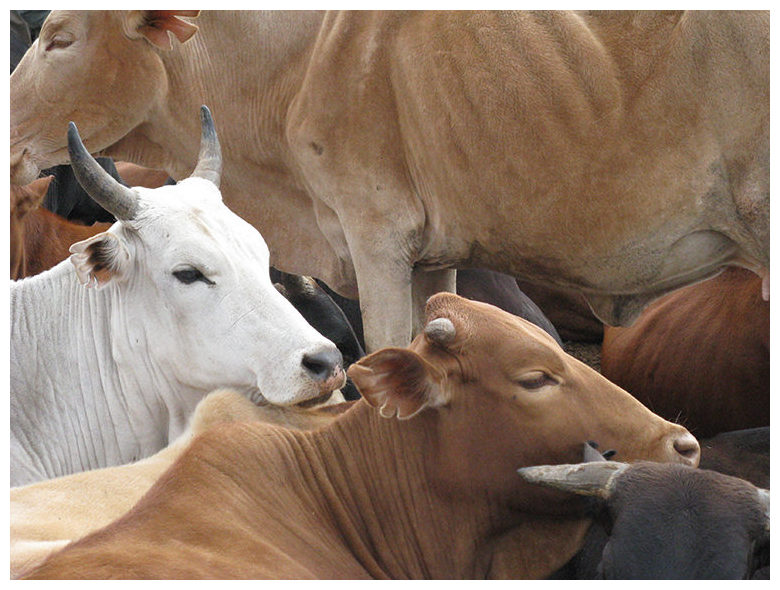
© Fiona MarshallAnthropologists from Arts & Sciences discovered lipid traces in ancient pots that offer the first direct evidence for milk processing by ancient pastoralist societies in eastern Africa.
Katherine M. Grillo, assistant professor of anthropology at the University of Florida and a 2012 PhD graduate of Washington University in St. Louis, teamed up with researchers, including Washington University's Fiona Marshall, the James W. and Jean L. Davis Professor in Arts & Sciences, for the study published this week in the Proceedings of the National Academy of Sciences. Julie Dunne at the University of Bristol in the United Kingdom is co-first author on the paper with Grillo.
After excavating pottery at sites throughout east Africa, team members analyzed organic lipid residues left in the pottery and were able to see evidence of milk, meat and plant processing.
"(This is) the first direct evidence we've ever had for milk or plant processing by ancient pastoralist societies in eastern Africa," Grillo said.
"The milk traces in ancient pots confirms the story that bones have been telling us about how pastoralists lived in eastern Africa 5,000 to 3,000 years ago — an area still famous for cattle herding and the historic way of life of people such as Maasai and Turkana," Marshall said.
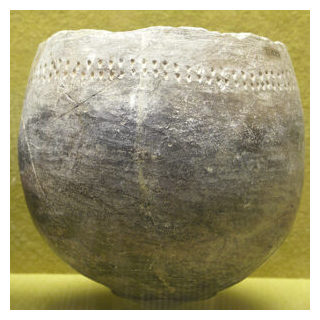
© Fiona MarshallA Pastoral Neolithic bowl from the Bromshead site in Kenya. Scientists analyzed residues in pottery shards of this type and discovered evidence of milk and meat residues.
"It's important because we still rely on our genetics to be able to drink fresh cow's milk once we are adults."
This research shows, for the first time, that herders who specialized in cattle — as opposed to hunting the abundant wildlife of the Mara Serengeti — were certainly drinking milk.
"One of the reasons pastoralism has been so successful around the world is that humans have developed lactase persistence — the ability to digest milk due to the presence of specific alleles," Grillo said.
Notably, in east Africa there are distinctive genetic bases for lactase persistence that are different from other parts of the world. Geneticists believed that this ability to digest milk in northeast Africa evolved around 5,000 years ago, but archaeologists knew little about the archaeological contexts in which that evolution took place.
The development of pastoralism in Africa is unique as well, where herding societies developed in areas that often can't support agriculture.
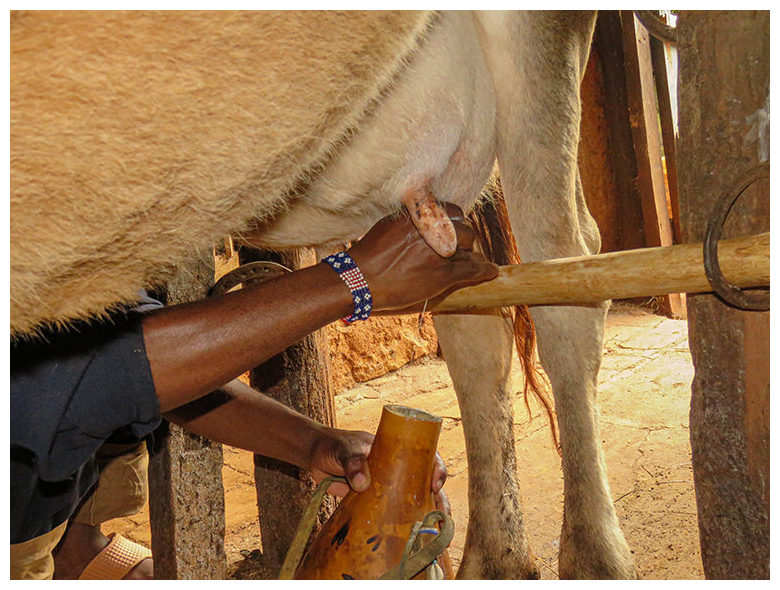
© Oliver RuddA modern day Kenyan collects fresh cow’s milk in a gourd.



Reader Comments
And why are there all these species of monkeys, against all chance, right for their environments? Because one gets boring, or because monkeys had some input for their own evolution after a time?