
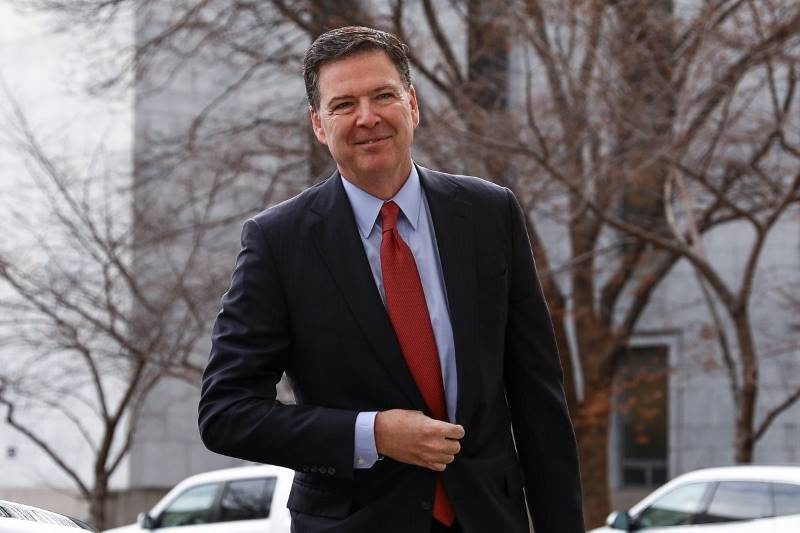
© Samira Bouaou/The Epoch TimesFormer Federal Bureau of Investigation Director James Comey arrives at the Rayburn House Office Building to testify to the House Judiciary and Oversight and Government Reform committees on Capitol Hill in Washington on Dec. 17, 2018.
"Comey's actions with respect to the Memos violated Department and FBI policies concerning the retention, handling, and dissemination of FBI records and information, and violated the requirements of Comey's FBI Employment Agreement," the report (pdf) states.
Comey wrote seven memos as a record of his conversations with the president. When Trump fired Comey in May 2017, Comey leaked one memo to The New York Times through an associate, Daniel Richman. Comey claims to have leaked the memo in an attempt to force the appointment of a special counsel. Days after New York Times published an article based on the memo, Deputy Attorney General Rod Rosenstein appointed special counsel Robert Mueller.
Comey issued a response on Twitter, quoting a portion of the report which dealt with whether Comey violated federal law concerning the disclosure of classified information.
"DOJ IG 'found no evidence that Comey or his attorneys released any of the classified information contained in any of the memos to members of the media,'" Comey wrote. "I don't need a public apology from those who defamed me, but a quick message with a 'sorry we lied about you' would be nice."
Comment: Three-year-old reasoning: "I leaked it to a friend, who leaked it to the media, so it really wasn't me."
"And to all those who've spent two years talking about me "going to jail" or being a "liar and a leaker" — ask yourselves why you still trust people who gave you bad info for so long, including the president," Comey added.
Comment: Time will tell if Comey is taking a premature victory lap. There's plenty more dirt to still come out.
While Comey was not found to have given classified information to the media, he provided classified information to his attorneys, the report found.
Comey told investigators that he considered six of the memos to be personal records. The inspector general concluded that the memos were FBI records. Since Comey kept several of the memos in his office at home after he was fired, the DOJ IG found that Comey violated applicable policies when he failed to surrender the memos to the FBI and failed to seek authorization to retain them. The former director also violated department policy when he failed to notify the FBI of the disclosure of classified information to his attorneys.
"Former Director Comey failed to live up to this responsibility," the report states. "By not safeguarding sensitive information obtained during the course of his FBI employment, and by using it to create public pressure for official action, Comey set a dangerous example for the over 35,000 current FBI employees — and the many thousands more former FBI employees — who similarly have access to or knowledge of non-public information."
In the course of the investigation of the memo leaks, some of Comey's close advisers used words like "surprised," "stunned," "shocked," and "disappointment" when they learned what Comey had done, the report states.
"We have previously faulted Comey for acting unilaterally and inconsistent with Department policy. Comey's unauthorized disclosure of sensitive law enforcement information about the Flynn investigation merits similar criticism. In a country built on the rule of law, it is of utmost importance that all FBI employees adhere to Department and FBI policies, particularly when confronted by what appear to be extraordinary circumstances or compelling personal convictions," the report states in the concluding paragraph.
"Comey had several other lawful options available to him to advocate for the appointment of a Special Counsel, which he told us was his goal in making the disclosure. What was not permitted was the unauthorized disclosure of sensitive investigative information, obtained during the course of FBI employment, in order to achieve a personally desired outcome."
The DOJ IG referred the findings to the Department of Justice Office of Professional Responsibility to determine if any action is necessary.
Ivan Pentchoukov is the Senior Political Reporter The Epoch Times. Ivan has reported on a variety of topics since 2011. He currently leads a team covering the Trump administration. He lives in New York City with his wife and daughter. Follow Ivan on Twitter: @ivanpentchoukov


Comment: There has been much outrage over Comey not facing charges for his conduct. Some have speculated there are larger charges to be made against Comey and for that reason the DOJ is not bothering with what may be relatively small potatoes. Others feel that AG Barr is shielding the principle players in the Emailgate, Russiagate, Spygate mess, just as he batted cleanup in the Iran Contra affair.
It's back to the Iran-Contra days under Trump So is Barr going to be one of the good guys in this matter or not? We shall see.