
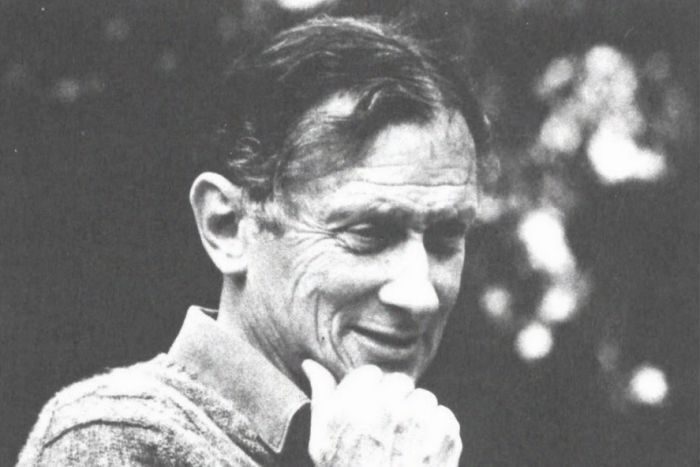
© Podolinsky familyAlex Podolinsky's work in biodynamic farming invited plenty of criticism, but his methods are still followed today.
Not even the founding father of Australian biodynamics Alex Podolinsky knew the answer.
But 50 years later, farmers who follow this practice are paid top dollar for their dairy products, beef, rice and almonds.
This week, the world's first international conference on biodynamics will be held in China, a fitting tribute to Mr. Podolinsky, who died in June, just shy of his 94th birthday.
A controversial pioneer
Mr. Podolinsky inspired an unlikely army of loyal troops, who every autumn across Australia scoop up fresh cow manure from their fields.
Then they squeeze the pungent green stuff into cow horns — many thousands of them — collected from abattoirs across the country.
The horns are carefully stacked and buried in earthen pits over winter, then they're dug up in spring and emptied of a dark organic matter called humus.
This is the crux of biodynamic farming and central to Mr. Podolinsky's pioneering version of it.
He named it Demeter-certified biodynamic farming, after the Greek goddess of grain and fertility.
He then developed machines to convert the humus into soluble fertiliser to spray onto crops and soil, and discovered optimal times and conditions for when to do it.
This could mean the right phase of the Moon or the dark of night.
Skeptics dismissed his methods as akin to witchcraft and biodynamic farmers as deluded cult members.
Science is still largely at a loss to explain why cow horns create the rich humus while porcelain vessels and wooden boxes filled with manure do not.
Those who practice biodynamic farming care little about how it works.
They are more focussed on the fact it does, applying it to soil as well as fruit and vegetable crops across Australia.
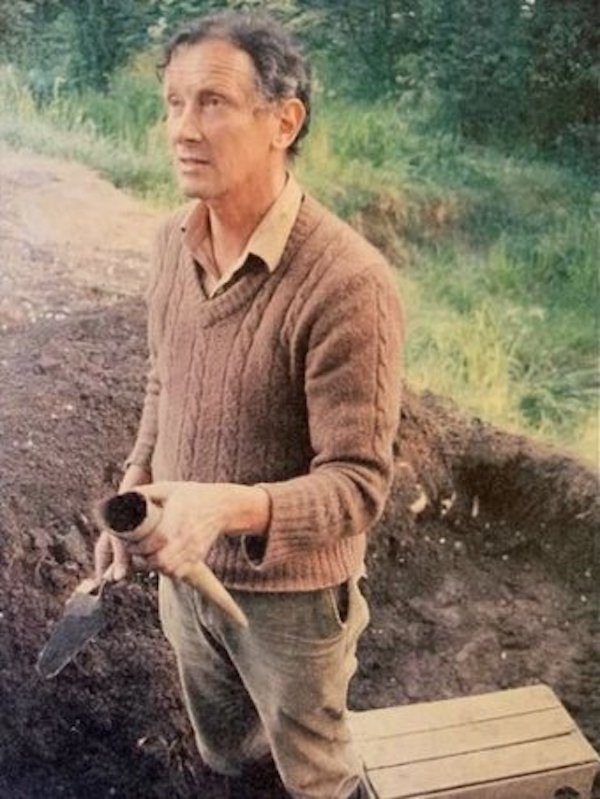
© Podolinsky familyPHOTO: A well-known biodynamic farming method is filling cow horns with manure and burying them.
Alexei de Podolinsky, born in Germany of noble Russian heritage, with an imagination fired by Dr Steiner's principles, emigrated to Australia in 1949.
"He wanted to come to where there was light and light is an important part of a plant's process," Alex's son Peter Podolinsky said.
"He was very conscious of nature and he saw things long before anybody else saw them.""In the 1960s, he was talking about carbon and things like that."
On a dairy farm in Melbourne's outskirts and later at Powelltown in the tall-timbered ranges further east, Mr. Podolinsky closely observed his Jersey milking herd.
With the application of his cow-horn-created "preparations" known as 500, the farm's fertility improved — as did the health and productivity of his herd.
The proof is in the price
By the mid-1960s, Mr. Podolinsky was gathering followers and his methods were gaining momentum.
At Merrigum in Victoria's fruit-growing region, Lynton Greenwood's father was an early adopter of Mr. Podolinsky's approach.
The Greenwoods made and applied tonnes of compost and the orchard's transformation was immediate.
The business has expanded in recent years and produces many varieties of pears and apples and a range of fruit juices.
All of it is biodynamic and all of it brings a premium price.
Lynton Greenwood has an easy answer to critics of biodynamic farming.
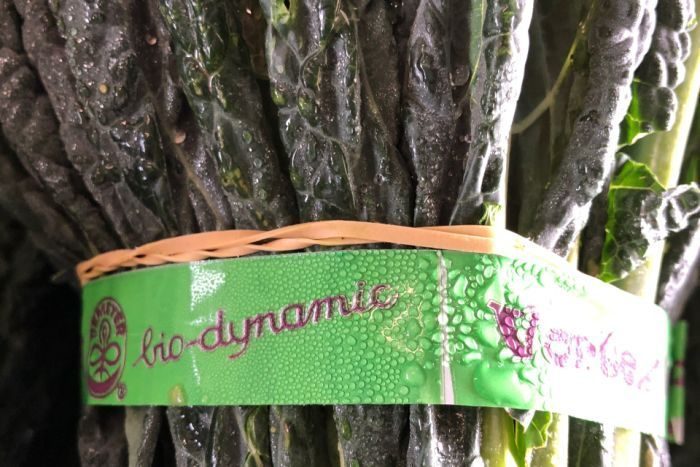
© ABC Landline: Tim LeeBiodynamic produce is paying off for farmers in Victoria.
"[After] having started it many years ago when we were ostracised by our neighbours, most of our neighbours we've bought out since then."At Nathalia further north, three decades of biodynamic farming are paying solid dividends for dairy farmer Mark Peterson.
His herd size is half the district's average but his biodynamic milk fetches three times the price of conventional milk.
The farm is almost self-sufficient, hardly needing to buy in fodder while elsewhere drought and poor milk prices bankrupt many.
"We were ridiculed 30 years ago when we started," Mr. Peterson said.
"Most of those people that passed comments have sold their farms, gone broke, moved on and we're still here, so that's a fairly telling story."
Mr. Podolinsky's legacy is already sizeable.
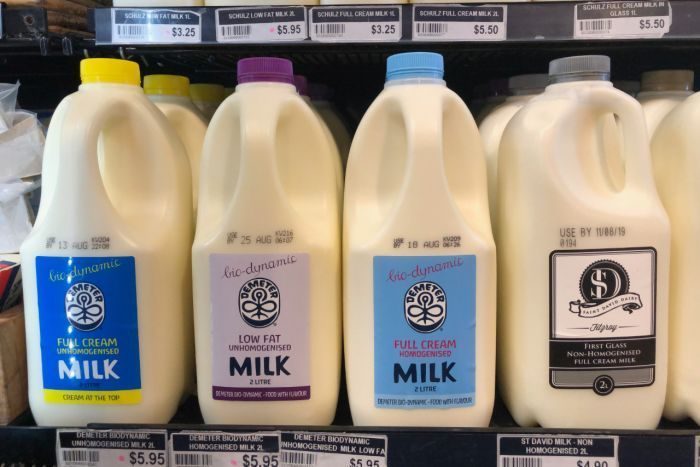
© ABC Landline: Tim LeeMr. Peterson's milk sells for three times the price of conventionally farmed milk.
He shunned notoriety but in a rare interview with the ABC 20 years ago said he was confident biodynamic farming would only get bigger.
And so it has. A few days ago, Vanya Cullen from a West Australian biodynamic winery was named Australian winemaker of the year.
In his later years, Mr. Podolinsky reinvigorated biodynamic farming in Europe.
There is now growing interest in many Asian countries.



Reader Comments
Humans have fully acknowledged the spiritual realm throughout history. Now suddenly we're modern and nothing spiritual exists anymore?
Materialists are the ones who should be ridiculed.
Many traditional religious organizations understand that people can put themselves in danger if they misuse spiritual knowledge. Their concern is not unjustified. Just as you don't allow 10-yr-olds to drive cars, you don't encourage spiritually immature people to play around with powerful, unseen forces. People who aren't mentally and emotionally mature enough can truly be drawn into activities with a very steep price tag if they expose themselves to regressive spiritual forces. The problem with blanket proscriptions, however, is that people don't develop their capacity for judgement when Daddy Church is making sure they remain at a spiritually immature level of knowledge. We teach people to drive when we judge that they are mature enough to do it, we don't say "driving is evil because you could get hurt, so you shouldn't ever do it". The truth is that a blanket proscription isn't ever mandated in order to care for people, it's done to have power over them. When it comes to spiritual development, as in any kind of development, knowledge is power - power to understand yourself and the world, power to discriminate, and power to protect yourself. They want you to remain as children, looking to Daddy Church for protection. If you are not mature enough, then Daddy Church makes sense for you. If you are mature enough, it's time to get behind the wheel and learn.
'Good' and 'evil' are reality in the spiritual world, just as they are in our manifest world. This is given to us by beings far more developed than ourselves so that we may develop the ability to discriminate one from the other, and become stronger and more capable of understanding. Fearing the spiritual world, imagining that the unknown must be inherently evil, just ensures that we remain unable to grow.
Makes pretty good sense to me.
"Haha, we lived off the grid in a tipi for a year."
"I try not to live in this rotten system any more than I have to."
I tend to think one of the main lessons of that whole hippy-generation-throw-up-the-system-and-live-in-a-teepee schtick was "actually, you are worse than your parents".
As per the Nazis and 'the occult', anyone that wasn't doing stuff directly for The Reich was slung in a camp. Sometimes astrologers were rescued from the camp when Adolf changed his mind about such stuff and decided he liked astrology this week. As The Reich didn't have RADAR, a lot of dowsers were rescued from camps to aid the U-boat cause. Dowsing was also the means by which they found Mussolini (allegedly).
Why sure, whatever you say, pal. LOL.