

© @ppchaudharyMoSIndia's nuclear capable surface-to-surface Agni-5 ballistic missile is a lethal strategic weapon
"Pokhran is the area which witnessed Atalji (former prime minister Atal Bihar Vajpayee's) firm resolve to make India a nuclear power and yet remain firmly committed to the doctrine of 'No First Use'. It is true that till now, India has strictly adhered to the 'No First Use' policy. What happens in future depends on the circumstances," Rajnath Singh told reporters in Pokhran, where he attended the closing ceremony of the army scout master competition in Pokhan.
Rajnath Singh made the comment as he paid tribute to Vajpayee on his first death anniversary at Pokhran where India held nuclear tests in 1974 (under the Indira Gandhi government) and in 1998, when the Vajpayee-led BJP was in power.
The ruling BJP's manifesto for the 2014 elections included a promise to "revise and update India's nuclear doctrine". But while campaigning for that election, Prime Minister Narendra Modi had dismissed a question on scrapping the No First Use policy in an interview to news agency ANI. "No first use was a great initiative of Atal Bihari Vajpayee - there is no compromise on that. We are very clear. No first use is a reflection of our cultural inheritance," he had said in April 2014, on the verge of an election in which he stormed to power.
The Defence Minister's comment has been read by many as a well-timed warning amid tension with Pakistan, which has targeted India over the government's move to end special status to Jammu and Kashmir under Article 370. Especially since the Narendra Modi government, after winning a second term by a landslide, has shown it is ready to take radical decisions.
Khan claims Pakistan 'doesn't fear death,' as Modi maintians stony silence
Pakistani Prime Minister Imran Khan has escalated his no-holds-barred verbal assault on nuclear rival India, as tensions once again reach boiling point over the disputed territory of Kashmir.
In recent days, Khan warned the Indian government of Prime Minister Narendra Modi that "no force can stop" Pakistan from achieving its goals, adding that India will "fail miserably in its attempt to smother the Kashmiri liberation struggle."
Khan's comments began during Pakistan's Independence Day on Wednesday, when he visited Pakistan-administered Azad Jammu and Kashmir to express solidarity with Muslims in the region. He has ramped up the war of words on Twitter ever since, culminating in a tweetstorm on Friday.
"The fascist, Hindu supremacist (Narendra) Modi government should know that while armies, militants and terrorists can be defeated by superior forces; history tells us that when a nation unites in a freedom struggle and does not fear death, no force can stop it from achieving its goal," Khan proudly declared.
He also took aim at the international community on Thursday, tweeting about the potential for a "Srebrenica-style massacre" in Kashmir following the Indian government-imposed communications blackout.
Meanwhile, Indian media is reporting that New Delhi's response to the slew of verbal tirades from the Pakistani PM has been "stinging silence."
Comment:...© Postcard
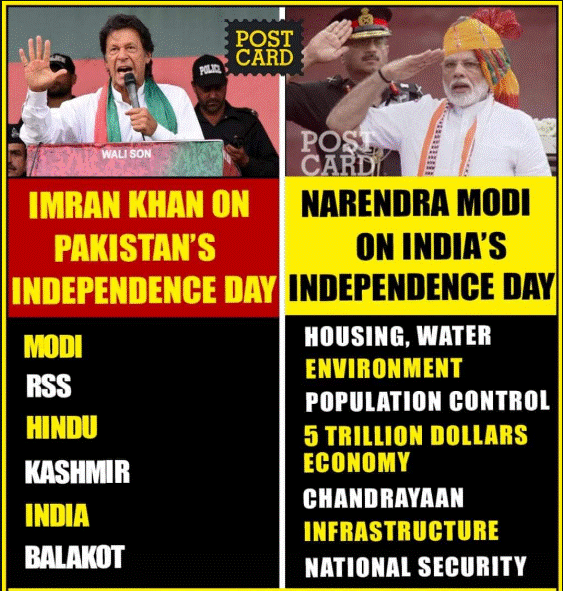
Modi did, however, address the situation in Kashmir, saying that "fresh thinking" is needed after seven decades of failure to ensure peace in the region. "We do not believe in creating problems or prolonging them," he said.
This is not the first time in the last few years that BJP leaders have said it was time to amend India's position. In November 2016, then Defence Minister Manohar Parrikar - who died last year -- had expressed reservations over India's nuclear posture. More recently, Lieutenant General BS Nagpal, the former commander-in-chief of the Strategic Forces Command, is reported to have said that the No First Use policy was a ''formula for disaster.''
Ties between India and Pakistan, strained over the past few years, have hit rock bottom since the Pulwama attack in which 40 soldiers were killed by a suicide bomber of the Pakistan-based Jaish-e-Mohammed. Days later, India sent fighter jets to Pakistan's Balakot to bomb a terror training facility, which led to a dogfight between the two nations at the Line of Control.
New Delhi has repeatedly said its decisions on Kashmir are its internal matter in which no country should interfere, Pakistan has called upon the UN Security Council to take it up.


Reader Comments
to our Newsletter