

© WestmincomThe aftermath of a grenade attack on a mosque in the southern Philippine city of Zamboanga, January 30, 2019.
This occurred just three days after twin blasts rocked a Roman Catholic cathedral on Jolo island, southwest of Zamboanga, and left at least 21 dead and more than 100 injured.
Chief Inspector Shellamae Chang, Zamboanga police spokesman, identified those killed as Mr Habil Rex, 46, and Mr Haj Sattal Bato, 47. Both were said to be Muslim missionaries, known as "tablighs".
An unidentified assailant reportedly turned off a nearby streetlight and lobbed a grenade at the Kamahaldikaan mosque, in Talon district, where about 10 people on a Muslim retreat were sleeping, just past midnight on Wednesday.
One investigator told online news site Rappler that a safety lever of a Belgian-made grenade was recovered at the scene.
In a statement, the Ulama Council of Zamboanga Peninsula called the attack "devilish, irrational and inhumane".
President Rodrigo Duterte's spokesman Salvador Panelo said in a text message: "Terrorism has once again reared its barbaric and ugly head."
"The successive attacks on two different places of worship depict the ruthlessness and the godlessness of these mass murderers," he said.
Defence Secretary Delfin Lorenzana said in a news conference on Wednesday that it was possible the Islamic State in Iraq and Syria (ISIS) terror group could also be behind the attack on the mosque.
ISIS has claimed responsibility for Sunday's cathedral bombing, which it said was carried out by suicide bombers.
"ISIS may want to bring it to a higher level of religious war. But Catholics, Christians and even mainstream Muslims are not biting into that," he said.
For now, he said, "there doesn't seem to be any connection".
Security forces are currently chasing after militants from the Ajang-ajang faction of the Abu Sayyaf, a small but brutal gang of self-styled Islamic militants founded in the 1990s with seed money from Osama bin Laden's Al-Qaeda network.
Initial investigations showed the two blasts that tore through the Cathedral of Our Lady of Mount Carmel were set off remotely using a cellphone, and were not a suicide attack.
Wading into the issue, Foreign Secretary Teodoro Locsin said in a tweet: "Now the mayhem is interfaith."
"That means the secession is over, and plain vanilla mass murder has taken over," he said.
Security officials, though, advised against painting the Jolo and Zamboanga attacks as a religious conflict.
"It is not a retaliatory act," Colonel Leonel Nicolas, commander of Joint Task Force Zamboanga, said of the attack on the mosque
Lieutenant-General Arnel de la Vega, chief of the Western Mindanao Command, called suggestions of a religion-defined war "fake news".
A local militant, meanwhile, was killed in a raid on Tuesday on a home where one of the suspects in the Jolo attack was hiding.
Colonel Gerry Besana, spokesman of the Western Mindanao Command, said Ommal Usop, 64, was killed when he drew a firearm as security forces were swooping down his home.
Usop is said to be a kin of a certain "alias Kamah", who was suspected to be one of the key planners of the bombing. Kamah and one other unidentified man managed to flee.
Only Kamah was seen in CCTV footage running away seconds after the first bomb exploded inside the Jolo cathedral. Usop, however, is a known Abu Sayyaf militant.
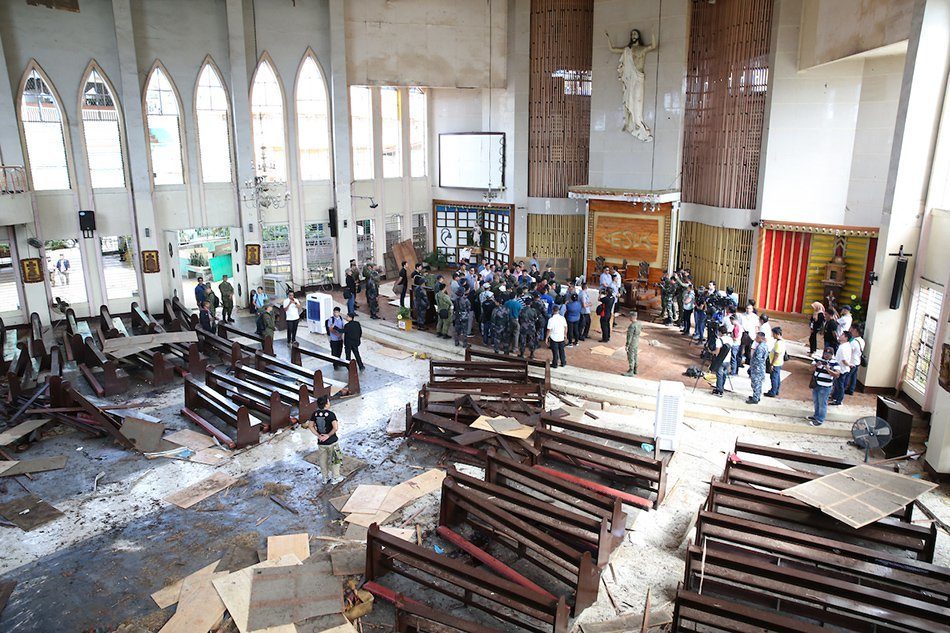
© Albert Alcain, Presidential PhotoPresident Rodrigo Roa Duterte conducts an inspection inside the Cathedral of Our Lady of Mount Carmel in Jolo, Sulu on January 28, 2019 where two explosions occurred inside and outside the church last January 27.
"It exploded. That is terrorism and suicide," he said when asked by reporters to clarify an earlier remark.
He said a woman wearing a crucifix detonated a bomb inside the cathedral, and that a male companion had blown himself up outside minutes later.
Military investigators, however, have said that bystanders saw a woman, presumably the female bomber, put a bag onto a wooden pew and leave the cathedral shortly before the blasts.
They also believe the second bomb was rigged onto a motorcycle parked just outside the church's compound.
Mr Lorenzana told reporters on Wednesday "the suicide bombing theory is hanging in the air".
"It appears to be suicide bombing... but we're still waiting for confirmation," he said.
He said one unvetted report where Mr Duterte could have drawn conclusion from was a text message from Mr Rohan Gunaratna, a terrorism expert with Singapore's S. Rajaratnam School of International Studies, claiming a Yemeni couple were behind the Jolo attack.
"These are all things that we have to validate," he said.
Raul Dancel has been in journalism for over two decades. He began his career as a reporter for The Manila Times, the Philippines' oldest newspaper, in 1990, running the whole gamut of field reporting before easing into the job as a desk editor. He later shifted from general news to financial reporting, joining The Business Daily in 1994, and then the Philippine Daily Inquirer, the Philippines' biggest newspaper, in 1999. In August 2007, he joined The Straits Times in Singapore as a sub-editor for the Money desk.



Comment: It's notable that Islamic terrorism has risen in the last few years, just as Duterte has been working to free his country from the Empire.