
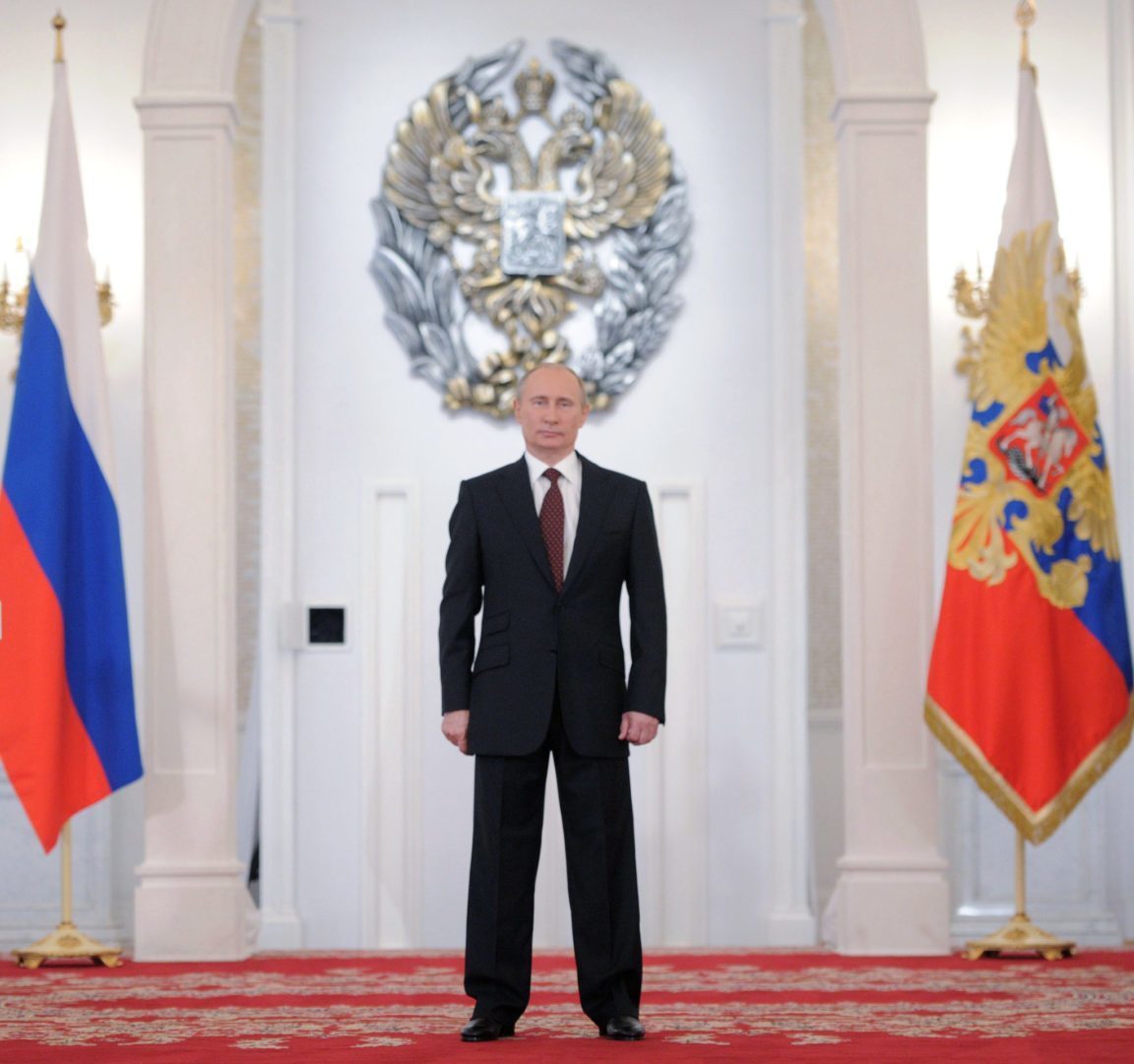
Of course, some of these monarchists have a top contender in mind for that post, none other than President Vladimir Putin himself.
This idea has long been used in a pejorative light in the West, as various shadowy and not-so-shadowy elements in the American media speculated over the years that Mr. Putin was actually aspiring to become Tsar. This was thrown around until probably the time that the Russian president spoke, lamenting the fall of Communism, and since then the prime accusation has been that President Putin wants to bring back the Soviet Union.
This is not true. It also does not appear to be the case that the Russian president wants to be Tsar. But the monarchists are not fazed in the slightest. Here is excerpted material from the WSJ piece, with emphases added:
The last time term limits forced Russian leader Vladimir Putin to step down from the presidency, he became prime minister for a few years.There is a very keen interest indeed among some in Russia that propose various options as to who might best become Tsar in the event that the Monarchy is restored.
This time around, a group of pro-Kremlin activists have a different idea: Proclaim him Czar Vladimir.
"We will do everything possible to make sure Putin stays in power as long as possible," Konstantin Malofeyev, a politically active businessman, said recently to thunderous applause from hundreds of Russian Orthodox priests and members of the country's top political parties gathered at a conference outside Moscow. They were united by one cause-to return the monarchy to Russia...
Even among those who want a monarchy, however, there are splits over what kind it should be. Is an absolute monarchy better than a constitutional monarchy? Should a blood line be established or should the czar be elected? For those who favor male succession, would it be a problem that Mr. Putin reportedly only has two daughters? Some have even suggested others besides Mr. Putin should accede to the throne.
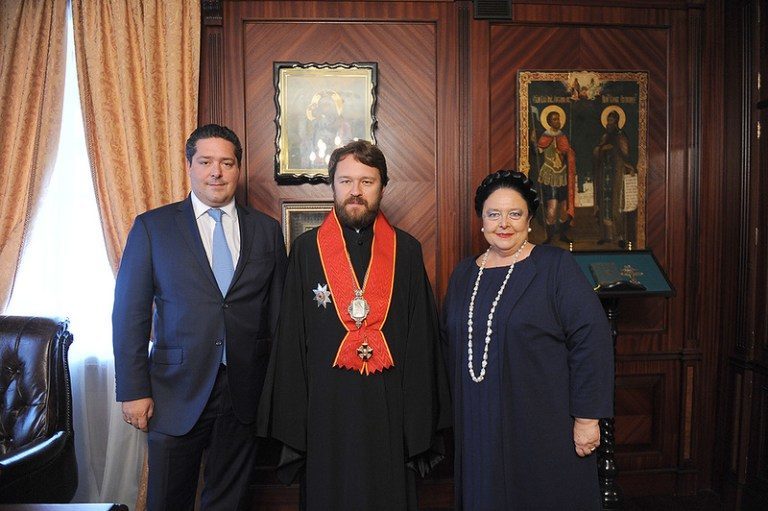
Grand Duke George Mikhailovich Romanov and his mother, Grand Duchess Maria Vladimirovna of Russia, together with Metropolitan Hilarion Alfeyev, head of the Russian Orthodox Church Department of External Relations
The restoration of the Russian monarchy is unique because to carries strong religious significance. As far back as the 8th and 9th centuries, A.D., a host of saints and prophets appear to have foreseen the advent of the Soviet times and the restoration of the Tsar after their conclusion.
Some such prophecies are attributed to anonymous sources, but some are named. Here are two with rather extensive editing, so please go to the site linked for the fullest description of the prophecies.
Monk Abel the Prophet (+1831).And from one of the most famous saints in Russian history:
In a conversation with Tsar Paul I (+1801), after prophesying the destinies of all the Tsars from Paul I to Nicholas II:
"What is impossible for man is possible for God. God delays with His help, but it is said that He will give it soon and will raise the horn of Russian salvation. And there will arise a great prince from your race in exile, who stands for the sons of his people. He will be a chosen one of God, and on his head will be blessing. He will be the only one comprehensible to all, the very heart of Russia will sense him. His appearance will be sovereign and radiant, and nobody will say: 'The Tsar is here or there', but all will say: 'That is him'. The will of the people will submit to the mercy of God, and he himself will confirm his calling. His name has occurred three times in Russian history. Two of the same name have already been on the throne, but not on the Tsar's throne. But he will sit on the Tsar's throne as the third. In him will be the salvation and happiness of the Russian realm."
"Russian hopes will be realized upon [the cathedral of Hagia] Sophia in Tsargrad [Constantinople]; the Orthodox Cross will gleam again; Holy Rus will be filled with the smoke of incense and prayer, and will blossom like a heavenly lily."
St. John of Kronstadt (+1908):What may surprise those in the West is that there are a great many people in Russia and in Orthodox Christian countries in general who take these prophecies quite seriously.
"I foresee the restoration of a powerful Russia, still stronger and mightier than before. On the bones of these martyrs, remember, as on a strong foundation, will the new Russia we built - according to the old model; strong in her faith in Christ God and in the Holy Trinity! And there will be, in accordance with the covenant of the holy Prince Vladimir, a single Church! Russian people have ceased to understand what Rus is: it is the footstool of the Lord's Throne! The Russian person must understand this and thank God that he is Russian."
"The Church will remain unshaken to the end of the age, and a Monarch of Russia, if he remains faithful to the Orthodox Church, will be established on the Throne of Russia until the end of the age."
Interestingly enough, when the idea of restoring the monarchy was brought to President Putin's attention, he regarded the idea as "beautiful" according to Lt. General Leonid Reshetnikov, but also expressed concern that it would lead to stagnation within the country.
A second statement, this one by Kremlin spokesman Dmitry Peskov, noted that President Putin does not like the idea of bringing back the monarchy, but offered no comment on the conversation with Mr. Reshetnikov.
The idea of restoring the monarchy is not completely absurd. Britain overthrew its own monarchy in 1649 during that country's Civil War, but it was restored shortly afterwards under King Charles II. Spain cast aside its monarchy in 1931, with its king, Alfonso XIII going into exile, but after sixteen years this monarchy, too, was restored.
Both of these monarchies have become largely ceremonial, with most governing functions carried out through some kind of Parliament and Prime Minister. It is therefore not clear what a ruling monarchy in Russia would look like.


Comment: Putin has done amazing things for Russia, so it's understandable that the people want to keep him running the Federation as long as possible. However, as is mentioned in the article, reinstituting the monarchy would present quite a number of problems, so it's not clear that such a course is a good long term solution. There's also the question of whether Putin actually wants to continue on in politics for the rest of his life. That's no easy decision to make.