
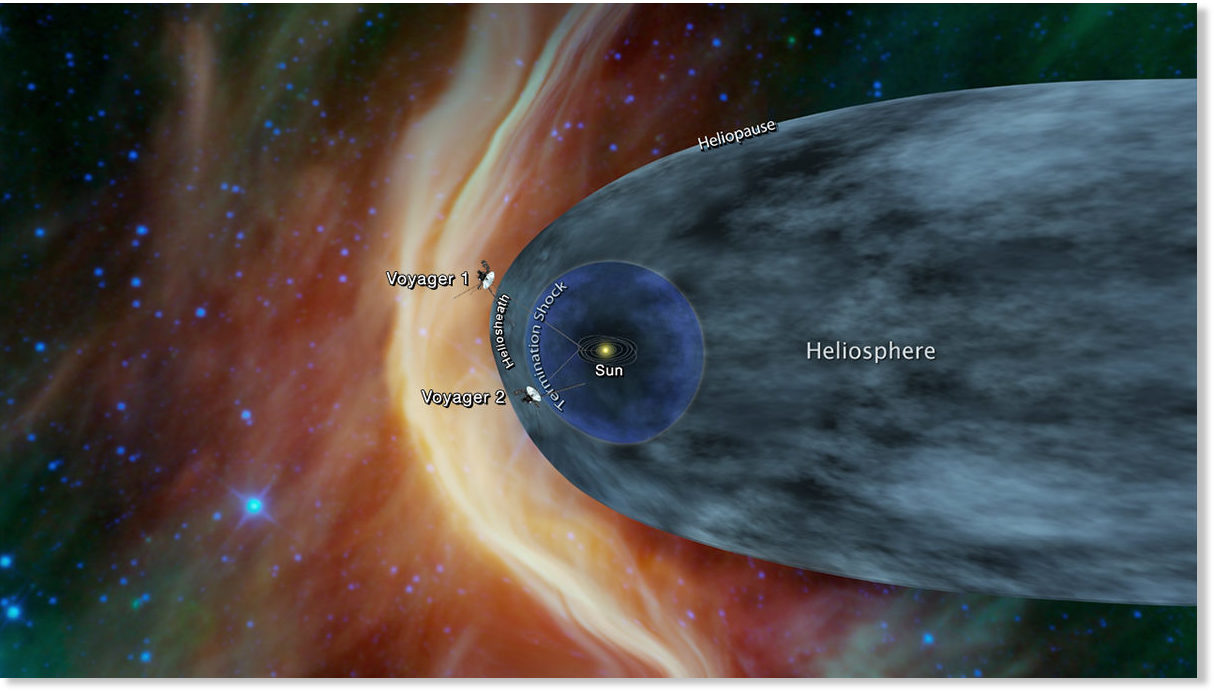
© NASA/JPL-CaltechThis graphic shows the position of the Voyager 1 and Voyager 2 probes relative to the heliosphere, a protective bubble created by the Sun that extends well past the orbit of Pluto. Voyager 1 crossed the heliopause, or the edge of the heliosphere, in 2012. Voyager 2 is still in the heliosheath, or the outermost part of the heliosphere.
Since 2007 the probe has been traveling through the outermost layer of the heliosphere -- the vast bubble around the Sun and the planets dominated by solar material and magnetic fields. Voyager scientists have been watching for the spacecraft to reach the outer boundary of the heliosphere, known as the heliopause. Once Voyager 2 exits the heliosphere, it will become the second human-made object, after Voyager 1, to enter interstellar space.
Since late August, the Cosmic Ray Subsystem instrument on Voyager 2 has measured about a 5 percent increase in the rate of cosmic rays hitting the spacecraft compared to early August. The probe's Low-Energy Charged Particle instrument has detected a similar increase in higher-energy cosmic rays.
Cosmic rays are fast-moving particles that originate outside the solar system. Some of these cosmic rays are blocked by the heliosphere, so mission planners expect that Voyager 2 will measure an increase in the rate of cosmic rays as it approaches and crosses the boundary of the heliosphere.
In May 2012, Voyager 1 experienced an increase in the rate of cosmic rays similar to what Voyager 2 is now detecting. That was about three months before Voyager 1 crossed the heliopause and entered interstellar space.
However, Voyager team members note that the increase in cosmic rays is not a definitive sign that the probe is about to cross the heliopause. Voyager 2 is in a different location in the heliosheath -- the outer region of the heliosphere -- than Voyager 1 had been, and possible differences in these locations means Voyager 2 may experience a different exit timeline than Voyager 1.
The fact that Voyager 2 may be approaching the heliopause six years after Voyager 1 is also relevant, because the heliopause moves inward and outward during the Sun's 11-year activity cycle. Solar activity refers to emissions from the Sun, including solar flares and eruptions of material called coronal mass ejections. During the 11-year solar cycle, the Sun reaches both a maximum and a minimum level of activity.
"We're seeing a change in the environment around Voyager 2, there's no doubt about that," said Voyager Project Scientist Ed Stone, based at Caltech in Pasadena. "We're going to learn a lot in the coming months, but we still don't know when we'll reach the heliopause. We're not there yet -- that's one thing I can say with confidence."
The Voyager spacecraft were built by NASA's Jet Propulsion Laboratory in Pasadena, California, which continues to operate both. JPL is a division of Caltech. The Voyager missions are a part of the NASA Heliophysics System Observatory, managed by the Heliophysics Division of the Science Mission Directorate in Washington.
For more information about the Voyager spacecraft, visit:
https://www.nasa.gov/voyager
https://voyager.jpl.nasa.gov



Reader Comments
you live your life under atmospheric pressure. and yet you know NOTHING about how powerful it truly is.
myself, I do not see any problems with machines operating in a vacuum.
Magdeburg hemispheres.
[Link]
I have walked for hours on end, it never drops off into a curve, no...its flatso. Flat as the top of your head. lol
there is more than one type of HVAC/R equipment that runs in a vacuum. among them are gas furnaces.
it is also routinely necessary to "pull" a vacuum down to 750 or 500 microns when servicing commercial equipment. and yes, I do in fact own a vacuum pump.
the subject matter at hand, had to do with a machine escaping our atmosphere and then operating in a vacuum.
the very fact that you have never met anyone like myself. and do not even appear to know what we do.
reveals quite a bit about who you are and what level you have obtained in life.
[Link]
if you had bothered to ask a question about our atmosphere. I would have answered it for you and increased your knowledge base. why else do you think that I am here?
HVAC/R is an acronym. ( mebbe you should look up just what it means) how could I do my work.. if I did not know what 'air' was?
here are the properties of 'Air"
[Link]
only a fool would think that the word entropy has something to do with a robot losing it's mind.
peace.
[Link]
a) Have you ever seem a ball of gas, free float in the vacuum ... or does the gas get sucked away into the vacuum?
b) Do you think prolonged exposure of an manufactured object, say 40+ years, inside a vacuum is likely to seriously weaken any joins in the object?
pressure does not flow, voltage does not flow. (voltage is electrical pressure) pressure difference causes flow.
to answer b. the vacuum would preserve everything. I would think that it still looks brand new even.
I do not pretend to be a know it all. those who know what I do for a living are aware that it touches on most every other trade.
One might argue that this would be a slow process but science implies that there has been a couple of billion years for our atmosphere to get sucked away
Maybe a vacuum does not affect the long term stability of an object - as there wouldn't be any pressure difference (in the same way that deep sea creatures aren't affected by the huge pressure)
It's just we seem to have been taught that space is a very harsh place, but by all accounts it seems extremely benign
Of course there are machines that were launched in 1977, have survived the benign harmless environment of space for 40 years and are still transmitting information back 17,700,000,000 km to Earth.
The crafts are still operating well within their design limits, increased doses of cosmic rays mean jack shit to these boys
It just such a shame that the Mandela affect caused all that technology to disappear
And you know this as a "FACT", your sure its not on the junkpile at the back of the NASA building.
Rusted and all bent up, with homeless people using it as a tent pole.
I think they fired it up and it bounced of the dome and is in the Marianne trench with a family of hernmit crabs using it as a motor home. As a matter of fact I think I saw a YouTube video on that..lemmi check I'll get back to ya.
I'm still waiting for a sensible answer as to how they coped with 30+KM of curve when building the 1224KM Nord Stream pipeline
100,000 pipes - each pipe is 12M long, 1.15M diameter and 24 tonnes - [Link]
A smooth curve would mean each pipe flexing 30cm
I do in fact own a tubing bender, but I really doubt that is how it is done.
a 'pipe' is a long hole . if you cap one end of it. it is a container. if you cap both ends it is a vessel.
all pipes are made with an extrusion process. I am certain that this is where the curve is formed.
As far as I am concerned the 100,000 pipes joined together are going to be pretty damn straight
The construction information includes details of the technical challenge of "landing" the pipe, where it had to go up an incline as opposed to being laid flat
The PDF has some great images and really give a sense of the scale of the project
The pipe are all uniform cylinders - but there are three different types Each pipe has 41mm steel walls, this is then coated with 4mm of corrosion protection before a 110mm concrete coating
Can you flex such solid pipes - 15cm thick walls
What is the Nord Stream pipe line?
Voyager - high Gain Antenna - [Link]
Brings to mind that question of how long wave radio waves can be transmitted around a globe (over 10,000KM = 90 degrees)
How does a radio wave from Berlin (13 degrees East) get received in New York (73 degrees West) ? ... 86 degrees of a circle?
What about LA (34N/118W) and Tokyo (35N/139E) ... 103 degrees
Maybe you are in Cape Town (33S/18E) and are listening to Melbourne (37S/144E) .. 126 degrees
It get even more questionable when you start to go South - if you can find any history
Here an article about Operation Tabarin - a British operation to the Falkland Islands in 1944 - [Link] Falkland Islands are 51S / 57W ... where the listening to London (51N/0E) or NY (40N/73W)
At the end of 1945, Tabarin was rebranded the Falkland Islands Dependencies Survey, using the same bases and many of the same personnel. In 1962, it became known as the British Antarctic Survey.