
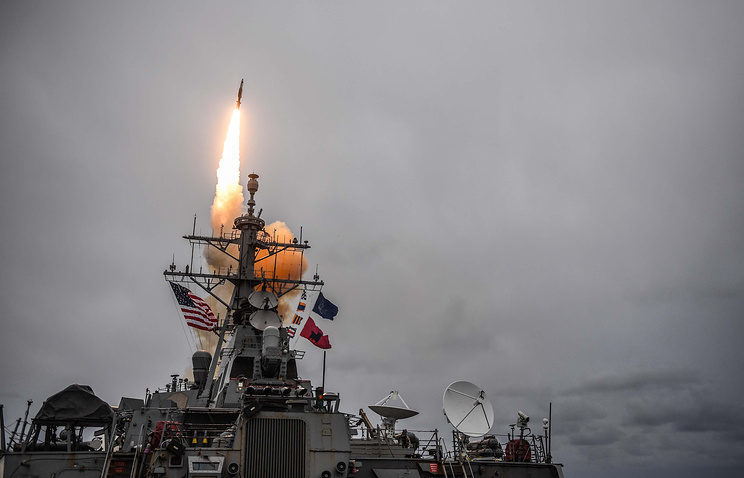
© EPA-EFE/US NAVY/MC1 THERON J. GODBOLDFile photo
The Russian Defense Ministry stated that 103 cruise and air-to-surface missiles were launched on different targets across Syria adding that 71 of them were intercepted by the Syrian Air Defense Forces (SADF).
"According to available information, a total of 103 cruise missiles were fired... The Syrian air defense systems basically comprising Soviet-made weapons successfully repelled the strikes by aircraft and naval ships. A total of 71 missiles were intercepted," Head of the Russian General Staff's Main Operations Department Colonel-General Sergei Rudskoi said.Rudskoi said that the SADF had used its S-125, S-200, Buk, Kvadrat and Osa air defense systems to repel the strike.
The Syrian General Command said that the US, the UK and France had launched 110 missiles also adding that most of them were intercepted.
The numbers provided raise serious questions.
Some experts contacted by SouthFront said that even theoretically the SADF had not been capable to shoot down more than 15-20% of the launched missiles using its S-125, S-200, Buk, Kvadrat and Osa systems only. The SADF just does not have enough means and measures to intercept such a number of missiles simultaneously in one striking wave.
So what really happened?
The experts suggested that the Russian military had possibly used its state-of-the-art electronic warfare (EW) systems to counter the launched missiles during their final phase of flight path.
The most part of the flight path, the guidance for the Tomahawk cruise missile is provided by GPS. However, in the final phase, the missile starts using its internal guidance system. During this phase of the flight path the missile is vulnerable for EW counter-measures.Another factor, which "highly likely" contributed to the effectiveness of the Syrian counter-measures, is that Russia had provided the Syrian military with operational data from its technical reconnaissance net, including satellites and other surveillance means. Likely, Iran had done a similar thing. Thus, missiles launched from the Red Sea were detected immediately and were being tracked during all their flight path.
The missiles impacted by EW systems start to steer off. The missiles' speed significantly reduces and they become an easy target for air defense systems or fall.
Using tracking data, Russian-made air defense systems are capable of shooting down cruise missiles with a relatively high efficiency.
In any case, the 71 intercepted missiles of 103 launched are a decisive failure for the US and its allies. No doubts, the US military leadership did not expect this scenario.
If the data provided by the Russian Defense Ministry is confirmed, this will be the first time in the history when some side was able to repel a massive strike of the so-called modern high-precision weapons/missiles. So, in a case of a nuclear exchange between the US and Russia, the Russians will be able to intercept most of the US attacking means suffering a minor damage. Russia's nuclear strike would be a crushing blow.
So far [13:15 CET], the US has provided no comments on reports about the 71 downed missiles and has not even provided official info about the targets and weapons involved in its strike on Syria. Considering that the administration of US President Donald Trump likes "PR moves", such a stance may be described as an idication that something "went wrong".





Comment: More 'facts on the ground' for the war mongers in the Pentagon to chew on. Will it make them more cautious in their future chest-thumping?
According to the Russian MOD, here is the breakdown of missiles fired and intercepted:
- Four missiles were launched at the area of the Damascus International Airport. All missiles were intercepted.
- 12 missiles were launched at the Al-Dumayr Military Airport. All missiles were intercepted.
- 18 missiles were launched at the Baly Military Airport. All missiles were intercepted.
- 12 missiles were launched at the Shayarat Military Airport. All missiles were intercepted.
- 9 missiles were launched at the Mezzeh Military Airport. Five missiles were intercepted.
- 16 missiles were launched at the Homs Military Airport. 13 missiles were intercepted.
- 30 missiles were launched at targets in the areas of Barzah and Jaramani. Seven missiles were intercepted.
In other words, 4 hit Mezzeh Airport, 3 hit Homs Airport, and 23 hit Barzah and Jaramani.Compare that to the Pentagon's: