
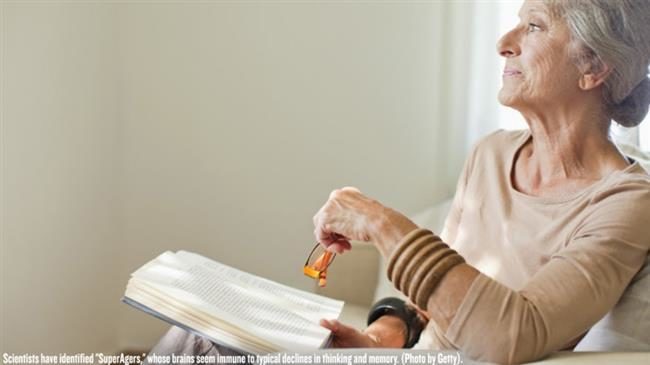
© Getty Images
The work is the flip side of the disappointing hunt for new drugs to fight or prevent Alzheimer's disease.
Instead, "why don't we figure out what it is we might need to do to maximize our memory?" said neuroscientist Emily Rogalski, who leads the SuperAging study at Chicago's Northwestern University.
Parts of the brain shrink with age, one of the reasons why most people experience a gradual slowing of at least some types of memory late in life, even if they avoid diseases like Alzheimer's.
Comment: Is brain shrinkage just a natural part of growing old or is it that our current toxic environment (both physically and mentally) leads to a deteriorating brain? Are "superagers" really an anomaly or are they how humans are supposed to age?
But it turns out that superagers' brains aren't shrinking nearly as fast as their peers. And autopsies of the first superagers to die during the study show they harbor a lot more of a special kind of nerve cell in a deep brain region that's important for attention, Rogalski told a recent meeting of the American Association for the Advancement of Science.
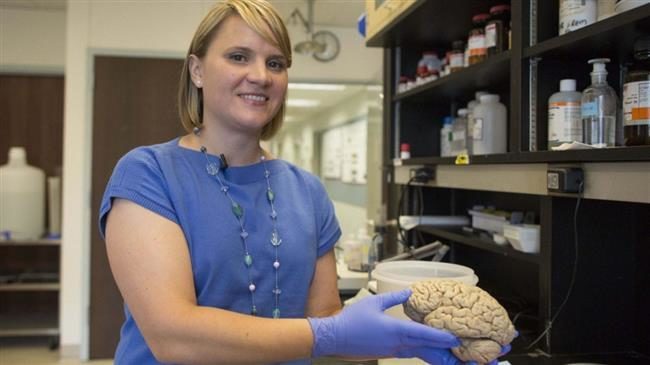
Emily Rogalski leads the SuperAging study at Chicago's Northwestern University
What does it take to be a superager? A youthful brain in the body of someone 80 or older. Rogalski's team has given a battery of tests to more than 1,000 people who thought they'd qualify, and only about 5 percent pass. The key memory challenge: Listen to 15 unrelated words, and a half-hour later recall at least nine. That's the norm for 50-year-olds, but the average 80-year-old recalls five. Some superagers remember them all.
Rogalski's superagers tend to be extroverts and report strong social networks, but otherwise they come from all walks of life, making it hard to find a common trait for brain health. Some went to college, some didn't. Some have high IQs, some are average. She's studied people who've experienced enormous trauma, including a Holocaust survivor; fitness buffs and smokers; teetotalers and those who tout a nightly martini.
Comment: Or maybe the researchers are asking the wrong questions. Perhaps looking at how people use their brains may offer more insight into how some manage to keep it healthy than whether or not they smoke or drink. See: New Cortex Study Uncovers How We Recognize What is True and What is False
But deep in their brains is where she's finding compelling hints that somehow, superagers are more resilient against the ravages of time.
Early on, brain scans showed that a superager's cortex - an outer brain layer critical for memory and other key functions - is much thicker than normal for their age. It looks more like the cortex of healthy 50- and 60-year-olds.
It's not clear if they were born that way. But Rogalski's team found another possible explanation: A superager's cortex doesn't shrink as fast. Over 18 months, average 80-somethings experienced more than twice the rate of loss.
Another clue: Deeper in the brain, that attention region is larger in superagers, too. And inside, autopsies showed that brain region was packed with unusual large, spindly neurons - a special and little understood type called von Economo neurons thought to play a role in social processing and awareness.
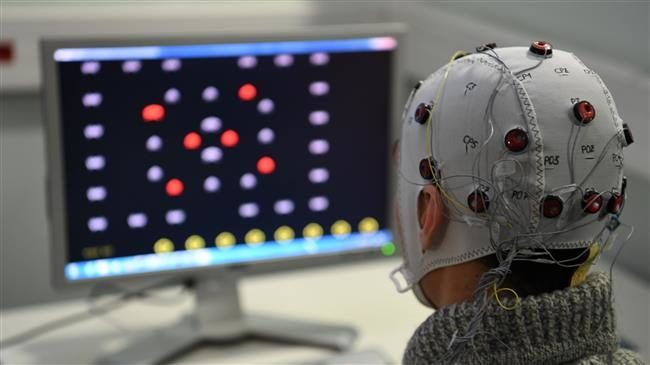
© AFPA picture taken on November 20, 2017 at the GIPSA-lab at the CNRS of Grenoble shows a researcher using a Brain-Computer-Interface helmet "Brain Invaders" which enables to select symbols without motor command.
The Northwestern study isn't the only attempt at unraveling long-lasting memory. At the University of California, Irvine, Dr. Claudia Kawas studies the oldest-old, people 90 and above. Some have Alzheimer's. Some have maintained excellent memory and some are in between.
About 40 percent of the oldest-old who showed no symptoms of dementia in life nonetheless have full-fledged signs of Alzheimer's disease in their brains at death, Kawas told the AAAS meeting.
Rogalski also found varying amounts of amyloid and tau, hallmark Alzheimer's proteins, in the brains of some superagers.
Now scientists are exploring how these people deflect damage. Maybe superagers have different pathways to brain health.




Remember that fear is a self-fulfilling prophecy, and see if love of life cannot replace fear of death (sickness and loss) as the mover of your life, now and now, for attending your now is not a loss of memory so much as a trusting to know what you need to know when you need to know it.
If we are attending what was or what may yet be, we are not in the true field of relationship. Dissociation from our source and sustenance drives a depleting, conflicted, exhausting attempt to manage under strain.
If going through the motions ticks a box for achieving certain markers assigned as 'healthy' are you in fact radiant?
Radiance is the natural disposition of joy. Using the mind as a tool for communication rather than as a manipulation of or defence against it, is a full spectrum immanence in which denials show up to be healed rather than piling up as toxic debt that then clogs or blocks the life force from its natural expression.