
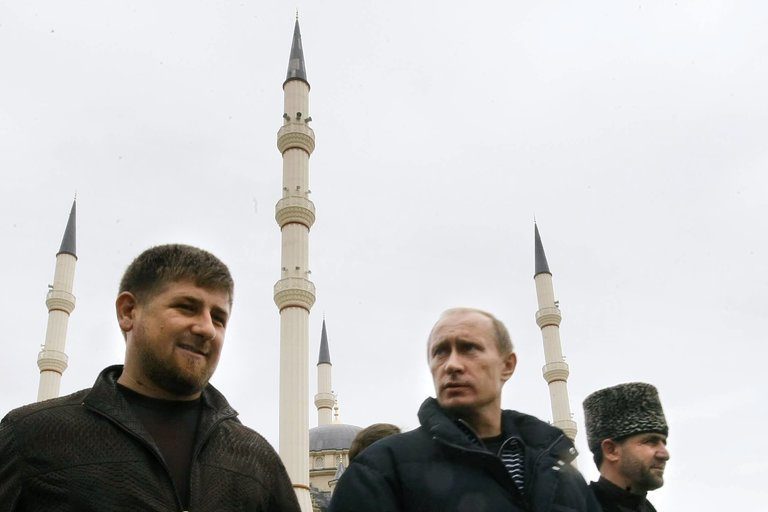
© Alexey NikolskyVladimir V. Putin visiting a mosque in Grozny in 2008 with the Chechen leader Ramzan Kadyrov.
He and President Trump, notably dismissive of political correctness, would seem to have found common language on fighting terrorism - except on one point of, well, language.
During his campaign, Mr. Trump associated Islam with terrorism and criticized President Obama for declining to use the phrase "radical Islamic terrorism."
However, Mr. Putin, whom Mr. Trump so openly admires for his toughness, has, for more than a decade, done exactly what President Obama did. He has never described terrorists as "Islamic" and has repeatedly gone out of his way to denounce such language.
"I would prefer Islam not be mentioned in vain alongside terrorism," he said at a news conference in December, answering a question about the Islamic State, a group he often refers to as "the so-called Islamic State," to emphasize a distinction with the Islamic religion.
At the opening of a mosque in Moscow in 2015, Mr. Putin spoke of terrorists who "cynically exploit religious feelings for political aims."
In the Middle East, Mr. Putin said at the mosque opening, "terrorists from the so-called Islamic State are compromising a great world religion, compromising Islam, sowing hatred, killing people, including clergy," and added that "their ideology is built on lies and blatant distortions of Islam."
He was careful to add, "Muslim leaders are bravely and fearlessly using their own influence to resist this extremist propaganda."
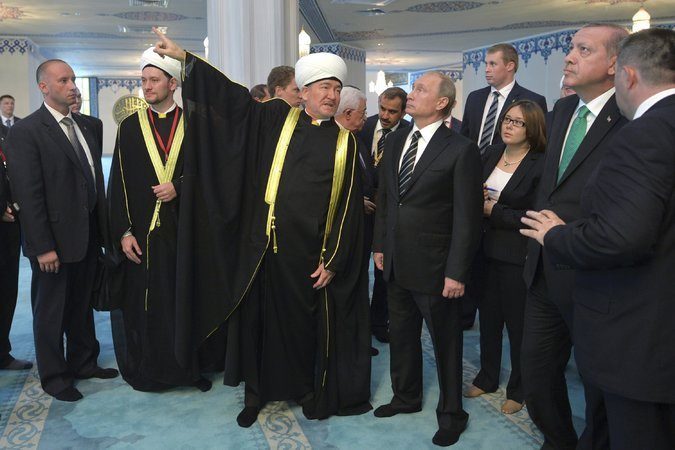
© RIA Novosti/ReutersMr. Putin and President Recep Tayyip Erdogan of Turkey, second from right, during the inauguration of a mosque in Moscow in September 2015.
Mr. Putin does not take this stance to soothe the feelings of Western liberals, a group he dismisses as hypocritical in any case.
"Putin prides himself on Russia's intelligence capabilities," the Brookings Institution wrote in a study of the early formation of his counterterrorism policies. "Russian leaders think they know their enemy," and it is not the governments of majority Muslim countries such as Iraq and Iran, or the majority of Muslims living in Russia.
Instead, Russian counterterrorism strategy focused on financing and militarily backing moderate Muslim leaders, with the breakthrough in the Chechen war coming when the region's imam, Akhmad Kadyrov, allied with the Russian military. His son, Ramzan Kadyrov, leads the region today.
Comment: What a concept! Backing moderates! The Western powers might want to try it some time.
While embracing Islamic leaders as a centerpiece of its counterterrorism strategy, however, the Kremlin did not avoid drawing distinctions along religious lines.
The Russian government backed the Kadyrov family's campaign to revive traditional Sufi Islam in Chechnya as a counterweight to the more austere Wahhabi denomination professed by many separatists. The Wahhabi strain was outlawed in another restive, predominantly Muslim province, Dagestan, and its adherents are persecuted in Russia, rights groups say.
Still, the alliance with moderate Islamic religious leaders became important in pacifying Chechnya and other North Caucasus regions, which have ceased to pose a serious security threat to Russia.
"Putin rules a multiconfessional country," Orkhan Dzhemal, a commentator on Islamic affairs, said in a telephone interview, noting that in the United States, in contrast, Muslims are not a powerful political force. "He cannot say 'Islamic terrorism' for a simple reason. He doesn't want to alienate millions of Russians."
The term preferred in Russian political parlance is "international terrorism."

Reader Comments
to our Newsletter