

Saturday's Forecast Upper-Level Pattern
Brighter colors indicate warmer temperatures and darker colors indicate cooler temperatures.
Brighter colors indicate warmer temperatures and darker colors indicate cooler temperatures.
A southward dip in the jet stream, or upper-level trough, was the common weather pattern during the summer in the East, while a northward bulge in the jet stream, or upper-level ridge, often set up in the West. This overall pattern will get a boost during the first full week of September as the trough sweeps almost as far south as the Gulf Coast.
Temperatures are typically below average underneath a trough as cooler air is drawn southward out of Canada, and a blast of true fall-like air will engulf the eastern and southern states at times during the middle of the upcoming work week.
Next Week
Temperatures will start the week closer to average before another cold front sweeps through much of the East and South Tuesday into Wednesday.
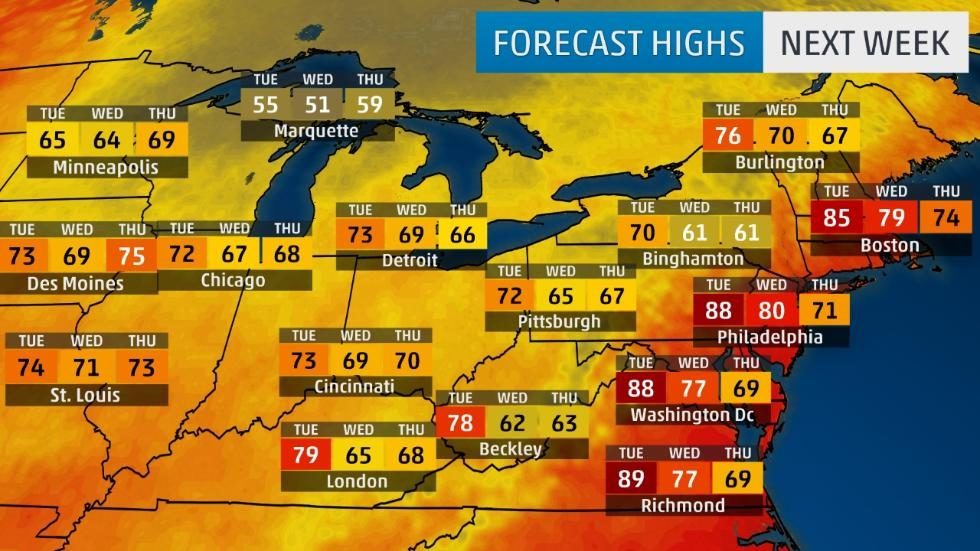
Forecast Highs
This means highs will be in the 60s and 70s across the Northeast, mid-Atlantic, Midwest and even much of the South by Wednesday and Thursday. However, temperatures may get stuck in the 50s across the upper Great Lakes mid-next week.
Lows should dip into the 50s as far south as the mid-South region mid- to late next week. In the upper Mississippi Valley and upper Great Lakes, a few spots may fall into the 30s and 40s. The Southeast and Gulf Coast will likely hold in the 60s to near 70 degrees for lows.
Labor Day Weekend Chill
Several record lows were set going into Labor Day weekend. On Friday morning, record lows were set in Alpena, Michigan (36 degrees - tied); Watertown, New York (37 degrees - tied); Flint, Michigan (39 degrees); Binghamton, New York (42 degrees); Syracuse, New York (42 degrees - tied); Poughkeepsie, New York (43 degrees) and Bridgeport, Connecticut (52 degrees - tied).
On Saturday morning additional record lows were broken, including, Glens Falls, New York (34 degrees); Albany (38 degrees); Binghamton, New York (39 degrees - tied); Poughkeepsie (40 degrees); Hartford, Connecticut (41 degrees); Springfield, Illinois (42 degrees); Providence, Rhode Island (46 degrees); Newark, New Jersey (49 degrees) and New York City's LaGuardia Airport (56 degrees - tied).
A few record-cold high temperatures have also been observed. On Friday the following cities set new records for coolest high temperature for the date: Dayton, Ohio (59 degrees), Columbus, Ohio (62 degrees), Pittsburgh (63 degrees) and Watertown, New York (64 degrees).


Reader Comments
I know only two definitions:
- climatological autumn (which may be related to this "meteorological fall", because meteorologists I know use it sometimes), which for temperate climate is when average daily temperatures change in range between 5°C and 15°C, and it comes after summer (which also has its definition, and comes after spring).
- astronomical autumn, which begins with autumnal equinox, and thus is closest to be defined by actual date. Still, its beginning varies, it's usually between September 22nd and 23rd, earliest on September 21st (Northern hemisphere, of course, it's shifted by 6 months for Southern one).
I suppose it's a thing of US meteorologists, which they devised for their convenience. There's not much calculation behind it (heh), so they can have time for more important things, like choosing a tie or doing a hair. Personally I would never use anything else than astronomical definition.