
Brzezinski, Chomiak, and Freeland blamed not Germany, but Russia, imperial and Soviet Russia, for taking away their Galician birthright; they spent lifetimes advocating war against the Russians in revenge. Chomiak also spent 1939 to 1945 on the German side, liquidating the Poles of Galicia, as well as the Jews and the Russians. Brzezinski was safe in Canada by then, where his father Tadeusz Brzezinski, a professional diplomat, was Poland's consul-general to Montreal. He remained there, employed by the Polish government in exile, after Germany invaded Poland and set up a special administrative zone for Galicia, incorporating southeastern Poland and northwestern Ukraine; Lvov (Lwow, Lviv) where the Chomiak family was living; and the Tarnopol (Ternopil) district where Zbigniew Brzezinski claims his nobility had its origin.
Brzezinski didn't think much of Canada. From the age of 10 until he graduated from McGill University at the age of 22, he lived in Westmount, the upper-class district of Montreal, and at a summer dacha 80 kilometres north of the city.
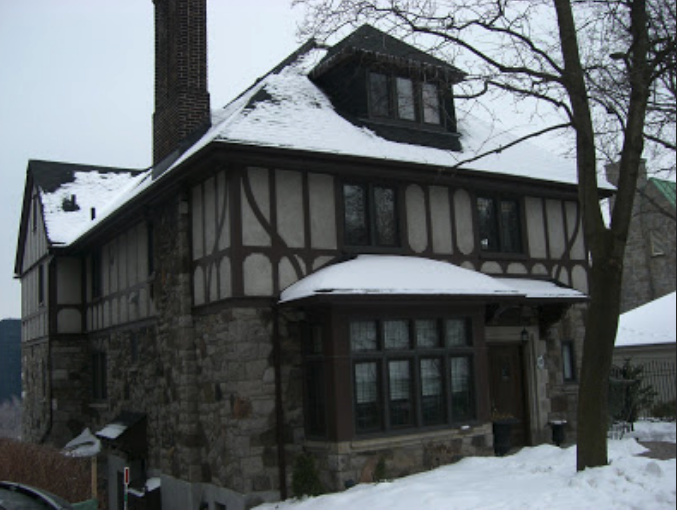
© UnknownThe Brzezinski family home at 60, Chemin St. Sulpice, Westmount (Montreal).
In his only reference to Canada in The Grand Chessboard, Brzezinski's 1997 master plan for what he subtitled "American primacy and its geostrategic imperatives", Brzezinski makes just one passing reference to his second homeland. He calls Canada "a state that is respected for the constructive use of its wealth and power but one that is neither feared nor resented." What Brzezinski meant was that if a country is neither feared nor resented, it has no power worth the term. Brzezinski wanted power and to be feared and resented himself. For that Canada was too small and insignificant to suit his ambitions and purposes.
So was Galicia, and Poland too; although according to Radoslaw Sikorski, a Polish and British citizen, foreign minister of Poland, speaker of the Polish parliament, and Russia-hater, "during the decades when Poland was stuck against her will behind the Iron Curtain, he [Brzezinski] and the Polish pope were the two most important voices for a free Poland abroad." Ousted from Polish government and politics, Sikorski is at the moment an employee of the Brzezinski Institute on Geostrategy at the Center for Strategic and International Studies (CSIS) in Washington.
Brzezinski's family name identifies its origin in Brzezany (Бережани), though Tadeusz was born in Zloczow (Zolochiv), Zbigniew in Warsaw. Brzezany is 90 kilometres southeast of Lviv in territory on the Russian empire side of the line dividing the older Polish empire. Zolochiv is equidistant from Lviv but due east, about 50 kilometres north of Brzezany.
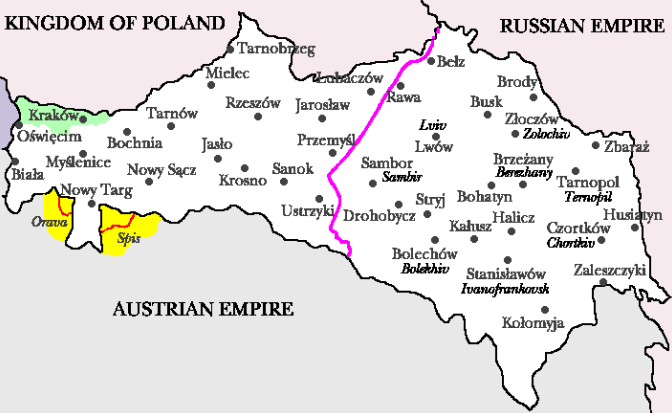
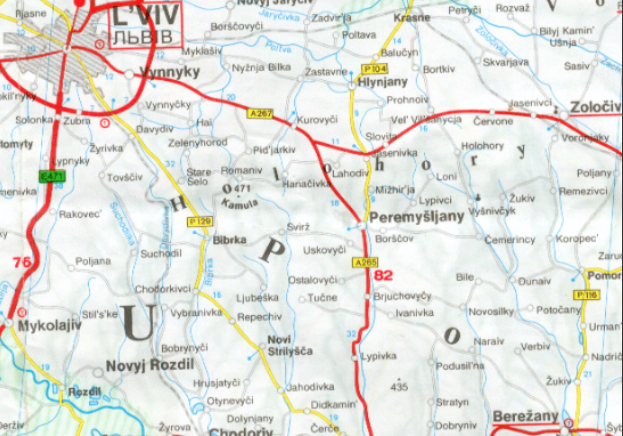
Brzezany (Berezany) on the map of Ukraine today; Zloczow, where Brzezinski's father was born, is Zolochiv (Ukrainian: Золочів), is 60 kilometres to the north.
During World War II Brzezany was occupied by the German Army, and administered by Galicians like Michael Chomiak; that's Chrystia Freeland's grandfather and proponent of the idea that Brzezany should be liberated, er liquidated of Poles, Jews, Russians, gypsies, communists. For that purpose the Germans set up the Bełżec death camp nearby, and later Majdanek. Lucky Brzezinski, who would have been rounded up and shipped to one or the other as a member of the Polish-speaking majority of Brzezany. But by then Brzezinski and his family were safe in Montreal.
As the Chomiak (Freeland) family fled to Bavaria with the German forces, and then signed up with US intelligence agencies running sabotage and propaganda operations in Soviet Ukraine, Tadeusz Brzezinski remained a Polish state employee until 1945. He then joined the Quebec culture ministry to manage French-speaking centres around the province. While the Lviv University graduate Chomiak spent the rest of his life mobilizing Ukrainian-Canadians from a home in Alberta (he died in 1984), the Lviv University graduate Tadeusz Brzezinski was doing something similar from Montreal at the Polish Canadian Congress, then the World Polish Congress. He died in 1990.
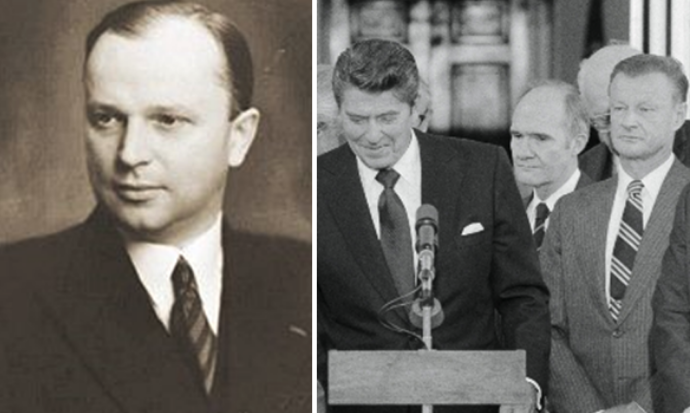
Left: Tadeusz Brzezinski. Right: Zbigniew Brzezinski, with President Ronald Reagan in 1981. Brzezinski claims (posthumously) that Reagan asked him to continue as his National Security Advisor, after President Jimmy Carter was replaced at the start of that year; Brzezinski claims he turned Reagan down.
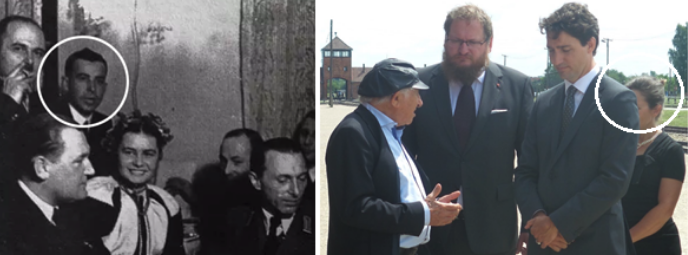
© UnknownLeft: Michael Chomiak with German military administrators in Cracow, 1943. Right: Chrystia Freeland behind Prime Minister Justin Trudeau at Auschwitz in 2016.
Freeland was once a junior afternoon panellist at a CSIS global security talkshow in April 2012, when Brzezinski was a senior panellist in the prime morning spot. In July 2014 they appeared together on a CNN talkshow to blame President Vladimir Putin for the destruction of Malaysia Airlines flight MH17, which had been shot out of the air over eastern Ukraine three days earlier.
According to Brzezinski, "this is truly a historically defining moment... We are, in fact, facing the first use of force over territorial issues in Europe since the outbreak of World War II. Putin is doing it." Brzezinski recommended setting up a war crimes tribunal to indict and punish those responsible for the killing of all on board MH17. Brzezinski's idea was that either Putin should put on trial those of his underlings whom Brzezinski already believed were guilty; or if Putin refused, that would prove to Brzezinski's satisfaction that Putin was guilty of the crime himself.
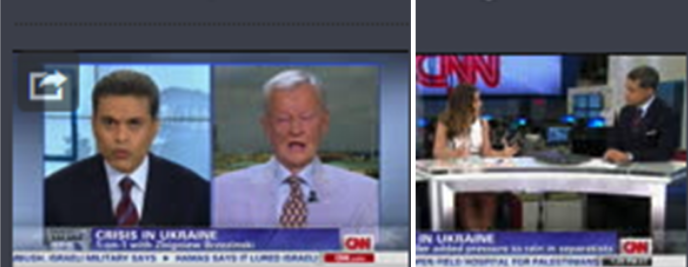
The CNN videotape reveals that Freeland (right) was in the studio, Brzezinski (left) elsewhere. Click to watch
Freeland played Little Miss Echo. "This is a fight entirely created, organized and armed by the Kremlin. This is not a Ukrainian civil war. The separatists, many of them are led by Russian nationals, openly Russian nationals who have worked for the Russian security forces. They are using weapons which have come from Russia. There is one person who could stop this tomorrow and that is Vladimir Putin....One thing, though, that I think is really important that's Zbig [sic] talked about is this could be an exit moment for Kremlin — for the Kremlin and for Putin. Putin can now say, if he is smart — you know, this is a disaster for him, it has gone completely wrong and if he is smart, he can separate himself from these guys and the world community can move on."
Putin's "exit moment" hasn't come. Brzezinski's came on May 26. Although Brzezinski became a US citizen in 1958, it isn't known whether he retained his Polish citizenship or ever held Canadian citizenship. In its death notice for him, the Canadian Broadcasting Corporation (CBC) omitted to mention that Brzezinski had grown up and been schooled in Montreal. A Canadian member of CBC's audience commented: "Sad the CBC can't report the formidable Canadian connection."
McGill University hasn't mentioned Brzezinski since 2001 when he was identified as a past Polish visitor of note (not a graduate), trailing Pope John Paul II (then Cardinal Karol Wojtyla) and the poet Czeslaw Milosz.
Freeland's tweet file is voluminous, but the only death she mentioned on May 26 was a terrorist attack in Egypt. Freeland hasn't mentioned Brzezinski before, or since.


For background notes: Global Research
In Canada, the Global Radio News Hour is broadcast by nine radio stations in British Columbia, Manitoba, Ontario and New Brunswick, including Simon Fraser University, University of Victoria, University of Winnipeg, campus and community radio stations in Ontario, and the University of New Brunswick St Johns.
In the US, the Global Radio News Hour airs from Boston College, Massachusetts, and the Progressive Radio Network. For more details, call-signs and listening times, click.

Reader Comments
It's these people in the background and that's what stands out to me in this article. Leeches sitting behind the king, whispering in his ear, and it's these people that have been in hall of power since forever. The Martin Bormann's of all political history. That's what thi guy was to me. I hated him for this more than any other single thing. I hate him for the unfounded influence he had, for the lives and wealth robbed from every day people so that he could have his way. I've grown to despise the political process and those who are a part of it because that's all any of them are now; just a bunch of people looking to fill their own pockets and whom couldn't care less about what's right or who's kid is now standing on a corner in America begging for spare change.
Call em a psychopath if you want, but that's not doing anything to get them out of power, and we still have the same thing going down. The processes for placing people in positions of control are corrupted. It's not like the way we choose the director of the FBI is a democratic process. No one collects a list of names of the most ethical and most intelligent people from communities across the United States, but we should, and then we should be the onces choosing those people and there should be no political labels applied to any of them, only the promises and words written and spoken by those exact same people for us to read, and from which to make a choice from.
This guy Donald has selected for the Director of the FBI, what do I really know about him? Are there any words he's written to the American People about who he is, what he promise to do, what his agenda would be if he were to become the director? No, instead I have to expect that, somehow, these stooges of corporate america whom now control the government will choose the right person, ask the questions I'd ask.
We can't expect change until we change how our top lawmen are chosen and none of those people should be politically appointed people. That's just stupid.
[Link]
[Link]