
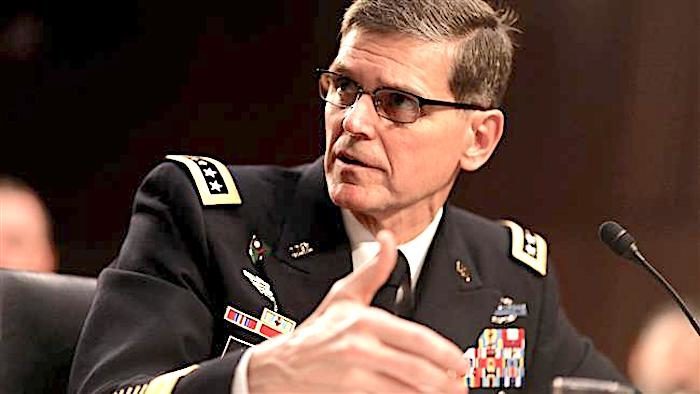
© ReutersUS Army General Joseph Votel, the commander of the US Central Command
Army Gen. Joseph Votel told the House Armed Services Committee on Wednesday that the U.S. does not want Yemen to be used as a sanctuary for attacks against the U.S. and allies or for militants to choke off the Red Sea's Bab el-Mandeb strait, which runs past Yemen on the Arabian Peninsula as well as Djibouti and Eritrea on the Horn of Africa.
Comment: If the US wasn't in the Bab el-Mandeb strait, it wouldn't be a sanctuary for attacks against the US. If Saudi Arabia and cohorts weren't bombing the blazes out of Yemen and killing off its population, the same applies.
The comments came as U.S. Defense Secretary Jim Mattis is asking the White House to lift restrictions on U.S. military support for Saudi Arabia and the United Arab Emirates, The Washington Post reported this week. The plan under consideration reportedly includes backing a planned Emirati offensive to retake a key Red Sea port.
Altogether, it would be a more aggressive tack against Iran for the U.S., beyond counterterrorism operations against the local al-Qaida affiliate. On Wednesday, Votel said Tehran "poses the greatest long-term threat to stability" of the region and that the U.S. must disrupt, expose and hold it accountable through a combination of diplomatic and military action. "That has to be done, they have to account for their destabilizing role in the region right now," Votel said.
The four-star general also stressed the threat posed by the al-Qaida affiliate in Yemen. "This is the franchise of al-Qaida that has demonstrated in the past — that has tried to attack our homeland, and some of those people still exist," he said. "That's a key aspect, and our focus is on disrupting it."
Comment: Perhaps Votel should refresh his memory on the origins of al-Qaida and who-all was really responsible for 9/11. He should also remind himself that Iran did not start the Yemeni conflict, did not destabilize the region, nor is it responsible for the massacre of the Yemeni people.
An escalating role for the U.S. would risk complicity in a spiraling humanitarian crisis, as fighting between a Saudi-led coalition of regional states and Houthi rebels has cut off food supplies and yielded thousands of civilian casualties. In the public hearing on Wednesday, which preceded a closed-door session, lawmakers did not probe the risks in depth. But Votel did nod at them in his discussion of U.S. interests. "All of that is against the backdrop of the civil war, and we all understand the implications of becoming involved in those types of activities, and if we don't choose to move forward militarily, we have to look at ways to move forward and resolve that situation," Votel said.
Rep. Paul Cook, a former Marine colonel and a member of both the the House Armed Services and Foreign Affairs committees, replied: "Obviously everyone wants peace in the area and the fighting to stop, but until that happens, I think we have to take the side of our friends and allies.
Comment: Wrong. They have to take the side of innocent civilians. That is what militaries were created to do. (But that doesn't count when you are selling weapons and equipment to the slaughterers.)
"They are so concerned that Iran is using the Houthi rebels as a proxy to destabilize and come after them," the California Republican said. "While I don't think we need boots on the ground, as much as we can do with [intelligence, surveillance and reconnaissance] to support our friends and allies is critical."
Amid questions from Cook, Votel affirmed the Foreign Military Financing and Foreign Military Sales programs are "extraordinarily important" in the region, and he said he was concerned when the U.S. does not share systems,potentially driving allies to buy elsewhere. The comments came after the State Department earlier this month reportedly approved a resumption of weapons sales that critics had linked to Saudi Arabia's bombing of civilians in Yemen. In September, the Senate voted down a measure to block the $1.15 billion sale of U.S. tanks to Riyadh.
In the Bab el-Mandeb strait, the U.S. Navy has already expanded its presence. The destroyer Cole was tasked Feb. 3 with patrolling the region, days after a suicide boat attack by Yemeni Houthi rebels on the Saudi frigate Al Madinah off the port of Al Hudaydah killed two sailors on the warship. Stressing the waterway's importance for international commerce and U.S. freedom of navigation, Votel said that it threatened to become "an extraordinarily restricted strait."
With Iran's backing, the strait has become militarized, he said, with "a layered defense" of coastal missiles, radar systems, mines and explosive-laden boats — "threatening ships and our security operations."
Comment: And US ships decked in full armor don't count in the militarization. Iranian paramilitary boats are small patrol boats.
These capabilities, he said, have migrated from the Strait of Hormuz, an important waterway for the oil trade at the mouth of the Arabian Gulf, where Iranian paramilitary boats have routinely faced off against U.S. naval forces.
Votel suggested use a combination of diplomatic and military efforts to resolve the issue. "This is an area where we will need the Department of State to help us," he said. Amid questions from lawmakers about Iran's probing naval maneuvers and perceived harassment of U.S. ships, Votel attributed the alleged aggression to Tehran's aspirations to be the dominant regional power and downplayed their effect.
"I'm extraordinarily confident in our leaders and in the processes, procedures and capabilities they have to properly defend themselves," Votel said. "The presence of these types of boats have seldom, if ever prevented us from doing their missions. [The paramilitary boats are] there to demonstrate their presence, in some cases be provocative."
Votel affirmed that Tehran had increased destabilizing acts since the nuclear deal, which intentionally or not, will hand ammunition to critics of the controversial treaty. "I believe they have," Votel said. "I believe that Iran is operating in what I would call a gray zone. It's a competition between states and its just short of open conflict. They do it through surrogate forces, through lethal aid, and through their own cyber activities and influence operations."
Comment: And who would know this mode of operation better than the creators, facilitators and protectors of ISIS?
There are more that 100,000 Iranian-backed Shia militants in Iraq, and that poses "a big concern" about Tehran's influence beyond the fight against the Islamic State group, he said, as the U.S. advises Baghdad on integrating Shia paramilitary forces.





Hey Bozo, I SERVED my country and it wasn't pretty, neither was it behind a desk writing reports. Give that stooge an M16 and send him in the middle East. I don't think that after that he 'll be able to utter a single word about "U.S. interests".
P.S. Under my command ,none, not a single person ever got hurt.