
© Getty
A study published this week in Nature Communications led by the DNA testing company Ancestry.com presents exactly this kind of bird's eye view. Last month, Ancestry surpassed 3 million customers in its DNA databases. That's an awful lot of DNA, and now the company has set its sites on figuring out exactly what it might learn from all of it.
In the new study, Ancestry's scientists set out to build a picture of how North America's population moved across the country over the past few hundred years. Using genotype data from over 700,000 individuals who have purchased the company's DNA kits, scientists created a network of genetically-identified relationships and then used network analysis techniques to identify clusters of individuals.
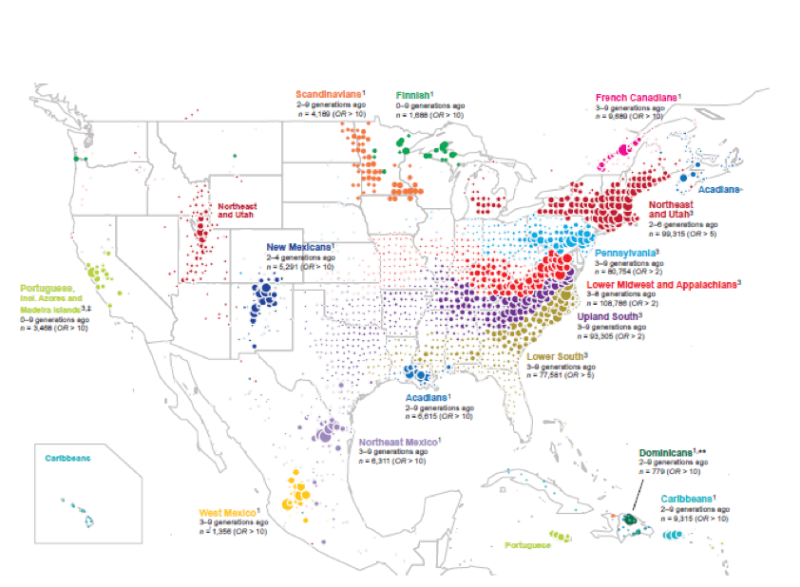
Distribution of ancestral birth locations in North America associated with clusters included in the study. Image: Nature Communications
Genetics have been used to track historical migration before, but this new study gives us a instead a look at recent history. Where the data is most remarkable is in its granularity—in the ability to point not just to France but to specific regions of France, and track the migration of those groups of people over time.
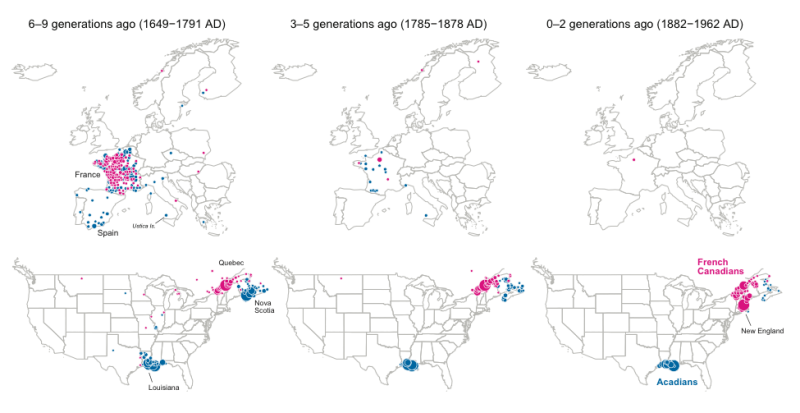
© Nature CommunicationsGenealogical data by generation traces migration of French Canadians (magenta) to the US and origins of Cajuns/Acadians in Atlantic Canada (blue). Genealogical data by generation traces migration of French Canadians (magenta) to the US and origins of Cajuns/Acadians in Atlantic Canada (blue).
For Ancestry, all this means that when the company sequences your genotype, it might one day be able to tell you the specific county in Ireland your great-great-grandfather hailed from.
"We've never had a map like this of North America," Topol said. "This is a massive data set."
This kind of data presents more opportunity than just a fun dive into the annals of history. Clusters of genetically-similar individuals could help us discover more about the genes certain groups have in common, and how those commonalities might impact things like health. For instance a protective gene variant, or allele, for squamous cell lung carcinoma appeared to be 10 times more common in a cluster of Finnish immigrants. A risk allele for prostate cancer similarly had a frequency of 5.6 percent in an African American cluster, but was extremely rare outside of it.
At a time when our nation is divided along lines both racial and political, though, perhaps the most important revelation in the study is that we really are all immigrants.



Reader Comments
The dna mining is a rich treasure trove. I am sure the corporates have already put in place the 'marriage brokers' who will provide verifiable blood lines for us. And I thought that the squeeze for a 'health care fee' was the last they would get out of us but NO, wrong again.