Alexander Mercouris
The DuranSat, 07 Jan 2017 20:51 UTC
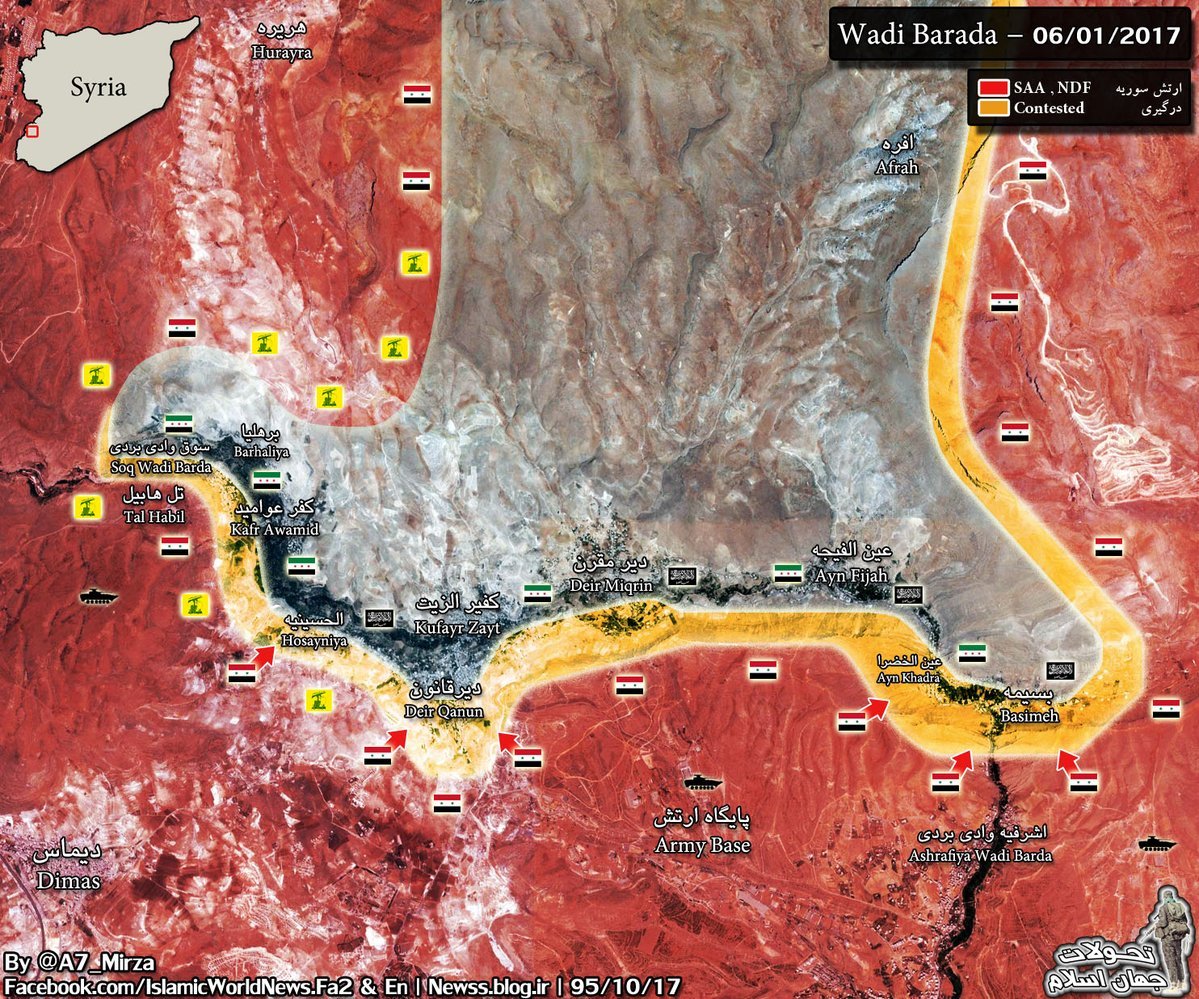
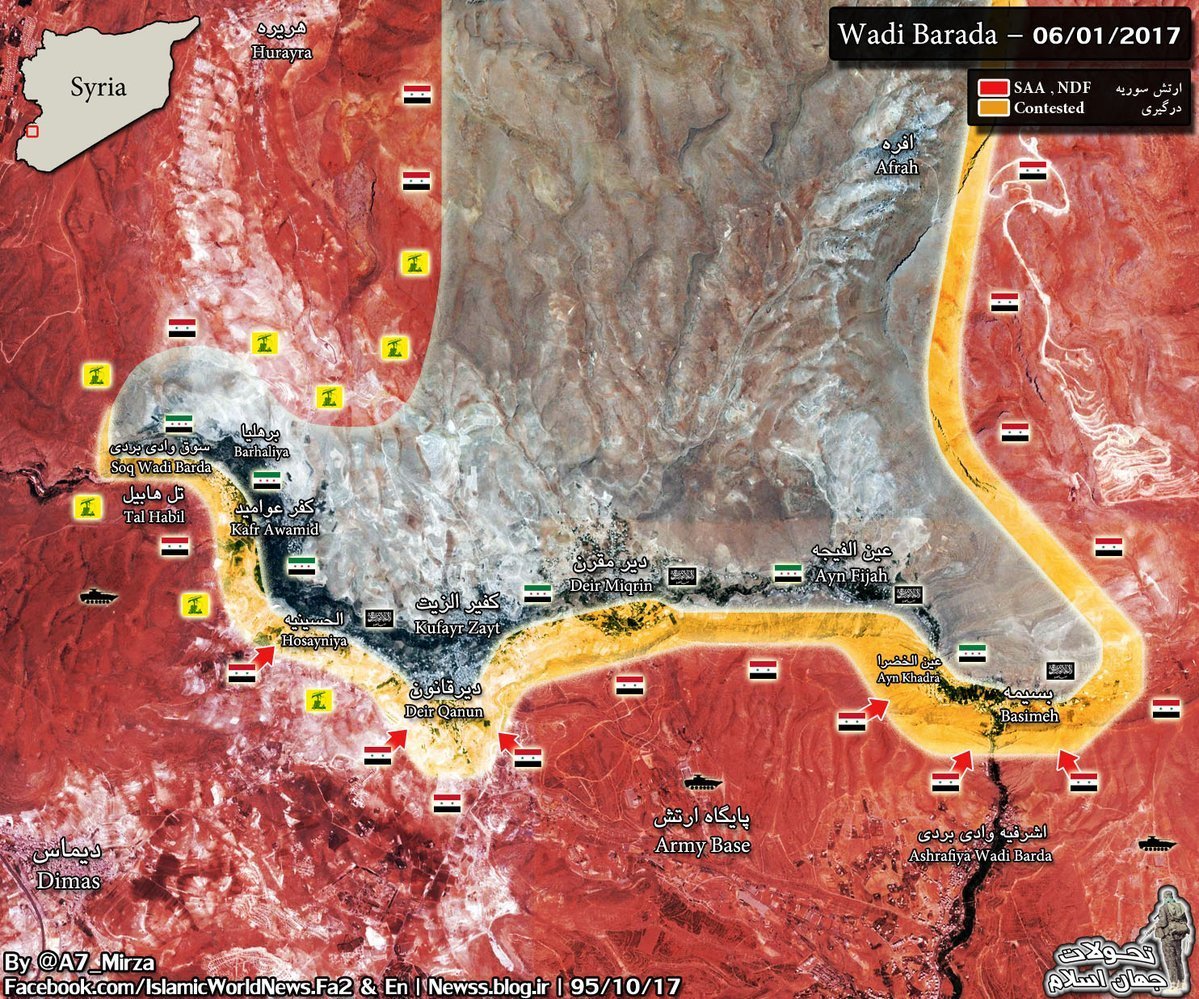
© @A7_MirzaSituation at Wadi Barada pocket on January 6th
Reports from Syria suggest that
the battle for Wadi Barada, and the water crisis in Damascus it is causing, may be coming to an end.
It seems that following Syrian army advances, and after negotiations brokered by a team of Russian officers,
several Jihadi groups in Wadi Barada have agreed to lay down their arms.
The agreement appears to follow the usual lines well known from the battle of Aleppo, with local Jihadis being allowed to leave for Idlib, or to stay and surrender to the Syrian army.
The battle of Wadi Barada is not however fully over,
with Al-Qaeda - which is responsible for the water crisis, and which is not covered by the Russian-Turkish ceasefire - refusing to surrender, and supposedly appointing a new commander. There are even some reports that
some local Jihadi groups, under pressure from Al-Qaeda to continue the battle, are actually asking for help from the Syrian army.
In a sign of how seriously the Syrian government is treating the situation, there are reports that the Syrian troops in the area are being commanded by General Maher Al-Assad, who is President Assad's brother.
Elsewhere in Syria the Russian-Turkish ceasefire appears to be generally holding, though fighting between the Syrian army and ISIS - which is also not covered by the Russian-Turkish ceasefire - continues in Deir Ezzor and near Palmyra.
Comment: Canthama writes for
Syrian Perspective:
The battle for Waadi Baradaa has been going on for 2 weeks since the day the terrorists started to blackmail 5 million people in the Damascus area. The initial approach by the SAA was to get closer to the main villages. There are some 11 villages which have been under terrorist occupation for over 4 years. When the SAA managed to control the southern hills overlooking some of the villages the SAA used pinpoint artillery and GRAD missiles hitting terrorists' headquarters and main gathering points. Little by little, the terrorists had to tolerate unsustainable losses in both killed and wounded. Surrounded on a larger hilly area without resupply and short on ammo, the terrorists started to blackmail the local civilians, forcing an estimated 2,000+ civilians to flee the area toward safer villages under Syrian government control.
Reinforcements arrived for the SAA and the final plan to liberate all Waadi Baradaa was finalized. In the last two days of battle, the SAA and its allies managed to break through from the northeast capturing vital hills such as Dhahrat Al-Nayla overlooking 6 key villages on the western end of the valley. In fact the SAA encircled and, thus, was able to control both the south and north high grounds resulting in checkmate.
In a matter of a few hours the terrorists called for reconciliation. The details are emerging but it is known that some terrorists will take the green buses to Idlib and several will apply for amnesty. At the moment, the SAA is already controlling the main water spring at 'Ayn Al-Feeja and water department technicians are on the scene in an attempt to restore the water supply to Damascus as rapidly as possible.
Wadi Barada was the last bastion of terrorists in the larger West Ghoutaa area. The implication of that is very important for what is coming which is the liberation of East Ghoutaa and the complete safety of millions of Syrians in Damascus Province. When all the Damascus area is free of terrorists, the number of battle-tested soldiers who would be freed to fight in other fronts is very substantial; very likely in the tens of thousands.
See also:




Comment: Canthama writes for Syrian Perspective: See also: