

© Getty Images
The reality is that the result wasn't a shock at all. The graphic from Real Clear Politics below is its final prediction of where the states would land, published on the day before the election. All Trump needed to do to overcome Hillary Clinton's slender lead was win a few thousand more votes in New Hampshire. Anyone who looked at this graphic alone would have said that the only certainty was a close race.
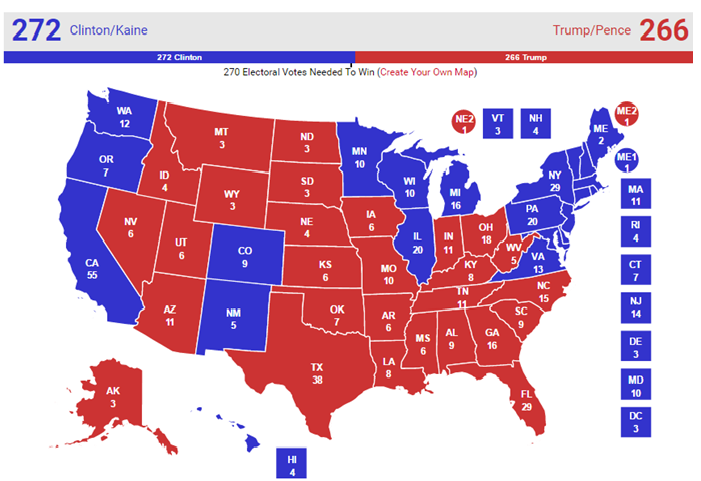
© Real Clear Politics
A reasonable person delving further into the widely available data would also have looked at the early voting patterns. Here, Trump was doing better than Romney did in key states. Clinton was leading, but it is widely known that Democrats do better in early voting and Republicans do better on Election Day. What the early voting also revealed was that polls were oversampling Democrat voters, a point Republican supporters had frequently raised.
Comment: Apparently they thought they could create their own reality. Seems that doesn't work. Huh. Who'd'a thunk it?
The response rate to polls had slumped from 20% to 5%, making the potential for error much higher than in previous elections. Yet still the polls had narrowed substantially in the weeks leading up to the election. On the final day, two of the three polls released had Trump ahead after Clinton had won most, but not all polls in the previous week. Many simply focused on the headline number of Clinton being ahead by an average of 2%, ignoring the early voting trends, the shift in the polls, the Electoral College distribution and discarding concerns about polls not being representative.
So how did the consensus get it so wrong? As is so often the case in financial markets, very few people looked at the data and instead deferred to "expert" opinion. People who had a personal bias and vested interests repeated the mantra that Clinton was the better candidate and therefore Clinton must win. The mainstream media, celebrities, economists, big donors and politicians all agreed. Their personal view on what "should" happen became their professional view on what "would" happen. The forgot to ask ordinary people, who make up the vast majority of voters, what they thought and assumed their view reflected what everyone else thought. This was Brexit all over again.
Comment: Yup.
To summarize, you would have been shocked by Trump winning if you were:
- Just looking at the headlines and not looking at the underlying data
- Not reading widely and listening only to people who think like you do (and also don't read widely)
- Deferring to and trusting people who had clear personal biases and vested interests
Comment: We love this guy. If that's the way you analyze anything, you have no business being a journalist, or pundit as well. People who don't read behind the headlines are just propaganda shills.
So if the consensus of expert opinion and financial markets got the U.S. presidential election wrong, what other consensus views might be wrong?
- Consensus says valuations are just a little above average but this time is different as low interest rates justify these valuations. The data say asset prices are substantially overvalued when actual company earnings are used rather than the inflated version that excludes all the bad stuff. This alternate view helps management please naïve investors, ensuring they get bonuses and keep their jobs.
- Consensus says the U.S. economy has had a decent recovery since the financial crisis. The data say this is the worst recovery from a recession in decades and it is running on the fumes of credit growth.
- Consensus says the world has deleveraged and de-risked since the financial crisis. The data say debt levels have continued to grow, with U.S. high-yield markets, emerging market debt and developed-market government debt levels growing the most. Some European banks remain woefully undercapitalized with very high levels of nonperforming loans.
- Consensus says money-printing isn't creating unacceptable levels of inflation. The data say there has been substantial inflation in asset prices, creating the risk of meaningful falls in asset prices if money printing is curtailed. Just because Japan hasn't seen hyperinflation yet doesn't mean that the hyperinflation in Zimbabwe and Venezuela can't happen in developed economies.
- Consensus says that government debt is a haven asset. The data say governments have made unsustainable promises to their citizens in pensions and welfare spending, both of which will be given priority over debt repayments in the event of a default. The low interest rates that make debt able to be serviced today can quickly change making refinancing of debt much more expensive if possible at all. The failure to generate budget surpluses and deleverage increases the risk that debt buyers will lose confidence.
Investors should take a big lesson from this: The market will punish uninformed opinion and feelings. If you can't put these aside and do independent analysis, you shouldn't be managing money for yourself or anyone else. If you can, you have a huge edge over the consensus and have a decent shot at outperforming other investors.
Jonathan Rochford is a portfolio manager at Narrow Road Capital, which specializes in high-yield and distressed credit. It was first published as "If You're Shocked That Trump Won, You Shouldn't Be Managing Money"





My shock over his victory does not come from some misaligned information that Killary was in the lead, rather it comes from a place of disbelief.
Disbelief that TPTB would choose him to be their current shill. I would have thought that Killary would be much easier to manipulate.