

© @Moises_GalvezVenezuela's metro service on Friday. Some strike!
Meanwhile pro-government supporters marched on the Miraflores presidential palace for the third time in less than a week, against what they are labelling as escalating right-wing attempts to depose the national government.
12 Hour Strike
Riding on the coattails of a huge anti-government march last Wednesday, opposition leaders grouped under the MUD coalition called on business owners and ordinary citizens to "turn the Venezuelan streets into a desert" on Friday by refusing to leave their homes or turn up for work.
The strike was called in response to the postponement of the opposition's recall referendum process by the National Electoral Council (CNE) on October 20, pending investigations into more than 53,000 fraudulent signatures collected in the first stage of the process.
But the MUD strike appears to have been flouted by all except its hardcore supporters, including by the country's largest business federation, FEDECAMARAS.
In an official communication, the federation called on the government to "restore the constitutional order" in Venezuela, but conceded that it was "the decision of each business, along with its workers, to join or not join the 12 hour general strike called by the MUD".
In Caracas, supermarkets, pharmacies and banks remained open throughout the day, although some universities closed as a "preventative" measure against possible violence. Despite reports of transport disruptions in the morning, buses were circulating normally by midday.
Citizens also generally eschewed calls to stay in their homes for 12 hours, but some accounts suggest that there were "fewer pedestrians" than normal on the streets early on in the day.
Most notably the opposition-led boycott of the nation's streets also failed to gain traction amongst some its business owning rank and file, who disagreed with strike action as a way of achieving political change.
"I could join in, because I don't agree with the economic policies implemented in the country, or the political situation, but I have always been a man of work, I don't share the view of a stoppage, that's not an exit-plan out of the crisis," Maracaibo business-owner Julio Leal told Venezuelan newspaper Panorama.
Despite the overall lukewarm reception to the strike, MUD leaders touted the day a success on social media - but were met with hostility from some of their own supporters.
"Freddy it's not like that," said Mariangela de Perez in reply to photos of Venezuela's "empty streets" published on Facebook by Popular Will legislator Freddy Guevara.
"I'd say there are tonnes of people in the streets," she added.
Other supporters from across Venezuela also took to the legislator's Facebook page to vent their frustration at the strike's lack of support.
"Let me tell you that I went outside just to have a look, and in Maturin people are in the streets, everything is normal. It looks like the strike lasted all of half an hour here," read another comment by Lelys Benitz Ortiz.
Chavistas March
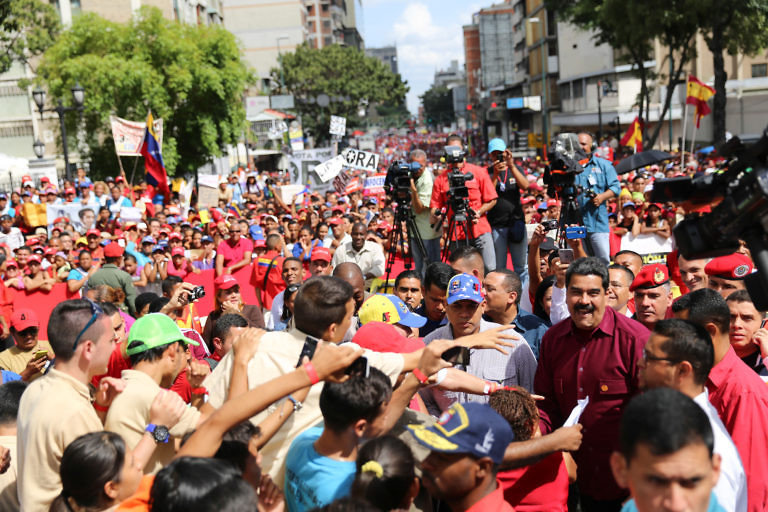
© AVNMaduro laughs amongst the crowd of pro-government marchers on Friday.
The march was addressed by President Nicolas Maduro, and attended by Vice-President Aristbulo Iturriz, as well as by other prominent members of the Chavista leadership. They labeled the opposition's strike action a "total failure".
"Today they called for a strike, and even business-owners turned their backs on them," Chavista legislator Diosdado Cabello told the crowd.
The Chavista leadership have called for "constant mobilisation" in defence of the revolution following an apparent attempt to impeach the president by congress on October 23. Friday's march is the third time that government supporters have taken to the streets in less than a week.


Comment: The criminal courts of Monagas, Carabobo, Aragua and Apure all annulled the referendum due to fraudulent votes (which contributed to the 1% required to proceed with the referendum process), thus halting the next step: a signature collection of 20% of the electorate. Like good Western oligarchs, the MUD called it a Madura coup against the constitution and accused Maduro of being a dictator. The National Assembly called it a "breach of constitutional order". Funny, that's exactly what these people supported back in 2002 in the illegal coup attempt against Chavez. Their talk of democracy and the constitution is all show, and brings to mind the "constitutional coup" against Rousseff in Brazil. See also: What's the Real Cause of Venezuela's Economic Crisis? Economic Warfare