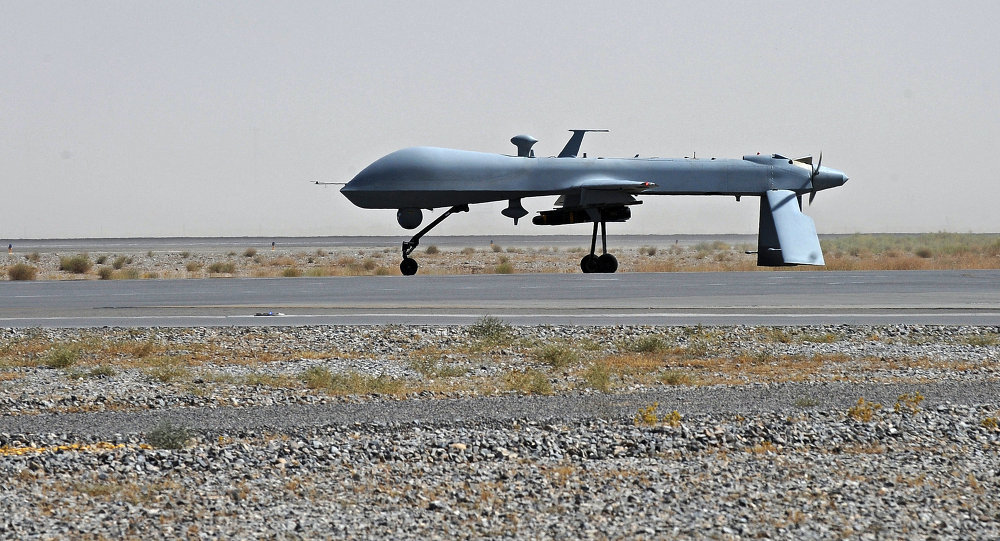
© AFP 2016/ MASSOUD HOSSAINI
The US authorities released a redacted version of the paper outlining the government's policy framework for drone strikes outside the United States and in "areas of actual hostilities," the American Civil Liberties Union (ACLU) said Saturday.
The Presidential Policy Guidance (PPG) was issued in May 2013 amid promises by the US administration of more transparency and tougher control over the drone program. However, only a short "fact sheet" on the document has been released for public.
In 2015, the ACLU filed a lawsuit under the Freedom of Information Act, demanding that the government release the PPG in full. In February 2016, a court ordered the government to submit the document for the court's review. The government said it would prepare a redacted version of the PPG for public.
"We welcome the release of these documents, and particularly the release of the Presidential Policy Guidance that has supplied the policy framework for the drone campaign since May 2013. The PPG provides crucial information about policies that have resulted in the deaths of thousands of people, including hundreds of non-combatants, and about the bureaucracy that the Obama administration has constructed to oversee and implement those policies," Jameel Jaffer, the ACLU Deputy Legal Director was quoted as saying in the union's statement.
According to the ACLU, the document provides details about policy standards governing drone strikes and an insight into the administration's "nominations" process for targeting persons with lethal force or for capture. The paper also describes governmental procedures for carrying out "after action reports" to assess the aftermath of lethal and capture operations.
The ACLU notes that it still remains unclear where the PPG applies, if the president has waived its requirements in some cases and how the standards outlined in the document can be reconciled with eye witness accounts, as well as those of journalists and human rights activists.
Comment: More from
RT:
In general, the disclosed operational plans that are either developed by the CIA or the Pentagon include the decision-making process regarding the timeframe for killing or capturing people, the "strike and surveillance" assets to be used in the operations and the specific counter-terrorism objectives to be achieved.
The Presidential Policy Guidance also seeks a "near certainty" reassurances that civilians will not get killed or injured while hunting down a specific target. The policy however never mentions the term "civilian", but rather a "non-combatant" which according to the document excludes those individuals who are "targetable in the exercise of national self-defense."
Strikes against high-value terrorist targets can only be taken "when there is near certainty" that the person is present. Besides targeting specific individuals, drone strikes are also permitted against the "infrastructure, including explosives storage facilities".
The playbook also stipulates that all operational plans "shall be presented to the president for decision" when there is lack of consensus or the designated target is a US citizen.
Besides the PPG, the White House also released four Pentagon documents. They include the 2014 "Report on Associated Forces," which outlines the groups the US government considers to be "associated" or "affiliated" with al-Qaida; and a 2013 "Department of Defense Implementation of the Presidential Policy Guidance," a heavily redacted memorandum shared with Congress.
The two other documents include a March 2014 "Report on Congressional Notification of Sensitive Military Operations and Counterterrorism Operational Briefings," that outlines the PPG's congressional reporting requirements; and a 2014 "Report on Process for Determining Targets of Lethal or Capture Operations," which discusses the legal and policy standards in the PPG.
Following the release of documents National Security Council spokesman Ned Price defended the US drone strikes abroad saying that the US "counter-terrorism actions are effective and legal, and their legitimacy is best demonstrated by making public more information about these actions as well as setting clear standards for other nations to follow."


Comment: More from RT: