
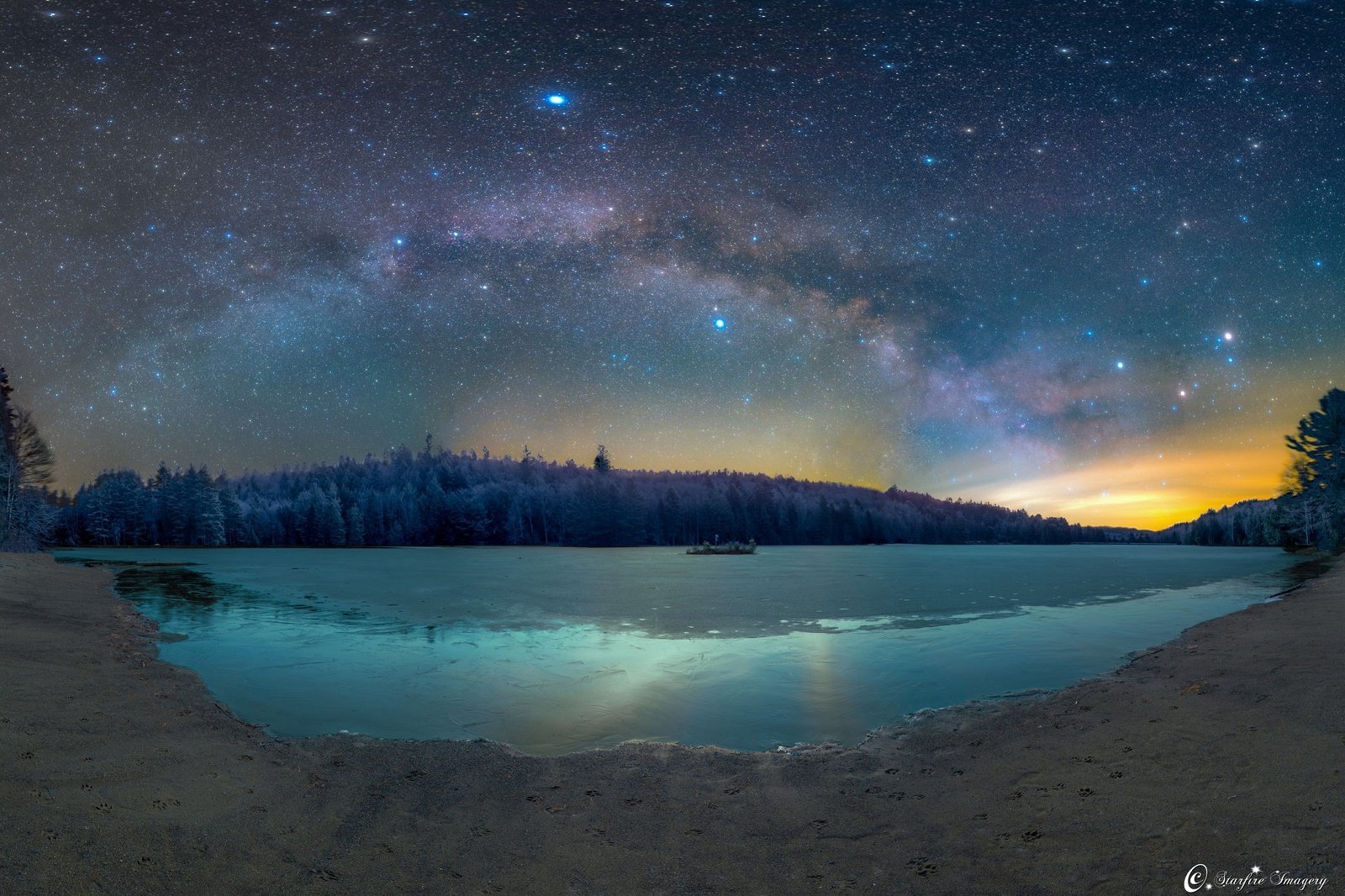
© Matt PollockMinutes before clouds gathered over the night sky, astrophotographer Matt Pollock took this image of the Milky Way on March 3, 2016, from Cherry Plain State Park in Petersburg, New York.
Pollock took the image on March 3, 2016 from Cherry Plain State Park in Petersburg, New York.
"Despite gathering clouds and the rapid approach of dawn, I managed to hike in, set up my tripod and align my Astro Track to the north star and get the 3 shots spaced 60 degrees apart necessary to capture the full arch of our home galaxy with its core peeking out through the haze, clouds and incoming fog," Pollock wrote in an email to Space.com.
The Milky Way is a spiral galaxy stretching between 100,000 and 120,000 light-years in diameter. It is estimated that the galaxy has approximately 400 billion stars. The brighter stars of the summer triangle are located in the center segment of the arch. The three bright orbs on the lower right are Saturn, Antares and Mars, which appears larger than normal due to a fog bank rolling in from the southeast causing light diffusion as well as the camera filter Pollock used for this image.
Pollock used a Nikon D800 with modded Baader filter, Niikon 16-35mm lens @ 16mm and a double fog filter. The night sky objects were tracked for 200 seconds at F4, ISO 800 and the foreground was taken during civil dawn at F6.3, 1/6th of a second at ISO 160.




The planets look big and bright because of fog?
So we are looking at the sun rising from the right hand side? ... somehow we can see Mars and Saturn, which presumably are the other side of the Sun?
Presumably the light travels from the Sun to Saturn, bounces of the shiny rock and reflects back, all the way past the Sun and onto us?