

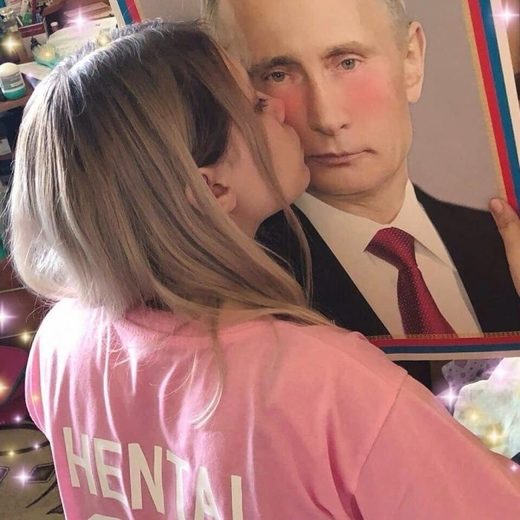
© www.wsj.comFor those who are not blind, the hope of the world rides with this man.
There is now evidence that pressure is indeed mounting on Putin to modify Russia's stance. The pressure is however not coming from a pro-Western opposition, but the hawks that are calling for the president to abandon his conciliatory approach and respond more coercively to deter NATO.
The main question asked in Moscow is why NATO is suddenly amassing its troops in an unprecedented military build-up on Russia's borders under the pretext of 'Russian aggression', more than two years after the seizure of Crimea? The prevailing response is that efforts to reconcile have not only failed, they are perceived as a weakness that has emboldened NATO.
General Aleksandr Bastrykin, the head of Russia's Investigative Committee, recently warned that Russia must rapidly develop its military and abandon illusions that a political settlement can be reached with the West. The resulting debate is mounting pressure on Putin to reverse what is deemed to be dangerous appeasement of NATO, and instead make preparations for the growing prospect of war. The West's failure to recognise the growing pressure on the Russian president derives from a failure to acknowledge that Putin actually represents the 'pro-Western' alternative in Russia.
The much-neglected reality is that the only real organised nation-wide opposition in Russia is the fiercely anti-Western Communist Party under Gennady Zyuganov, and to a lesser extent the radical nationalists under the leadership of Vladimir Zhirinovsky. In the Russian parliament, the only other opposition party represented is 'A Just Russia', a socialist party created in 2006 with the support of the Kremlin. Putin's intention was to cultivate a more moderate opposition on the left that could siphon off the protest vote that would have gone to the communists. The West's nostalgia for the 1990s under Yeltsin tends to culminate in the support for a political class and oligarchs that are discredited and politically irrelevant.
Yeltsin's pro-Western political platform stipulated that Gorbachev's envisioned 'Common European Home' was only feasible by committing to liberal democracy, capitalism and unambiguous alignment with the West. Yeltsin (and Gorbachev) therefore repeatedly warned that NATO expansion would eliminate this entire political platform by repudiating 'Greater Europe' and marginalising Russia. As predicted, NATO expansion in March 1999 vindicated the opposition that had been warning the West would not embrace Moscow if it walked away from its empire, but would rather attempt to exploit and perpetuate Russia's subsequent weakness. Twelve days after NATO's expansion, NATO abandoned its status as a solely 'defensive alliance' by bombing Serbia without a UN mandate. Henry Kissinger warned: 'The transformation of the NATO alliance from a defensive military grouping to an institution prepared to impose its values by force... undercut repeated American and allied assurances that Russia had nothing to fear from NATO expansion'. Yeltsin's policies and platform was lost and only radical alternatives remained.


Glenn Diesen, "Moscow's seizure of Crimea" is not a good way to start an article if you want SOTT readers to believe anything you say.
Someone from 'Russia Insider' aught to know that the Crimea was populated by Russians; twentyfive thousand of them being military, airforce and naval personnel and tens of thousands more operating support businesses and industry for large Russian installations. Installations for which the Russian government paid the Ukrainian government billions of dollars a year in rent.
You had best pray that "the eventual downfall of Vladimir Putin" only comes with his old age because if you really are a 'Russian insider' you know that your life and the lives of those around you will be torn apart if he should suddenly wake up dead in the next 24-months.