
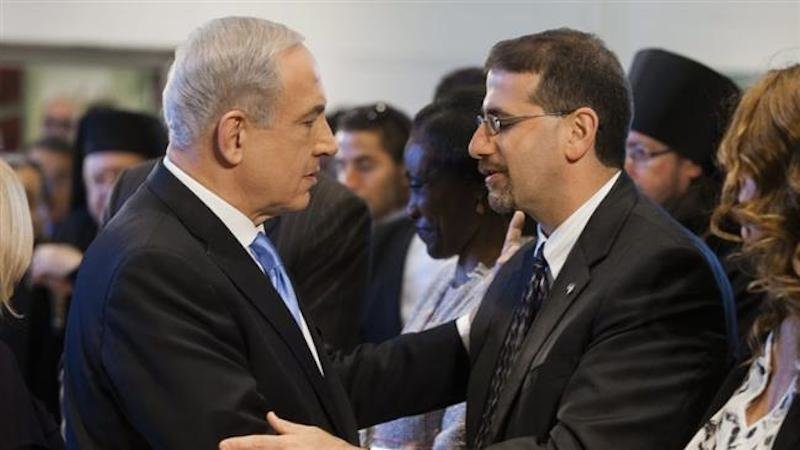
© Times of IsraelPrime Minister Benjamin Netanyahu greets US Ambassador Dan Shapiro
Shapiro also raised "questions about Israel's long-term intentions" in the occupied West Bank, saying the US administration is "concerned and perplexed" by Tel Aviv's settlement policy in the area. "This government and previous Israeli governments have repeatedly expressed support for a negotiated settlement that would involve mutual recognition and separation," he said. "Yet separation will become more and more difficult" if Israel continues its settlement activities.
The prime minister's office rejected Shapiro's unprecedented criticism, calling his remarks "unacceptable and wrong." "Israel enforces the law on Israelis and Palestinians. The onus for the stalemate in the diplomatic process is [on] the Palestinian Authority, which continues to incite and refuses negotiations," it said.
Comment: Yes, Israel enforces the law on Israelis and Palestinians. But take the occupied West Bank for example. There, Israeli settlers largely fall under civilian rule, while Palestinians are subject to Israeli military law. It's a total double standard, and when one looks at the situation through the lens of Palestinians living under armed military occupation, who can blame them for fighting back against their oppressors?
In December, Israel's ministry of military affairs added a compound in the West Bank to the jurisdiction of the Gush Etzion regional council, a grouping of 20 settlements with a population of more than 20,000. The plan will stretch Israel's illegal settlements to the proximity of a volatile Palestinian refugee camp, raising the prospect of more clashes.
On January 8, US State Department Spokesman John Kirby slammed Israel for the plan, saying "continued settlement activity and expansion" will make it difficult to achieve a so-called "two-state solution." The continued expansion of Israeli settlements in occupied Palestine has created a major obstacle for the efforts to establish peace in the Middle East.
The United Nations and most countries regard the Israeli settlements as illegal because the territories were captured by Israel in a war in 1967 and are hence subject to the Geneva Conventions, which forbids construction on occupied lands.Shapiro's remarks were made on a day that an Israeli settler in a car ran over two Palestinian youths, riding on a motorbike, in an area near Salfeet city, killing one and injuring the other. Late in 2015, Israeli troopers shot and killed a young Palestinian woman after she allegedly tried to stab soldiers at a checkpoint in the West Bank village of Beit Einun, five kilometers northeast of al-Khalil (Hebron).
Since October 2015, at least 162 Palestinians and over two dozen Israelis have been killed amid tensions that rose after the Israeli regime imposed restrictions in August on the entry of Palestinian worshipers into the al-Aqsa Mosque compound in East al-Quds.



In making the occupation permanent, Israel’s leaders are undermining their state’s viability. Unfortunately, domestic movements to avert that fate have withered. Thanks to an economic boom and the temporary security provided by the West Bank barrier and the Iron Dome missile defense system, much of Israel’s secular Zionist majority feels no need to take the difficult steps required for a durable peace, such as evicting their countrymen from West Bank settlements and acknowledging the moral stain of the suffering Israel has caused to so many Palestinians.
We are at a critical juncture. Settlement growth and demographic trends will soon overwhelm Israel’s ability to change course. For years, we have supported Israeli governments — even those we strongly disagreed with — in the belief that a secure Israel would act to defend its own long-term interests. That strategy has failed. Israel’s supporters have, tragically, become its enablers. Today, there is no realistic prospect of Israel making the hard choices necessary to ensure its survival as a democratic state in the absence of outside pressure.