
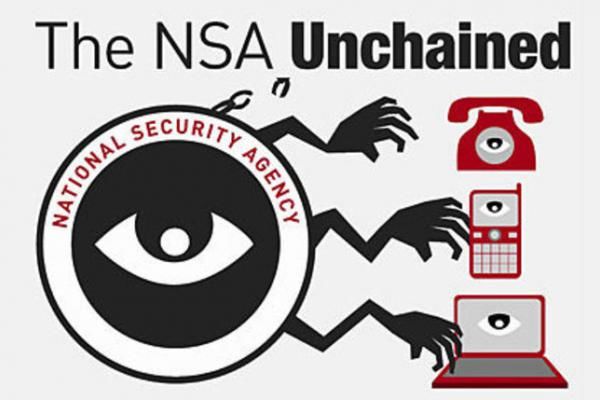
© free.niooz.fr"Unchained Malady"
The Obama administration, on the same day the USA Freedom Act became law on June 2, went to the Foreign Intelligence Surveillance Court (FISA court) with a request (pdf) to continue sweeping up phone records during a six-month "transition" period before the Freedom Act provisions take effect.
The USA Freedom Act specifies that call records be maintained by the phone companies, and the government may access them only with a warrant from the FISA court. That's evidently not good enough for the Obama administration.
The Justice Department asked the FISA court to ignore the decision in May by a federal appeals court in the case of American Civil Liberties Union (ACLU) vs. Clapper that said the National Security Agency overstepped its bounds in the bulk collection of phone data. "This Court may certainly consider ACLU v. Clapper as part of its evaluation of the Government's application, but Second Circuit rulings do not constitute controlling precedent for this Court," Assistant Attorney General John Carlin wrote in the request.
Comment: ACLU vs. Clapper ..."The district court held that § 215 of the PATRIOT Act impliedly precludes judicial review; that plaintiffs‐ appellants' statutory claims regarding the scope of § 215 would in any event fail on the merits; and that § 215 does not violate the Fourth or First Amendments to the United States Constitution. We (ACLU) disagree in part, and hold that § 215 and the statutory scheme to which it relates do not preclude judicial review, and that the bulk telephone metadata program is not authorized by § 215." -US Court of Appeals for the Second Circuit, Argued September 2, 2014, Decided May 7, 2015
"The only federal appeals court to have considered this surveillance concluded, after very careful analysis, that it's unlawful. It's disturbing and disappointing that the government is proposing to continue it," Jameel Jaffer, deputy legal director of the ACLU, told The Guardian.
The Justice Department's request was countered on June 3 by the conservative group FreedomWorks. They filed a motion asking that the administration's request be denied on the basis of Fourth Amendment grounds of improper search and seizure, according to The Guardian. FISA judge Michael Moseman gave the Justice Department until Friday to respond, but there's no word yet on what the response was.




Comment: "The government does not cite a single case in which analysis of the NSA's bulk metadata collection actually stopped an imminent terrorist attack," Judge Richard Leon, unreasonable search or seizure under the Fourth Amendment
Because the Second Circuit declined to order the issuance of an injunction against the Government, its ruling has no immediate effect, even as to the parties to that proceeding. [...]
"allowing the program to remain in place for a few weeks while Congress decides whether and under what conditions it should continue is a lesser intrusion on appellants' privacy than they faced at the time this litigation began," such that it is prudent "to pause to allow an opportunity for debate in Congress that may (or may not) profoundly alter the legal landscape." -US Foreign Intelligence Surveillance Court, Washington D.C., June 2, 2015
FISC: destroying American right to privacy, trampling civil rights of citizens, using unscrupulous means to achieve illegal activities, spying on US citizens...useless with no apologies, authorized by nineteen different judges and renewed forty-one times...what's not to love?