
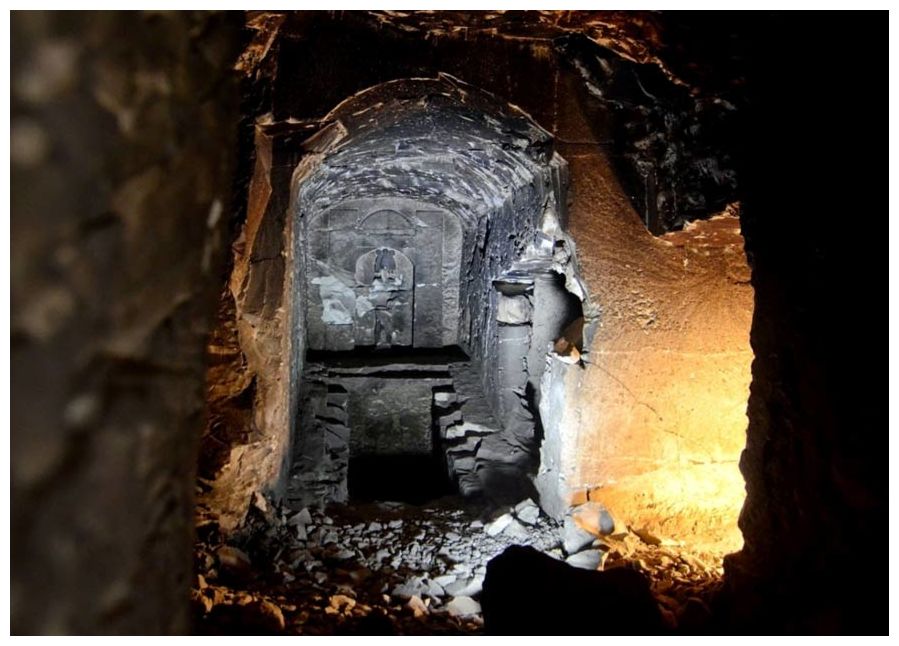
© www.ancient-origins.netInside the replica of the tomb dedicated to the god Osiris.
According to the Spanish news agency EFE, the tomb embodies all the features of the tomb of Osiris, as told in ancient Egyptian legends, and is a smaller version of the design of the Osireion, built under Egyptian pharaoh Seti I in the city of Abydos, Luxor. Researchers believe the tomb complex dates back to the 25th dynasty (760 - 656 BC) or 26th dynasty (672 - 525 BC), based on a comparison to similar tombs that contain Osirian elements.
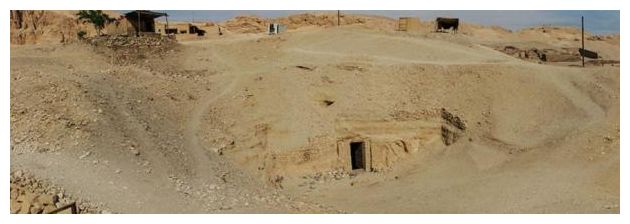
© MinProject/Archaeological Mission Canaria-ToscanaEntrance to the funerary complex of Osiris.
To the west of the central temple is a funerary room with the reliefs of demons holding knives. The leader of the Spanish-Italian team that uncovered the tomb, Dr. María Milagros Álvarez Sosa, told EFE that the demons are there to protect the body of the deceased.
Opposite the statue of Osiris is a staircase with a 29.5 foot (9 meter) shaft leading to another chamber. Inside this chamber is a second shaft that descends 19.6 feet (6 meters) into two more rooms, which are currently full of debris.
"The symbolism of Osiris is very evident here, since all the elements recalling the mythical Osiris tomb are present," writes Luxor Times Magazine, "a big staircase of 3.5 meter long with a 4 meter high ceiling at the bottom leading to the Netherworld and another one leading directly to the Osiris statue, which is therefore at a higher level and ideally isolated on 'his island'; the Osiris statue itself; the empty corridor surrounding it which symbolizes the channel of water (see Osireion in Abydos); the expected burial chamber below the statue, thus identifying the deceased with Osiris."
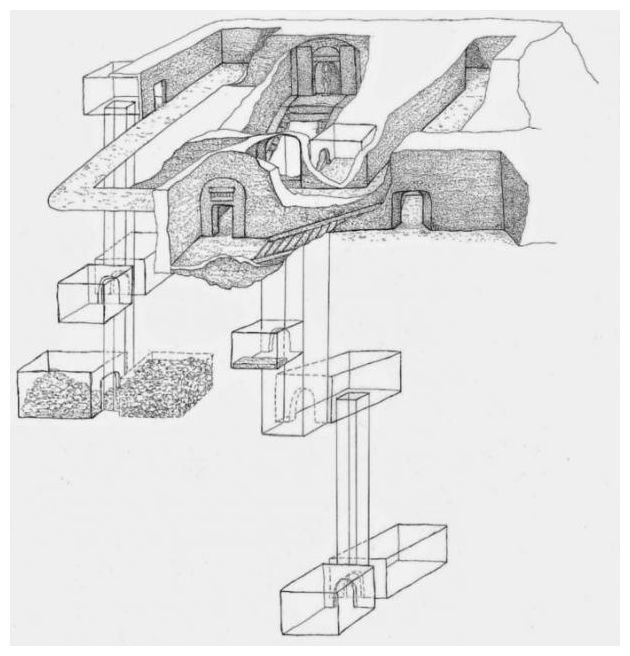
© MinProject/Archaeological Mission Canaria-ToscanaSketch showing the outline of the tomb of Osiris. Drawing of the tomb's architecture made by Raffaella Carrera.
Alvarez Sosa told EFE that the tomb is of "great importance" because "the burial chambers contain dead who slept their eternal sleep under the god of the dead, Osiris".
According to Egyptian mythology, Osiris, god of the underworld, was killed by Set, god of storms, disorder and violence, who shut Osiris in a coffin and threw it in the Nile river. After his body was recovered by Isis, Set tore his body into pieces and threw them back into the river. Isis collected all the pieces and bandaged the body together. This form of Osiris traveled to the underworld in a boat and became god of the dead.
The only body part Isis could not locate was the phallus, as it had been eaten by catfish. Isis created a golden phallus and briefly brought Osiris back to life with a spell, which gave her enough time to become pregnant by Osiris before he returned to death. Isis later gave birth to Horus, who became seen as a representation of new beginnings and the destroyer of the evil Set.




"Osiris" is the "Greek" name. Actually the Yoni/Ionian Greek, closely related to the 666 BC "Assyrians" that conquered Egypt and built the famous temple of Seti I at Abydos. "Osir" would be the Egyptians spelling but the name is really Asur. The Assyrian sun God driving a chariot. The "catfish" that "eats Asurs penis" is the supreme God VishNu. You see, the ORIGINAL resurrection God of Abydos is Wepawet, the Whippet. The other is Khentamentui, depicted at the Seti I temple as a monkey on the "Isis as a falcon lowering herself on Osiris phallus" scene. Can you figure it out? That monkey is Hanuman. Best friend of Shiva, that Egyptians called "Shu." Hanuman tui, meaning KING OF THE TWO LANDS. So much hidden The Mother wants us to know...