
© Alamy
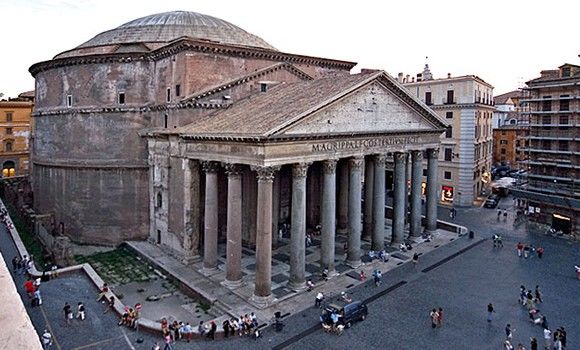
While Britain's 1960s concrete tower blocks and flyovers are crumbling, Roman monuments such as the Pantheon and the Colosseum are still standing.
Now scientists have discovered the secret ingredient behind the longevity of Roman concrete - volcanic ash.
The study by the University of California, in Berkeley, found Roman concrete showed no corrosion, with a smooth surface suggesting long-term stability.
Manufacturing modern cement requires heating a mix of limestone and clay at 1,450C.
But, Roman architectural mortar uses 85 percent volcanic ash, fresh water and lime, which is cast at a much lower temperature, significantly reducing its carbon footprint.
Now, the researchers want to take the Roman techniques and apply them to modern cements.
Dr. Marie Jackson said: 'If we can find ways to incorporate a substantial component of volcanic rock in the production of specialty concretes, we could greatly reduce the carbon emissions associated with their production. We could also improve their durability and mechanical resistance over time.'
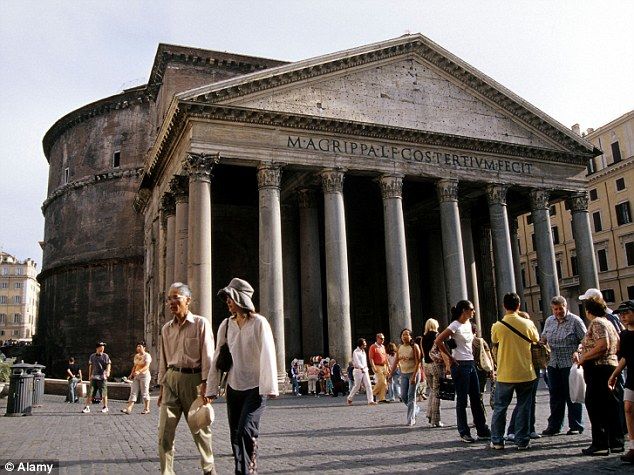
© AlamyWhile Britain’s 1960s concrete towerblocks and flyovers are crumbling, the Pantheon in Rome is still standing.
In the concrete walls of Trajan's Markets in Rome, constructed around 110 AD, this mortar binds cobble-sized fragments of tuff - consolidated volcanic ash - and brick.
The team observed the mineral changes that took place in the curing of the mortar over a period of 180 days and compared the results to 1,900-year-old samples of the original.
They discovered that the concrete contained particular water-based elements that prevented it from cracking.



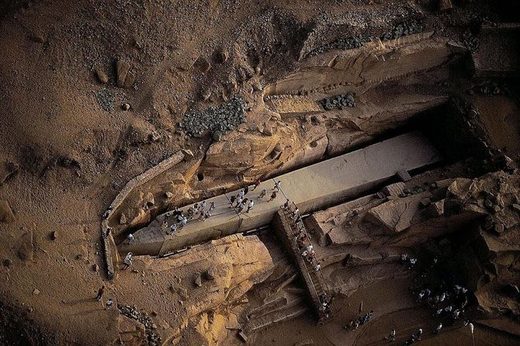
The vast majority of Roman buildings have crumbled.
One secret of the Pantheon was that the dome is under compression.
Even weak concrete works quite well if it isn't subject to tension.
Freezing and thawing kill concrete. This isn't a big problem in Rome.
Steel reinforcement is absent in the pantheon which helps survival. Steel
expands when it becomes rust so it works against long life for structures.
The "secret" of volcanic ash(or is manufactured cousin, fly ash) is well known.
It can readily be purchased to improve certain properties of concrete.
We are capable of building structures that would outlast those of the ancients.
We don't because they are obsolete long before they wear out.