
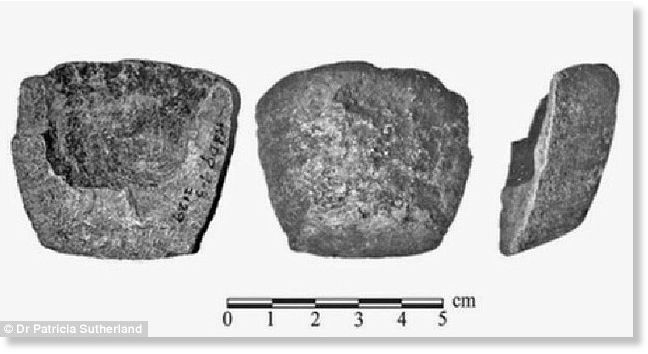
A small stone container unearthed half-century ago has now been recognised as further evidence of a Viking or Medieval Norse presence in Arctic Canada
Researchers reporting in the journal Geoarchaeology discovered that the interior of the container, which was found at an archaeological site on southern Baffin Island, contains fragments of bronze as well as small spherules of glass that form when rock is heated to high temperatures.
The object is a crucible for melting bronze, likely in order to cast it into small tools or ornaments. Indigenous peoples of northern North America did not practice high-temperature metalworking.
The Norse would likely have travelled to the area to obtain furs and walrus ivory. "The crucible adds an intriguing new element to this emerging chapter in the early history of northern Canada," said lead author Dr. Patricia Sutherland, who has recovered other specimens in Arctic Canada that resemble those used by Europeans of the Viking and Medieval periods.
"It may be the earliest evidence of high-temperature nonferrous metalworking in North America to the north of what is now Mexico."
Journal Reference:
Patricia D. Sutherland, Peter H. Thompson, Patricia A. Hunt. "Evidence of Early Metalworking in Arctic Canada." Geoarchaeology, 2014; DOI: 10.1002/gea.21497


Reader Comments
In September 2008, Nunatsiaq News reported that a team led by Dr. Patricia Sutherland had found archaeological remains of yarn, rats, tally sticks, a carved wooden Dorset culture face mask depicting Caucasian features, and possible architectural remains, which place European traders and possibly settlers on Baffin Island not later than AD 1000.[18] What the source of this Old World contact may have been is unclear; the report states: "Dating of some yarn and other artifacts, presumed to be left by Vikings on Baffin Island, have produced an age that predates the Vikings by several hundred years. So [...] you have to consider the possibility that as remote as it may seem, these finds may represent evidence of contact with Europeans prior to the Vikings' arrival in Greenland". Dr Sutherland's research eventually led to a 2012 announcement that whetstones had been found with remnants of alloys indicative of Viking presence.[19] The archaeological site at Nanook is thought to be a trading post and port, and thus Baffin Island would be Helluland.[20]