
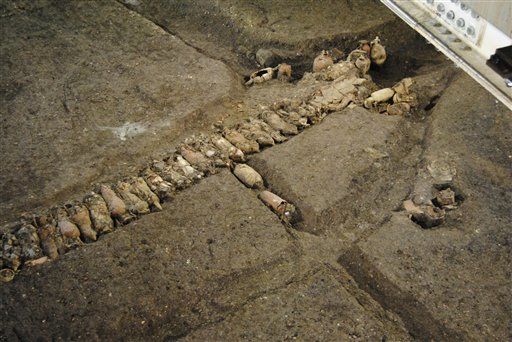
© AP Photo/Cooperativa ArcheologiaLined up amphoras were discovered during a subway construction in Rome. Archaeologists have unearthed an ancient commercial farm in the heart of modern Rome.
They worked some 20 meters down (some six stories deep) near St. John in Lateran Basilica. Today's Rome rests upon medieval layers and, under those, more ancient strata of life.
Rossella Rea, the dig's leader and a culture ministry official, said Wednesday that archaeologists discovered a first-century agricultural business, the closest to Rome's ancient center ever found, an irrigation basin measuring 35 by 70 meters (115 feet by 230 feet), and an extensive drainage system near the ancient Aqua Crabra water source.
Notable finds included a three-pronged iron pitchfork, storage baskets, leather fragments possibly from a farmhand's glove or shoe, and traces carved into stone by a waterwheel's repeated turning. Also extraordinary are well-preserved vestiges of willow and other tree roots and stumps.
Peach pits, presumably from the farm's orchard, also were found. Peaches were still a novelty, first imported from the Middle East.
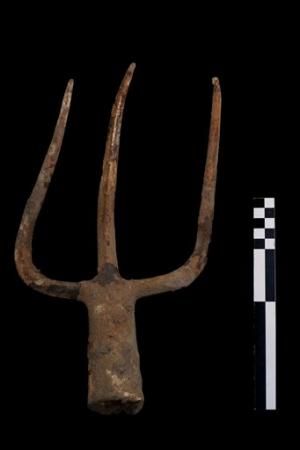
© Cooperativa ArcheologiaA three-pronged pitchfork found during a subway construction in Rome.
Ancient Romans recycled. Amphorae, the jars they favored to transport and store food, were lined up with their ends cut open to double as water conduits.
Other older signs of life were carriage ruts from as long ago as the 6th century B.C.
Rea said some discoveries will eventually be integrated into the St. John's subway station so the public can see them, while other artifacts will go on display in Rome museums.
Visitors will have a long wait for that subway station. Metro C line construction is running years behind schedule.
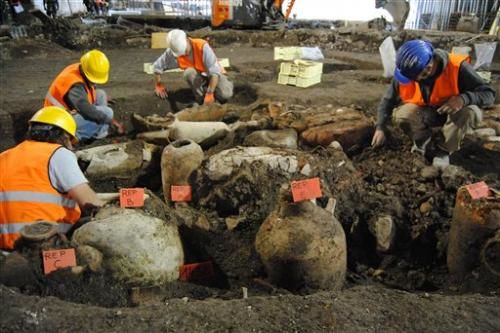
Archeologists work next to unearthed amphoras in Rome.


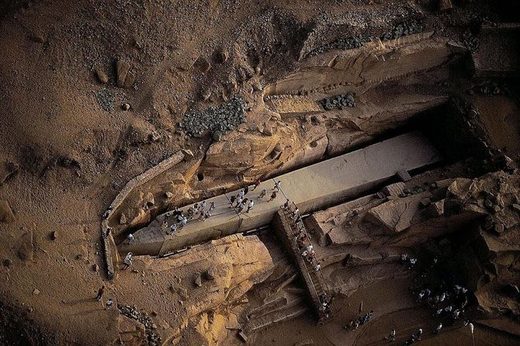
Comment: Archeologists are continually finding artifacts from Rome's vast civilization:
'Entire streets' of Roman London uncovered in the City
Magnificent ancient Roman silver treasure revealed
Finest Roman-British Sculpture Found in London
Latrines, sewers show varied ancient Roman diet