

© www.natureworldnews.comThe dodder plant is a parasite that attacks its host.
As described in a study recently published in the journal Science, weed science expert Jim Westwood of Virginia Tech took a close look at how the parasitic plant called a dodder attacks his host.
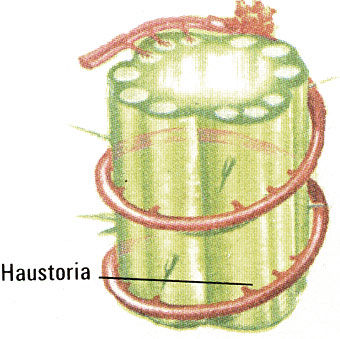
© www.wikipedy.comThe dodder sends suckers called haustoria into a nettle stem to tap its host's tissues.
Researchers had done previous work that found that when the dodder first sinks its "fang" into its victim, it also begins to transport RNA - a sort-of DNA translator - between it and its host.
This latest study expands on that, finding that a surprising amount of messenger RNA (mRNA) is constantly being exchanged between both plants during the parasitic relationship.
"The discovery of this novel form of inter-organism communication shows that this is happening a lot more than any one has previously realized," Westwood said in a recent release. "Now that we have found that they are sharing all this information, the next question is, 'What exactly are they telling each other?'"
What they found is that like any true vampire, the dodder has a "silver tongue," sweet-talking its victim into lowering its defenses.
With this knowledge, Westwood says, experts can now develop novel ways to fight parasitic weeds that specifically target major crops - namely witchweed and broomrape.
"The beauty of this discovery is that this mRNA could be the Achilles [heel] for parasites," Westwood said. "This is all really exciting because there are so many potential implications surrounding this new information."






Also known as the Federal Reserve plant.